
Why You Shouldn’t Convert to LED Headlights
Why Converting to LED Headlights Won’t Improve Night Vision
Hundreds of companies sell Halogen to LED conversion kits for your car. Despite the apparent advantages of LED headlights on new car, converting your vehicle’s current halogen or HID (High-Intensity Discharge) headlights to LEDs is not a good idea. This article will explore the potential risks, legal issues, and drawbacks of switching to LED headlights, providing a comprehensive look at why this conversion might not be worth it..
First, it’s illegal to convert to LED
In the U.S. and Canada, all headlamps and taillamps must comply with the Federal Motor Vehicles Safety Standard (FMVSS 108) and Part 564. To meet those regulations, carmakers design the reflector and lens combinations to work with a particular bulb. If you substitute a different bulb into that same housing, even if the bulb fits properly, it will not produce the same results, and the headlight will no longer meet DOT regulations.
Non-compliance with Standards: Not a single retrofit LED headlight kit complies with current headlight standards, which is why none of them carry a D.O.T. mark. This non-compliance can result in your vehicle failing an inspection or, worse, you could be fined for using non-approved lighting on public roads.
Insurance Complications: If you are involved in an accident and your vehicle is found to have non-compliant LED headlights, your insurance company may refuse to cover the damages, citing that your vehicle was not road-legal at the time of the accident. This could lead to significant out-of-pocket expenses.
You can’t aim your way out of a non-compliant headlight bulb
You cannot re-aim the headlight to “refocus” a non-compliant LED beam pattern because moving the headlight assembly moves all the light patterns, not just the ones that hit the road in the right place. So, while you’re realigning to throw more light on the road, you’re also throwing more glare into oncoming traffic.
Marketing baloney has nothing to do with light physics.
No LED manufacturer can claim its bulbs are street-legal for use in halogen headlights. Whether you have a reflector or projector-style headlight, understand this: It is optically impossible for a halogen headlight to produce the proper beam pattern if you convert to LED headlights.
What’s different about LED bulbs compared to halogen bulbs?
1) LED Bulbs Have Multiple Light Sources Versus a Single Light Source
First, to get the same light output, LED bulbs have at least two, if not more LED chips. In other words, they have multiple light sources, whereas a halogen bulb only has a single light source: the tungsten filament.
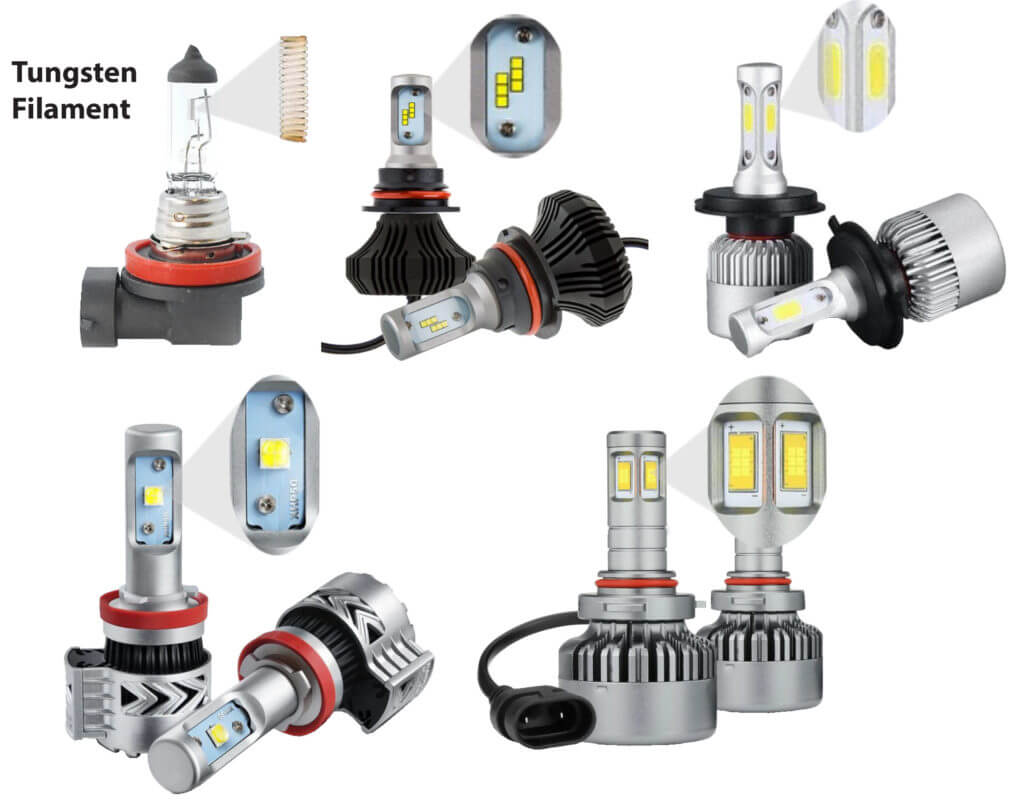
The single filament in a halogen headlight bulb is rectangular, with the brightest spot in the center of the filament. Look at the various numbers and shapes of LED chips on LED bulbs. They are different shapes and located in different places, so they don’t line up properly with the reflector’s focal point.
Right off the bat, the multiple light sources of an LED bulb and their differing distances from the rear of the reflector change the way the light bounces off the reflector, producing glare.
Again, the reflector is designed to work with the bulb the headlight was certified for at the factory. If you change the bulb, the headlight assembly can’t possibly produce the proper beam pattern.
2) LED bulbs seem bright, but they put less light where you need it
While LED headlights are generally brighter than halogen bulbs, brighter does not always mean better. If the light is not focused correctly, it can create hotspots and dark areas in the beam pattern, reducing your ability to see the road clearly. This can be particularly dangerous in situations where precise visibility is critical, such as on winding roads or in heavy traffic.
Since the reflector wasn’t made for multiple light sources at differing distances from the focal point, the reflector can’t produce the same beam pattern on the road. So even though the LED bulb will look brighter, they throw LESS light on the road than the bulb the headlight was designed for.
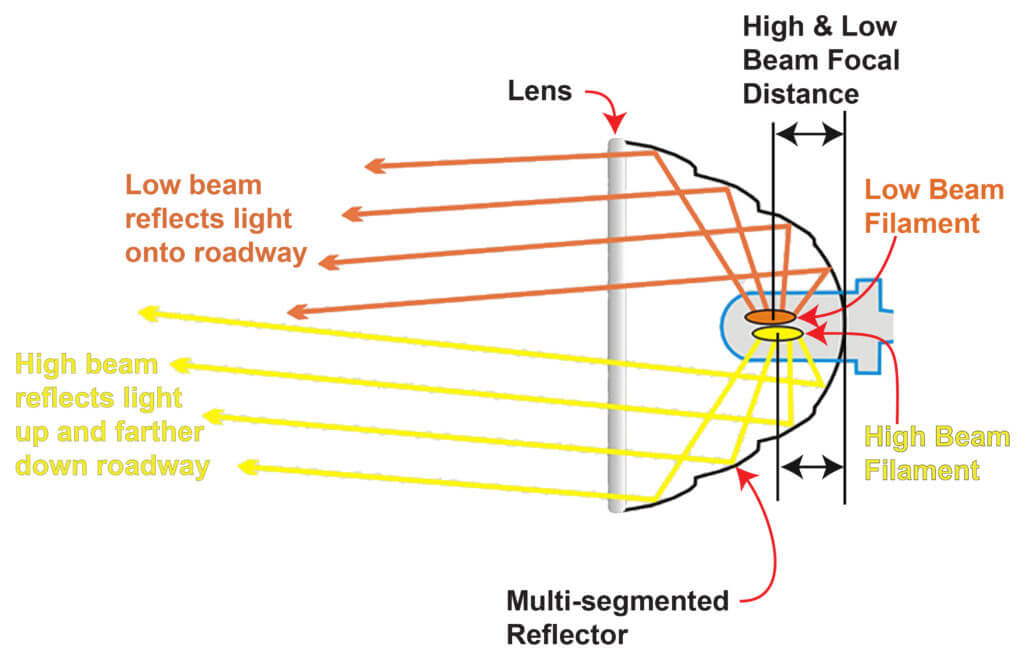
Here’s a typical high and low beam setup with a traditional reflector headlight assembly. The focal point of the filament is critical to casting the most light on or down the road. Change the focal distance, and you change where the light goes. LED bulbs don’t have a bright spot in the same place as halogen bulbs.
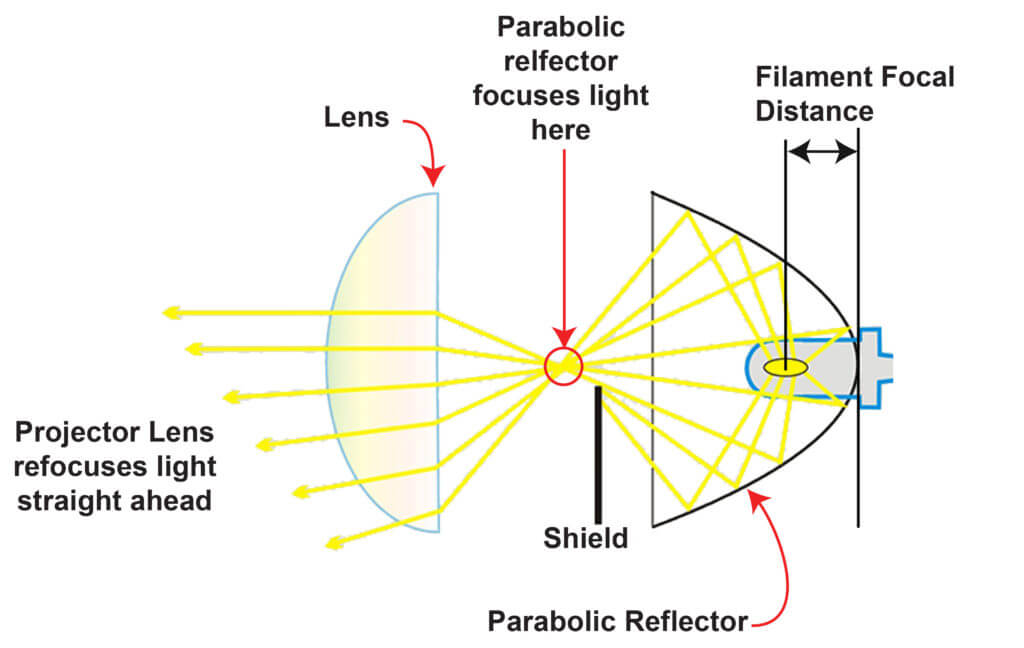
Projector headlights focus the light at a spot between the reflector and the lens. The lens refocuses the light on the road. Change the bulb and you change the location of the mid-way bright spot, resulting in less light on the road.
3) LED bulbs don’t work in a halogen projector assembly either
Many car enthusiasts claim that projector headlight assemblies can handle the change to an LED bulb because the lens will focus the light properly.
That’s wrong. A projector headlight works by reflecting light into a space behind the lens. However, if you use an LED bulb, the reflector can’t put the light in the correct spot, nor can it focus the light properly.
In other words, the light is in the wrong place behind the lens. So the lens can’t possibly focus it properly.
Other Headlight Facts that make it impossible to convert to LED headlights
• The filament in a halogen bulb is a cylinder that produces an elliptically shaped light source centered in the middle of the reflector and broadcasting light in a 360° pattern.
• LED bulbs don’t have a filament. Instead, they have at least two flat light sources. They’re a different size and shape than the light source the headlight was designed for. In addition, since they can only broadcast light up and down in a 270° pattern instead of a full circle, less light gets reflected forward.
• Since the LED light sources have different sizes, shapes, and broadcast patterns, they throw less light on the road and produce more glare into oncoming traffic. It’s the glare that makes them appear brighter, but they’re not putting that light on the road where you need it most.
• Not a single LED retrofit bulb carries a DOT mark, so none are approved for street use.
Retrofit LED Bulbs Fail the Reliability Test
In a study published by the SAE, the researchers found that manufacturers’ claims of bulb brightness, color, and lifespan fall far short of promises. Read the results of the study here.
©, 2020 Rick Muscoplat
Posted on by Rick Muscoplat