
Why Your Brake Pedal Goes to the Floor and How to Fix It
Common Reasons a Brake Pedal Goes to the Floor and How To Fix It
Quick Summary
When the brake pedal goes to the floor, it is never something to ignore. In my experience, the most common causes are low brake fluid, air in the brake lines, an external hydraulic leak, a failing master cylinder, a stuck open ABS valve, or rear drum brakes that are badly out of adjustment. In some cases, a pedal that sinks slightly only when the engine is running can also indicate normal power assist.
Why Your Brake Pedal Goes to the Floor: Common Causes, Diagnosis, and What to Check First
When a driver tells me the brake pedal goes to the floor, I treat it as a serious safety problem. A low brake pedal is not just an annoyance. It means the hydraulic system is not building pressure the way it should. Since modern braking systems rely on hydraulic force to clamp pads against rotors or push shoes into drums, any loss of pressure or excess travel can leave you with little to no stopping power.
The first thing to understand is that not every low pedal feels the same. Sometimes the pedal drops suddenly. Sometimes you can pump it up, and it stays firm, or it slowly sinks while you hold steady pressure at a stoplight. Noting how the pedal goes to the floor is an important part of the diagnostic procedure. The way the pedal falls tells you a lot about whether the problem is air in the lines, an adjustment issue, a fluid leak, or an internal master cylinder failure.
The most common reasons a brake pedal goes to the floor
Low brake fluid, especially after brake repair — If the master cylinder reservoir is low, the system can draw in air. Air compresses, unlike brake fluid, so instead of sending solid hydraulic force to the calipers or wheel cylinders, part of your pedal travel is wasted compressing trapped air bubbles. The result is a soft pedal with too much travel.
An external brake fluid leak — I see this at flexible rubber hoses, steel brake lines, calipers, rear wheel cylinders, and sometimes at fittings or the ABS hydraulic control unit. If brake fluid leaks from the system, pressure drops, and the brake pedal goes to the floor or nearly to the floor.
A failing master cylinder is also high on the list — The seals on the master cylinder piston must seal properly to create enough pressure to apply your brakes. When those seals wear out, brake fluid bypasses them. The pedal may feel normal at first and then slowly drift downward under steady pressure. In that case, you may not see any fluid leaking outside the system, but the pressure is bleeding off internally.
Rear drum brake problems can also create a low pedal. If the shoes are badly out of adjustment, the wheel cylinder pistons must travel farther before the shoes contact the drum. That extra movement shows up as excessive pedal travel. Many people overlook this, especially on vehicles where the front brakes get most of the attention.
Air in the system after a repair is another major cause. If the calipers, wheel cylinders, hoses, brake lines, or the master cylinder were replaced and the bleeding procedure was incomplete, the pedal can still go low even though all the new parts are installed correctly.
Less often, I find damaged caliper slide hardware, excessively worn pads or rotors, rear drum hardware issues, swollen brake hoses, or an ABS hydraulic unit problem contributing to the complaint.
It’s Important to follow a Step-by-step diagnostic strategy
When I diagnose a vehicle where the brake pedal goes to the floor, I do not start by throwing parts at it. I follow a process.
Step 1: Check the brake fluid level in the master cylinder. Point a flashlight toward the side of the reservoir to get the best view of the level. Also, look at fluid color. Very dark fluid does not automatically cause a low pedal, but it often tells me the system has been neglected.
• If the fluid level is FULL — That rules out an external leak and points to a possible master cylinder problem. Go to Step 2.
• If the fluid is empty or low — There’s a sure sign of an external leak in a hard brake line, hose, caliper, or wheel cylinder. If the reservoir is empty, refill it with brake fluid and move to Step 2.
Step 2: Press the brake pedal with the engine off. Does the pedal go to the floor right away with little to no resistance, or does it build some pressure and then sink slowly to the floor? Or, does it build some pressure but feel spongy?
• The pedal builds some pressure and then sinks — The fact that it’s building some pressure is an indication that the master cylinder is working at least partially. So the fact that the pedal is dropping means there’s a small leak in a line, caliper, or wheel cylinder. However, at this point, we can’t completely rule out worn master cylinder piston seals.
• Goes to the floor right away and never builds pressure — The fact that there’s no pressure buildup indicates a major leak in a brake line, hose, caliper, wheel cylinder, or a stuck open valve in the ABS valve body. Go to Step 3
• Feels spongy — Dead giveaway for air in the system.
Step 3: Press the brake pedal with the engine running. With the engine off, the brake booster isn’t providing assist. You’re pushing the master cylinder purely with your leg force. Once the engine is running, the brake booster multiplies your input force, usually by 3–5 times. That power assist changes everything:
• It can mask marginal hydraulic problems
• It can also exaggerate internal leaks
• Pedal Firm Engine OFF, but drops to the floor when the engine is running —This shows the system can hold pressure without assist, but once the boosted force is applied, pressure leaks internally. This is an indication of classic master cylinder internal seal failure
• Pedal Drops Engine with the engine OFF AND RUNNING — The system can’t hold pressure at all, indicating an external fluid leak (lines, calipers, wheel cylinders, or severe master cylinder failure
• Pedal stays high with the engine OFF, but drops slightly when the engine is running. This is actually what you want. In a properly operating brake system, the pedal should drop slightly as vacuum boost builds. The drop tells you the vacuum booster is working and the system is responding normally.
• Pedal feels spongy only when the engine is running. Since the booster applies much higher hydraulic pressure, the spongy feel can indicate bulging brake hoses, air in the system, or compromised hydraulic integrity. Weak components that “pass” with low force will fail under boosted force.
Step 4: Inspect for external leaks. Look for puddles on the ground and check for leaks behind each wheel. Remove the wheels if necessary. Inspect the calipers, wheel cylinders, backing plates, rubber hoses, steel lines, line unions, the ABS unit, and the area where the master cylinder mounts to the brake booster. Wetness, peeling paint, or fluid tracks are major clues. On rear drum systems, you’ll have to remove the drum to check for a leaking wheel cylinder. If the leak is just starting, you can’t always see it from the outside.
If you find wet spots, locate the leak and repair the line or hose, or replace the caliper or wheel cylinder. Then bleed the system and test again.
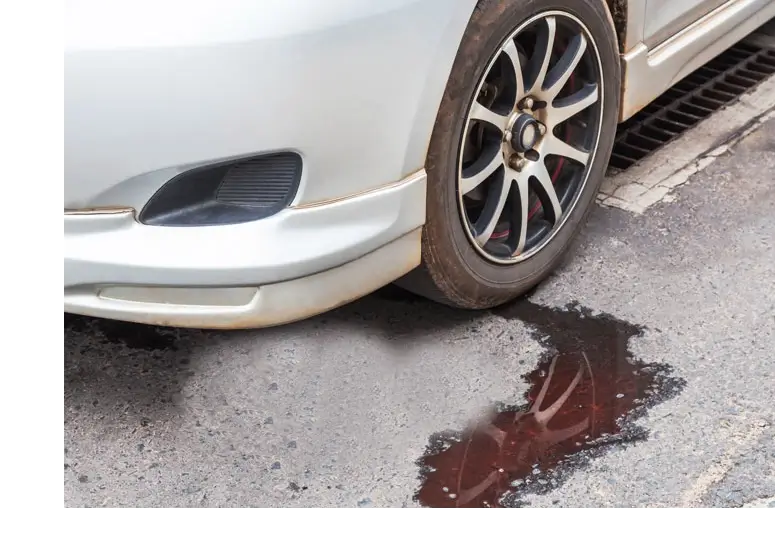
A puddle of brake fluid behind the wheel indicates a line, hose or caliper failure.
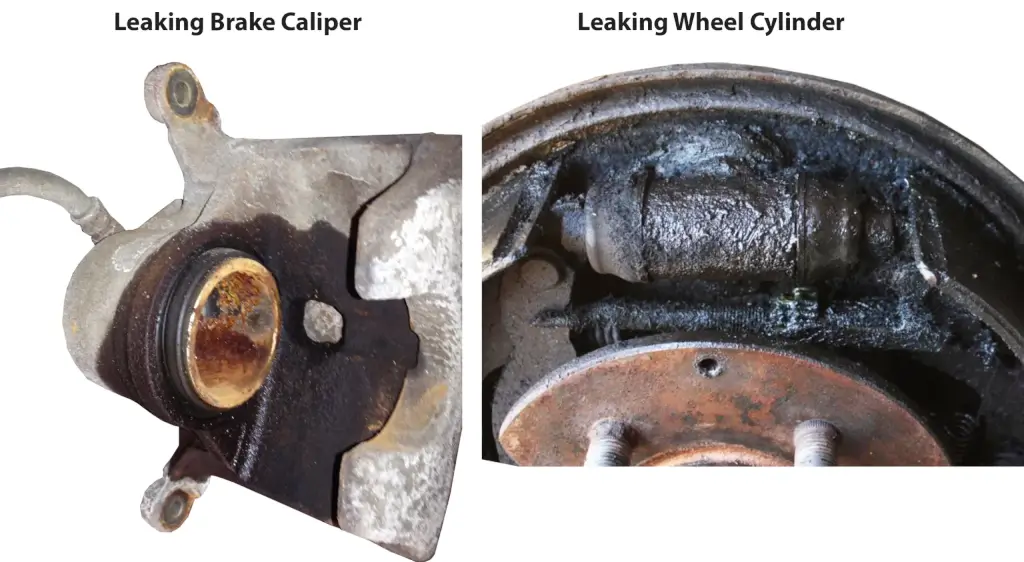
This image shows a leaking brake caliper and a leaking wheel cylinder
Step 5: Test for master cylinder bypass. With the engine off, apply firm, steady pressure to the brake pedal and hold it. If the pedal slowly sinks toward the floor without any visible external leak, worn piston seals in the master cylinder are a prime suspect. That is one of the classic internal-bypass symptoms, indicating that the brake fluid is bypassing around the piston seals. Replace the master cylinder.
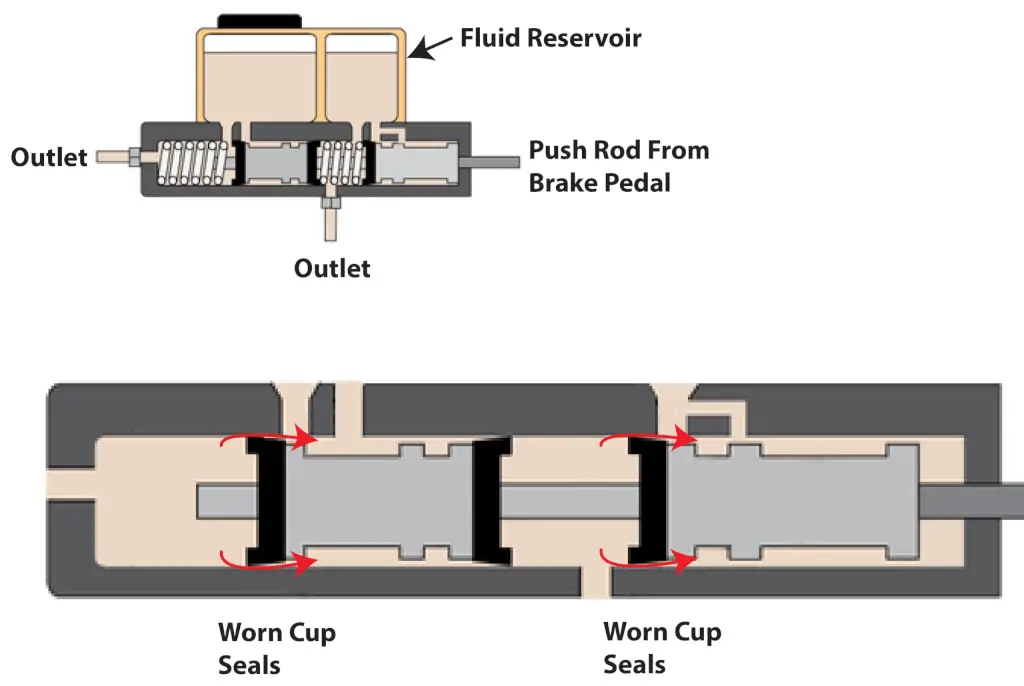
This image shows internal master cylinder leakage caused by worn cup seals
Step 6: Inspect rear brake adjustment. If the vehicle has rear drum brakes, inspect the shoes, drums, wheel cylinders, and self-adjuster mechanism. I have seen many cases where a driver says the brake pedal goes to the floor, and the real problem is rear shoes that are far out of adjustment.
Step 7: Bleed the system correctly. If repairs were recently performed, or if air is suspected, bleed the system using the correct sequence for that vehicle. Some vehicles with ABS may require a scan tool-assisted bleed procedure. If you skip that when it is required, you can chase a soft pedal for hours and never fix it.
Step 8: Recheck the pedal feel and road-test carefully. After repairs, the pedal should feel firm and consistent. Only then should the vehicle be road-tested, and the first test should be conducted at a very low speed in a safe area.
Final expert advice
If your brake pedal goes to the floor, do not keep driving and hope it clears up. Brake problems almost always get worse, not better. In my experience, the smartest diagnostic path is simple: verify the symptom, check fluid, inspect for leaks, evaluate master cylinder behavior, inspect rear brake adjustment, and bleed the system correctly. That process finds the cause far faster than guessing.
A healthy brake system should deliver a firm pedal with predictable travel every time. Anything less is a warning sign that deserves immediate attention.
©, 2024 Rick Muscoplat
Posted on by Rick MuscoplatCategories
Tags
- air in brake lines
- bad master cylinder symptoms
- brake fluid leak symptoms
- brake hydraulic system problems
- brake pedal goes to floor
- brake pedal sinks to floor
- brake pedal troubleshooting
- how to diagnose brake pedal goes to floor
- low brake pedal diagnosis
- master cylinder failure
- rear drum brake adjustment
- soft brake pedal causes