
Why Your Car AC Blows Cold Then Warm
What to Check If Your Car AC Blows Cold Then Warm
I’ve helped countless drivers figure out why their car AC blows cold then warm, and it’s one of the most frustrating problems you’ll encounter in hot weather. Fortunately, troubleshooting why your car AC blows cold then warm isn’t as complicated as it seems. I’ll walk you through the most common causes and how to fix them yourself.
Low Refrigerant Charge and Evaporator Icing: The #1 Culprit Behind an AC System That Blows Cold Then Warm
If you’re troubleshooting why your car’s AC blows cold, then warm, start by checking the refrigerant charge and pressure. A low charge causes the evaporator coil to run too cold. Here’s how that happens: at first, cold air blows from your vents. The low refrigerant charge causes the refrigerant to linger too long in the evaporator coil behind your dash, causing it to run at around 32°F. In other words, it’s overcooking. As the humidity in the air hits the super cold evaporator coil, it freezes on the evaporator fins. The longer it runs in this condition, the more it builds a layer of ice. Eventually, the ice blocks the airflow. The system shuts off the compressor to protect itself, leaving you with warm air. When the ice melts, the cycle begins again.
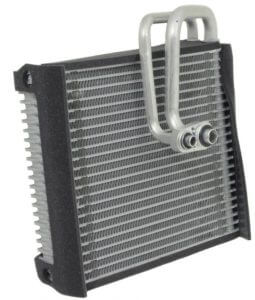
Evaporator coil
You would think it would be just the opposite, that a low charge would cause it to never get cold enough to freeze. To understand why that’s wrong, you first have to understand how refrigerant works.
As the liquid refrigerant is metered into the evaporator (the cooling coil inside the passenger compartment), the liquid refrigerant picks up heat from the cabin air flowing across the coil. That heat causes the refrigerant to boil and change from a liquid to a gas. All the refrigerant needs is just enough heat to cause that “change in state” from liquid to gas. Removing that amount of heat from your car’s cabin is what causes it to feel cool.
The proper refrigerant charge will cause the evaporator to remain slightly above the freezing temperature and produce an air temperature around 40°F
Once the refrigerant has changed states to a gas, it should pick up a maximum of 10°F more heat and then flow out of the evaporator into either the compressor or the accumulator to complete the cycle.
But when a system is low on charge, the gaseous refrigerant stays in the evaporator longer and removes even more heat from the cabin air passing over the coil. The refrigerant leaving the evaporator is superheated by more than 10°F. The additional heat the refrigerant removes from the cabin air causes the evaporator temperature to fall below freezing. Humidity in the cabin air freezes on the evaporator. Over time, the moisture builds to the point where ice blocks the airflow across the evaporator. That shuts off the AC, and you no longer get cooling.
A clogged cabin air filter can also cause evaporator icing
Just as with a low refrigerant charge, low airflow caused by a clogged cabin air filter allows the refrigerant to remove too much heat, resulting in the evaporator freezing.
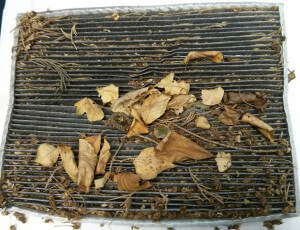
Cabin air filter catch all the debris from fresh air, like leaves, dust, and pollen
If your car has a cabin air filter and you suspect an evaporator freeze-up problem, begin by inspecting the condition of your cabin air filter.
Moisture in the AC system can also cause your car’s AC to blow cold then warm air
Any time you lose refrigerant from your car’s AC system, that leak allows air and moisture to enter. If you add more refrigerant every year without fixing the leak, you build up too much internal moisture.
Moisture can freeze into ice crystals at the orifice tube or expansion valve, clogging it and stopping the flow. The symptom appears as an AC system that blows cold and then warm air. If you shut off the AC for a while, the ice crystals melt, and the system will start cooling again, but it will still freeze up.
How do you tell whether your AC has low charge or moisture?
When an evaporator freezes due to low charge, you’ll also have decreased airflow because the ice blocks the air. If you shut off the vehicle and leave it for half an hour, you’ll see a huge puddle of water under the vehicle. That’s the sign of a low charge. All the ice has melted and drained out of the condensation tube onto the ground.
If the AC blows cold, then a warm condition was caused by moisture in the system; you won’t notice a decrease in airflow, and you won’t see a puddle of water after shutting off the vehicle.
A refrigerant overcharge can also cause an AC blows cold then warm condition
An overcharged car AC system can start out pumping cold air. However, that cold air turns warm fairly soon after because the high side pressures build up to the point that the high-pressure switch shuts off the compressor clutch. Once pressures equalize, the high-pressure switch allows the compressor to start up again. The cycle repeats, providing a short period of cold air followed by warm air. The fix? Evacuate and recharge the car AC system.
A bum radiator fan can also cause an AC blows cold then warm condition
If your car’s AC blows cold air when driving at highway speeds but turns warm at stop lights or when driving at slow speeds, you may have a bad radiator fan or radiator fan relay. Many cars have two radiator fans, while others have one fan that can run at different speeds. In cars with dual fans, one fan is designed to run at full speed whenever the AC is on. If that fan isn’t working properly, it can’t cool the condenser enough to remove enough heat from the gaseous refrigerant to get it to condense back into a liquid. That also causes high pressures that can shut off the compressor. The fix? Check the radiator fans to make sure at least one fan turns on when the AC is switched on.
However, some cars operate both fans at low speeds while driving and switch to high-speed mode when the AC is running. So don’t get tricked into thinking your fans are okay simply because they’re running. They must run at high speed to draw enough air across the condenser to make the system cool properly.
Most common reasons car AC won’t cool
©, 2017 Rick Muscoplat