
10 Reasons Your Car AC Isn’t Blowing Cold After a Recharge
The Most Common Reasons an AC Isn’t Blowing Cold After a Recharge
Quick Summary
If your AC isn’t blowing cold after a recharge, don’t assume you need more refrigerant. In my experience as an automotive technician, the most common causes are;
• An incorrect refrigerant charge
• A refrigerant leak
• A failing compressor
• A clogged expansion valve or orifice tube
• Blend door problems
• Cooling fan failures
• Electrical faults.
The key is to diagnose the root cause rather than repeatedly adding refrigerant. In this article, I’ll walk you through the 10 most common reasons a car AC isn’t blowing cold after a recharge and explain how I pinpoint the actual failure.
Why Recharging Doesn’t Always Fix an Air Conditioning Problem
One of the biggest myths in automotive air conditioning is that adding refrigerant automatically fixes complaints about warm air.
I see it every summer. Someone buys a DIY recharge kit, tops off the system, and expects ice-cold air. Instead, the vents still blow warm air.
That’s because refrigerant charge is only one piece of the puzzle.
For an AC system to cool properly, the compressor must compress refrigerant, the condenser must remove heat, the metering device must regulate refrigerant flow, and the evaporator must absorb cabin heat. If any part of that process fails, your AC isn’t blowing cold after a recharge, regardless of how much refrigerant is in the system.
1. The System Is Overcharged or Undercharged
This is the most common DIY mistake. Many recharge kits only include a low-pressure gauge, which tells only part of the story. Modern AC systems are extremely sensitive to refrigerant charge levels.
With R-134a systems, being only a few ounces over or under specification can significantly reduce cooling performance. More refrigerant does not mean colder air. In fact, an overcharged system often cools worse than a slightly undercharged system.
Symptoms of an overcharged AC system
• High vent temperatures
• High-side pressure too high
• Compressor cycling problems
• Poor cooling at idle
See these posts to learn how to test for the correct charge
Heat load test for orifice tube system
Heat load test for the expansion valve system
2. The Refrigerant Leaked Back Out
A recharge may temporarily restore cooling, but if a leak remains, the refrigerant can escape again within hours, days, or weeks.
I’ve found leaks in:
• Condensers
• Compressor shaft seals
• Evaporators
• Hose connections
• Schrader valves
• Service ports
If your car’s AC is not blowing cold after a recharge worked briefly and then quit, a refrigerant leak is one of my first suspects.
3. A Blend Door Is Mixing Hot and Cold Air
Many drivers immediately assume they have an AC problem when the refrigeration system is actually working perfectly.
Modern HVAC systems use blend doors to control air temperature. If the blend door actuator fails, warm air from the heater core mixes with cold air from the evaporator.
Common Symptoms
• Airflow is strong but not cold
• Driver and passenger temperatures differ
• Clicking sounds behind the dashboard
• Temperature changes unexpectedly
Faulty blend door actuators are far more common than most DIYers realize.
4. The Compressor Is Worn Out
The compressor is the heart of the air conditioning system. If internal pistons, valves, or control mechanisms wear out, refrigerant circulation drops dramatically. The system may appear fully charged, but it simply isn’t moving enough refrigerant to create cooling.
How I Diagnose It
I compare:
• High-side pressure
• Low-side pressure
• Pressure differential
• Compressor response to RPM changes
Minimal pressure difference often indicates a worn compressor.
5. The Compressor Clutch Isn’t Engaging
Many compressors use an electromagnetic clutch to connect the compressor to the engine. If the clutch never engages, the compressor cannot pump refrigerant.
Common causes include:
• Blown fuse
• Failed relay
• Faulty pressure switch
• Bad clutch coil
• Wiring problems
• Computer control issues
Before replacing expensive components, I always verify the clutch’s operation. 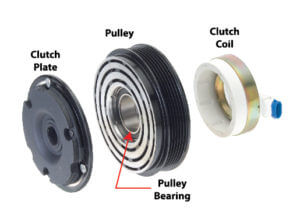
The compressor clutch is controlled by the AC switch on your heater control, the high and low-pressure switches in your vehicle, a compressor clutch relay, and commands from the computer.
Read these posts to diagnose compressor clutch problems
AC compressor won’t run
AC light flashing
6. The Orifice Tube Is Clogged
Vehicles using fixed-orifice systems rely on a small metering tube to regulate refrigerant flow. Over time, contamination can block the tiny opening and filter screen. The result? Poor refrigerant flow and warm air from the vents.
This commonly occurs after refrigerant leaks allow moisture and air to enter the system. Moisture reacts with refrigerant oil, forming acids and sludge that clog the orifice tube.
Symptoms
• High high-side pressure
• Low low-side pressure
• Frost near restriction
• Reduced cooling
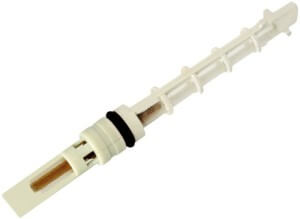
Orifice tubes are color-coded. Buy the same color if you replace yours.
The orifice tube in a properly maintained car AC system can last the life of the vehicle.
However, if your car’s AC system develops leaks and you don’t fix them, you set yourself up for total system contamination and orifice tube failure. Here’s how it happens.
Every car AC system has either a receiver/drier or an accumulator. These devices contain a packet of desiccant to absorb moisture that enters the system. Moisture reacts with the refrigerant and oil, producing acid and foam that can plug the orifice tube and damage the compressor. The desiccant can only absorb a specified amount of moisture. Whenever refrigerant leaks out of your system, ambient air gets in. If you don’t fix the leak, ambient air and the moisture it carries will eventually cause clogging and failure of the orifice tube.
The only fix for a clogged orifice tube is replacement, along with a full system flush and a new drier or accumulator.
7. The Expansion Valve Has Failed
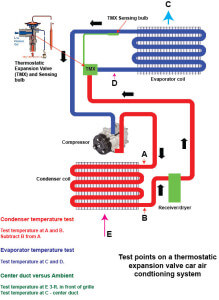
Click on the image to open a full-size PDF in a new window
Many newer vehicles use a thermal expansion valve instead of an orifice tube. The valve automatically regulates refrigerant flow based on evaporator temperature.
When it sticks closed or becomes restricted, refrigerant can’t enter the evaporator properly.
I’ve diagnosed countless systems where the refrigerant charge was correct, but a failed expansion valve prevented cooling altogether.
8. The Condenser Is Restricted or Blocked
The condenser’s job is to remove heat from the refrigerant. When airflow is restricted by:
• Dirt
• Leaves
• Road debris
• Bent fins
• Internal contamination
The refrigerant cannot condense efficiently.
That causes high operating pressures and reduced cooling performance. In severe cases, the high-pressure switch may disable compressor operation entirely.
9. Electrical Problems Are Preventing Proper Operation
Modern AC systems depend heavily on electronics. A single electrical fault can disable cooling.
Common electrical failures include:
• Blown fuses
• Failed relays
• Broken wiring
• Corroded connectors
• Bad pressure sensors
• Faulty climate control modules
I’ve solved many AC isn’t blowing cold after a recharge complaints with nothing more than an electrical diagnosis and repair.
10. The Cooling Fans Aren’t Working Properly
Many drivers overlook radiator and condenser cooling fans. These fans are absolutely critical for AC performance, especially at idle. Without adequate airflow through the condenser:
• High-side pressure rises
• Refrigerant temperature increases
• Cooling performance drops
Typical Symptoms
• Cold while driving
• Warm while stopped
• High condenser pressure
• Compressor cycling off frequently
When someone tells me their AC cools on the highway but not in traffic, cooling fans are one of the first things I inspect.
How I Diagnose a Situation Where Your Car AC Isn’t Blowing Cold After Recharge
Instead of guessing, I follow a systematic process:
Step 1: Verify Refrigerant Charge — Measure actual pressures and compare them to ambient temperature.
Step 2: Check Compressor Operation — Verify clutch engagement and compressor output.
Step 3: Inspect Condenser Airflow — Confirm fan operation and condenser cleanliness.
Step 4: Evaluate Refrigerant Flow — Look for restrictions in the orifice tube or expansion valve.
Step 5: Inspect HVAC Controls — Verify proper blend door movement.
Step 6: Test Electrical Components — Check fuses, relays, sensors, and control circuits.
This approach quickly identifies the true cause instead of wasting money on unnecessary parts.
See these other posts
AC compressor oil
AC compressor won’t run
AC light flashing
Car AC compressor
AC compressor clutch
The Bottom Line
If your AC isn’t blowing cold after a recharge, adding more refrigerant is rarely the solution. The problem is usually an incorrect charge, a refrigerant leak, a failing compressor, a clogged metering device, a bad blend door actuator, cooling fan failure, or an electrical issue. The only reliable way to fix a car AC not blowing cold after recharge complaint is to diagnose the root cause and repair it correctly rather than repeatedly topping off the refrigerant.
©, 2017 Rick Muscoplat
Posted on by Rick Muscoplat