
Subaru Replacement CV Axle: Which Brand Is Best?
Subaru Replacement CV Axle: Why Aftermarket Axles Often Fail and Which Brands Work Best
Quick Summary
If your Subaru has a clicking CV joint, vibration during acceleration, or repeated axle failures, the problem may not be the axle alone. Subaru’s horizontally opposed (boxer) engine and unique drivetrain place greater demands on the CV axles than many front-wheel-drive vehicles. Worn engine or transmission mounts, suspension modifications, and poor-quality aftermarket axles can all contribute to vibration and premature failure. When searching for a Subaru replacement CV axle, my first recommendation is to retain and rebuild the original OEM axle whenever possible. If that’s not practical, premium aftermarket brands such as GKN, NTN, TrakMotive HD, and GSP generally provide the best results.
Subaru owners have long known that replacing a worn CV axle isn’t always as simple as installing a new part. Unlike many other vehicles, Subarus can develop driveline vibration even after a brand-new axle is installed. Over the years, I’ve found that many of these problems aren’t caused by defective parts—they’re caused by the way Subaru’s drivetrain is engineered.
Understanding why Subaru axles fail and why some aftermarket replacements don’t perform well can save you from replacing the same axle twice.
Why Subaru CV Axles Are Different
Most Subaru models use a longitudinally mounted boxer engine coupled to an all-wheel-drive drivetrain. The engine’s horizontally opposed cylinders create unique side-to-side movement, and the drivetrain requires the CV axles to operate through a wider range of plunge and articulation than many front-wheel-drive vehicles.
Because of this design, Subaru axles are especially sensitive to:
• Engine movement
• Transmission movement
• Suspension geometry
• Axle plunge travel
• CV joint articulation angle
Even small changes in drivetrain alignment can produce vibration.
The Most Common Subaru CV Axle Problems
Subaru CV axles generally last well over 100,000 miles when the boots remain intact. Most failures begin with one simple problem.
1) Torn CV Boots — Unlike most CV axles where the outer boot tears first, Subaru CV axles tend to tear the inboard boot first due to excessive plunge movement. The rubber boot is the weakest link.
Once it cracks or tears:
• Grease escapes.
• Dirt and water enter the joint.
• Internal wear accelerates rapidly.
• The joint begins clicking during turns.
Replacing a damaged boot early can often save the original factory axle.
2) Outer CV Joint Failure — The outer joint experiences the greatest steering angle and is usually the first joint to wear.
Common symptoms include:
• Clicking while turning
• Popping during parking maneuvers
• Grease sprayed around the suspension
• Torn outer boot
• Inner Joint Wear
3) Inner CV joint failure — Unlike an outer joint, an inner joint often becomes noisy only after significant wear.
• Vibration during acceleration
• Shudder under load
• Driveline shake
Why Many Aftermarket Subaru Replacement CV Axles Don’t Work
Subaru owners frequently report vibration immediately after installing inexpensive replacement axles. Several factors contribute to this problem.
1) Manufacturing Tolerances — Subaru drivetrains are particularly sensitive to small dimensional differences.
An aftermarket axle with slight variations in:
• Overall length
• Plunge travel
• Joint articulation
• Balance
• Shaft stiffness
may install perfectly yet still create vibration.
2) Limited Plunge Travel
One of Subaru’s unique challenges is the amount of linear movement—or plunge travel—required as the suspension moves. According to TrakMotive, many original-equipment-style axles rely entirely on the inboard joint for plunge travel, limiting both articulation angle and available linear movement. Their Subaru HD axle relocates the telescoping function to the center shaft, increasing articulation to approximately 45 degrees and providing up to 50% more linear travel, reducing binding on vehicles with worn transmission mounts.
3) Excessive Articulation — Worn control arm bushings primarily increase CV articulation angle and plunge during dynamic driving (acceleration, braking, and bumps) rather than changing the static axle geometry. On Subarus, this dynamic movement is a well-recognized contributor to premature inner CV boot and joint wear, especially when combined with a softened transmission mount.
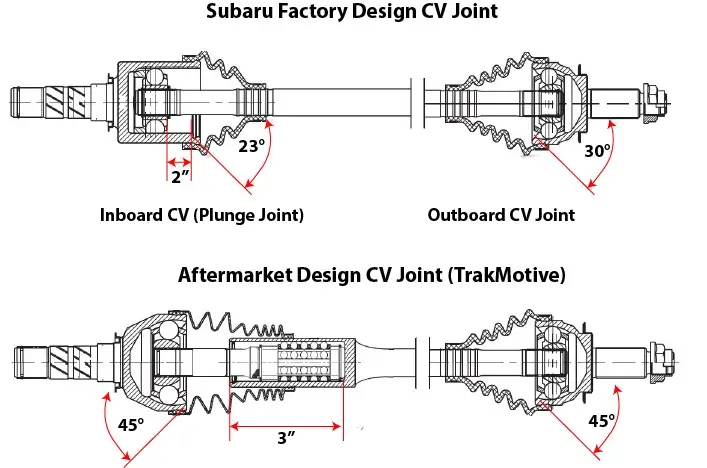
Notice the difference in plunge and articulation between a Subaru OE axle and a TrakMotive axle
4) Cheap Boot Materials — Many inexpensive replacement axles use lower-quality rubber boots that harden from heat and ozone exposure. Once the boot cracks, contamination quickly destroys the joint.
Worn Engine and Transmission Mounts
One of the most overlooked causes of repeated Subaru axle problems isn’t the axle at all; it’s a worn transmission mount.
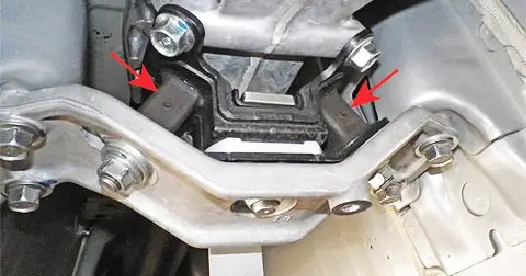
Subaru rear transmission mount
Subaru transmission mounts are prone to softening and deterioration over time because the horizontally opposed (boxer) engine creates greater side-to-side drivetrain movement than many inline or V-engine designs. As the transmission mount loses stiffness, it allows the engine and transmission assembly to shift excessively during acceleration, deceleration, and gear changes.
This increased lateral movement forces the inner CV joint to plunge in and out farther than it was designed to during normal operation. The excessive plunge repeatedly stretches and compresses the inner CV boot, placing abnormal stress on the rubber bellows. Over time, this can cause the boot to tear, allowing grease to escape and contaminants to enter the joint, ultimately leading to premature CV axle failure.
Solution:
Always inspect the transmission mount whenever replacing a torn inner CV boot or CV axle on a Subaru. If the mount is soft, cracked, oil-soaked, or allows excessive drivetrain movement, replace it before installing the new axle. Installing a new CV axle without correcting a worn transmission mount leaves the axle exposed to excessive plunge travel, greatly increasing the likelihood of another torn inner boot and premature axle failure.
Worn Control Arm Bushings Cause Premature CV Axle Failure
Subaru front lower control arm bushings are designed to hold the steering knuckle and lower suspension in the correct fore-and-aft position while allowing only limited suspension movement. As the bushings age, the rubber softens, cracks, or separates from the metal sleeves, allowing the control arm to move excessively during acceleration, braking, and cornering.
That extra movement changes the distance between the transmission’s differential and the wheel hub. Because the CV axle must compensate for these changes, the inner plunge joint is forced to extend and compress farther and more often than it was designed to. The additional plunge travel also causes the CV joints to operate at greater articulation angles, increasing friction and internal loading on the bearings and races.
The repeated over-travel places abnormal stress on the inner CV boot, stretching and compressing the rubber bellows beyond its normal operating range. Over time, the boot can crack or tear, allowing grease to escape and dirt and water to enter the joint. Once contamination occurs, the CV joint wears rapidly and typically begins clicking or vibrating before ultimately failing.
Solution:
Whenever replacing a CV axle on a Subaru, inspect the front lower control arm bushings for excessive movement, cracked or separated rubber, leaking hydraulic fluid (on hydraulic-style bushings), or metal-to-metal contact. If the bushings are worn, replace the control arm or install new bushings before installing the replacement axle. Correcting the suspension movement prevents excessive CV joint plunge and articulation, helping the new axle achieve its expected service life.
What Causes Subaru CV Axles to Fail?
The most common causes include:
• Torn CV boots
• Loss of grease
• Water contamination
• Worn transmission mounts
• Worn engine mounts
• Lift kits that increase axle operating angles
• Aggressive driving
• Inferior aftermarket manufacturing
The axle itself is often not the root cause of the failure.
Final Thoughts
Finding a Subaru replacement CV axle successfully requires more than choosing the lowest-priced part. Because Subaru’s drivetrain is especially sensitive to axle geometry, plunge travel, and drivetrain alignment, the quality of the replacement axle matters far more than it does on many other vehicles.
Whenever possible, preserve or rebuild the original Subaru axle. If replacement is necessary, choose a premium manufacturer and inspect the engine and transmission mounts before blaming the new axle. Spending more on a quality axle—and correcting the underlying cause of the failure—will usually provide a smoother, longer-lasting repair.
©, 2026 Rick Muscoplat
Posted on by Rick Muscoplat