
Why Your Car Battery Keeps Dying
The Real Reason Your Car Battery Keeps Dying
If your car battery keeps dying and you’re stuck jump-starting it just to get moving, you’ve got a problem that goes beyond simple inconvenience. As an automotive expert, I’ve encountered this issue numerous times, and I’ll guide you through the most common reasons why a car battery keeps dying—and, more importantly, how to address them.
#1 The Battery Is Worn Out
In my experience, most batteries last about four years. If your car battery keeps dying near the end of year 3 or 4, chances are the internal cells can no longer hold a proper charge. Sometimes the plates inside shed material, creating shorts that permanently reduce capacity. Fortunately, modern battery testers make diagnosis simple, and most auto parts stores will test yours for free without removing it from the car.
#2 Leaving the Car Parked Too Long Without Driving It
One of the most overlooked reasons a car battery keeps dying is when the vehicle sits unused. Even when parked, onboard computers, alarms, and keyless entry systems draw small amounts of current. A new battery may tolerate weeks of discharge due to inactivity, but an older one can be dead within 10 days. All batteries self-discharge over time. But, when you combine the natural self-discharge of a lead acid battery (1–2% daily in warm weather) with the power draw from the vehicle’s computers, you’ve got a recipe for a dead battery.
Letting your lead-acid battery sit in a discharged state causes two things:
1) Acid stratification, where a higher concentration of the sulfuric acid settles out of the acid/water mix, falls to the bottom of the battery, and degrades the plate material, and
2) Sulfation — During discharge, sulfate crystals develop on the plate material, decreasing the battery’s ability to hold and deliver power when you need it. The industry saw more batteries ruined this way during the Covid lockdowns than for any other reason.
3) Or, they’ve shed plate material, and that’s created an internal short that prevents the battery from holding a charge.
#3 Short Trips Don’t Recharge the Battery
Every engine start pulls a significant current from the battery. If you only drive short distances, the alternator never has the chance to recharge what was lost. Add in accessories like heated seats, headlights, and defrosters, and you’re draining even more. To fully restore a battery, you need at least 30 minutes at highway speeds. Don’t assume idling will help—it takes nearly four hours of idling to equal one solid highway recharge.
#4 You Have Corroded Battery Terminals
I can’t tell you how many times I’ve seen corrosion on battery terminals cause unnecessary headaches. That buildup creates resistance, limiting how much charg
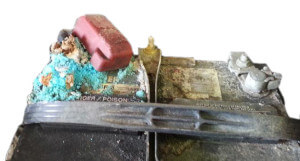
Look at the corrosion on these battery cables. And you wonder why it won’t start?
e the alternator can deliver. So even if you drive long distances, the battery never truly recharges. Corrosion also causes the alternator to work harder, which in turn shortens its lifespan. Cleaning the terminals is one of the most straightforward, most effective steps you can take to prevent your car battery from dying prematurely.
#5 Parasitic Battery Drain
Another culprit is parasitic drain—when a module fails to enter sleep mode after you shut the car off. All vehicles draw a little power for systems like the remote entry receiver, but if a module stays awake, it can drain a fully charged battery overnight. This type of problem requires diagnostic work. If you’re comfortable with a multimeter, you can track it down yourself. Otherwise, it’s time to take the car to a professional.
Modern car battery testers can diagnose the condition of your battery without removing it from the vehicle. Most auto parts stores will perform the test for free.
#6 Your charging system is failing
Alternators have a limited life span. As mentioned above, you can hasten the demise of your alternator by not cleaning the car battery terminals. Alternators fail due to overheated or shorted diodes, worn brushes, deteriorated windings, or electronics failure.
You leave lights on and your car battery keeps dying
Lights Left On
Finally, never underestimate the draw of lights. Parking lights alone will kill a 50-amp-hour battery in about 16 hours. Turn on the headlights and that same battery can be dead in less than four hours. Whenever I diagnose a car that mysteriously won’t start in the morning, the first thing I check is whether the lights were left on.
Let’s take a look at how much power gets drained from your battery when you leave your lights on:
Parking lights: 4 side marker lights, two from parking lights and two rear parking lights. Total draw 2.45-amps (approx 30-watts). If your car battery is rated at 50-amp hours, it will be completely dead in 16.6 hours.
Headlights. Side marker lights, parking lights and headlights = 8.3-amps (140-watts). At 50-amp hours, the battery will be dead in 3.57 hours.
©, 2021 Rick Muscoplat
Posted on by Rick Muscoplat