
5 common transmission problems and their causes
Learn the most common causes of transmission problems
Transmission problems usually cost big bucks to fix. There’s no mechanical system in your car or truck with more moving parts than your automatic transmission. They can fail completely, where you step on the gas, and nothing happens, or they can fail partially, where it won’t shift properly or makes strange noises. Finding the root cause of the failure is complicated and usually involves removal, tear down, and a rebuild. Few transmission problems can be solved with a quick and cheap fix.
The five most common transmission problems
• The transmission shifts late— You hear and feel the engine RPMs rise much higher than normal before it finally shifts into the next gear
• The transmission shifts harshly into gear with a hard bang or jerks into gear
• The transmission spins for a few seconds (flare) between shifts before finally shifting into the next gear
• The transmission stays in one gear and won’t shift to the next gear
• You get no response from the transmission when applying the gas. The vehicle won’t move when shifted into drive
What causes late shifting?
Transmission clutch packs and bands require high pressure to engage or hold spinning parts. Here are the most common causes of delayed shifting
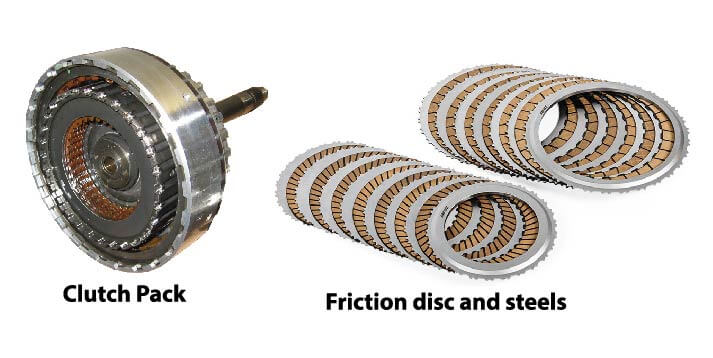
Worn clutch pack seals can leak and prevent the clutch pack from developing the needed pressure. Worn clutch discs slip until the pump supplies more pressure.
• Low fluid level— The transmission has developed a leak and is low on fluid/
• Low fluid pressure— The pump is worn, or the pressure regulator is bad. Or, there’s an internal leak that’s bleeding pressure.
• Internal seal leaks— Rubber seals are cracked or hardened and can’t hold pressure
• The bands or clutch discs are worn— Worn out or burnt transmission fluid due to overheating, owner neglect, or abuse
• Failing shift solenoid— A weak or failed shift solenoid can prevent proper pressurization
What causes hard shifting?
• Low fluid level— The transmission has developed a leak and is low on fluid/
• Low fluid pressure— The pump is worn, or the pressure regulator is bad. Or, there’s an internal leak that’s bleeding pressure.
• Failing shift solenoid— A weak or failed shift solenoid can prevent proper pressurization
What causes flare?
• Low fluid level— The transmission has developed a leak and is low on fluid/
• Low fluid pressure— The pump is worn, or the pressure regulator is bad. Or, there’s an internal leak that’s bleeding pressure.
• Failing shift solenoid— A weak or failed shift solenoid can prevent proper pressurization
What causes a transmission to not shift into the next gear?
When the powertrain computer senses transmission problems that could damage the transmission even more, it will limit shifting. This is referred to as “limp-in mode.” It allows you to drive the vehicle to get it in for service, but by not allowing it to shift beyond a certain gear, limp-in mode prevents additional damage.
What causes a no-response when you shift into drive?
• Low fluid level — Pan or shaft seal leaks
• Failed pump
• Failed solenoid
• Failed torque converter
• Failure in the valve body
Where can transmission problems be diagnosed and repaired?
Independent neighborhood auto repair shop
I usually recommend using an independent neighborhood shop for most repairs. But in this case, I hesitate. Here’s why: most neighborhood repair shops don’t deal with transmission problems on a regular basis, and they usually don’t do their own rebuilding. Instead, they remove the transmission and send it to a local rebuilder. That way, they keep you as a customer and earn their normal hourly rate for removal and re-installation. Is there a problem with that? Not really, except that most independent neighborhood shops just narrow the diagnosis down to the transmission and then recommend a complete rebuild.
They’re not really transmission experts, so they don’t continue their diagnosis to find the root cause. That approach works for 90% of all their customers. But sometimes the transmission problems are just a symptom of a software or computer problem. In those cases, the shop might recommend a rebuild, only to discover that it didn’t fix the problem. At that point, the shop is out a lot of money for the rebuilder who did his job, and they’re out all the labor for removal and replacement. The shop will be looking to you to pay the bill because, after all, you did get a rebuilt transmission.
If you use an independent neighborhood shop for major transmission repair, get some assurance up front that they’ll stand behind their diagnosis and offer a solid warranty on the rebuild.
Should you go to the dealer for transmission problems?
Like an independent shop, most dealers don’t specialize in transmission rebuilds. The dealer will replace your transmission with a factory rebuild if it is toast. However, they are often better equipped to diagnose a software or computer problem. For that reason, I think you should consider having your car diagnosed there before you choose another shop. Yes, you’ll pay for the diagnostic work, but you don’t have to have the actual rebuild work done at the dealer.
Should you go to a transmission repair shop?
Now we’re getting down to the nitty-gritty. Here’s the bottom line with transmission shops. Most chain-operated transmission shops are either company-owned or franchised. They don’t perform their own rebuilding. They remove the transmission and send it to the franchisor or get a replacement from the company warehouse.
In my opinion (and it’s just my opinion), no matter what’s wrong with your car, when you take it to a chain-operated transmission shop, they will sell you a rebuilt transmission—because that’s all they have to offer. In most cases, their technicians are trained in removal and installation, not diagnosis. So, my advice is to avoid chain-operated transmission shops.
How about independently owned transmission shops? Maybe. First, they must belong to and be in good standing with the American Transmission Rebuilders Association (ATRA). Second, they must do their own rebuilding, have the latest scan tools and access to factory software, and have good diagnosticians. There are quite a few really good independently owned transmission shops around. But they’re hard to find. They don’t advertise on TV, they don’t offer discount coupons (because they don’t have to), and they have good ratings with Yelp and the BBB.
The bottom line is to go to a reputable independently owned transmission shop or your local dealer for diagnosis and repair.
Should you install a rebuilt transmission instead of rebuilding yours?
This is a really tough call because it depends on what killed yours. If your transmission is known for failing predictably, then the replacement transmission from the junkyard will also fail that same way, and you’ll be back in the same boat. Rebuilders usually update the transmission with parts specifically designed to prevent the same type of failure. So I would choose a rebuilt from a reputable local rebuilder or a factory rebuilt transmission from a dealer before I’d choose one from a junkyard that has known failure issues.
But if your transmission failed due to a leak, abuse, or neglect, then a junkyard transmission may be a good option, as long as the shop has confidence in the supplier. You want to avoid shopping around junkyards for the best price on a used transmission and then asking a local shop to install it. You don’t know the reputation of the local junkyard, so you’re buying a pig in a poke. Don’t expect the installation shop to stand behind it because they didn’t make any money. And don’t expect the junkyard to pony up a refund with a smile. They will blame the failure on the installing shop. At best, they’ll offer you another transmission, but they won’t pay for the labor to remove and replace it a second time. If you’re going to install a junkyard transmission, let the local shop find it and put their reputation on the line.
©, 2016 Rick Muscoplat
Posted on by Rick Muscoplat