
AC Fully Charged But Not Cold? The Most Common Causes
How Moisture and Air Contamination Destroy AC Performance
Quick Summary
If your car’s AC is fully charged but not cold, adding more refrigerant is almost never the answer. In my experience diagnosing automotive air conditioning systems, the most common causes are;
• Air or moisture contamination
• A clogged expansion valve or orifice tube
• A failing compressor
• A restricted condenser
• Cooling fan problems
• Blend door issues inside the HVAC housing.
The key is understanding that refrigerant charge is only one part of the system. A properly charged system can still blow warm air if refrigerant isn’t flowing correctly, pressures aren’t normal, or the HVAC controls aren’t directing air through the evaporator.
Why Your AC Can Be Fully Charged But Still Not Blow Cold
One of the biggest misconceptions I see is the belief that if the refrigerant pressure looks good on a gauge, the air conditioning system must be working properly.
That’s simply not true.
I’ve diagnosed countless vehicles where the owner said, “The system is full, but the AC isn’t cold.” In many cases, they had already added refrigerant several times using a DIY recharge kit. Unfortunately, a full refrigerant charge doesn’t guarantee proper cooling.
For cold air to come out of the vents, the system must:
• Compress refrigerant properly
• Condense heat efficiently
• Meter refrigerant through the expansion device
• Evaporate refrigerant in the evaporator core
• Move air across the evaporator
• Direct that cooled air into the passenger compartment
A failure anywhere in that chain can leave you with an AC that’s fully charged but not cold.
The Most Common Cause: Air and Moisture Contamination
Whenever refrigerant leaks from an AC system, air and moisture can enter the system. That’s where the real trouble begins.
Air occupies valuable condenser space but doesn’t condense like refrigerant. As a result, condenser efficiency drops dramatically. High-side pressures increase, cooling performance falls, and vent temperatures rise.
Moisture contamination is even worse.
Water reacts with refrigerant and compressor oil to form acids that attack aluminum, copper, steel, and internal compressor components. Over time, corrosion particles mix with oil and form sludge. This sludge can clog the expansion valve or orifice tube, restricting refrigerant flow throughout the system.
Symptoms of Air or Moisture in the System
• High-side pressure is excessively high
• The gauge needle fluctuates or flutters
• Cooling starts normally but becomes warm after several minutes
• Compressor cycles abnormally
• Poor cooling at idle
• Intermittent cold air output
If an AC system blows cold for a few minutes and then suddenly turns warm, moisture freezing inside the expansion valve or orifice tube is one of my first suspects.
A Restricted Expansion Valve or Orifice Tube
The expansion valve or orifice tube controls refrigerant flow into the evaporator. When debris, sludge, compressor particles, or desiccant contamination partially block that component, refrigerant can’t flow properly.
I’ve removed orifice tubes that were completely covered with black sludge—a condition many technicians call “black death.” Once that happens, cooling performance drops dramatically, even if the refrigerant charge is perfect.
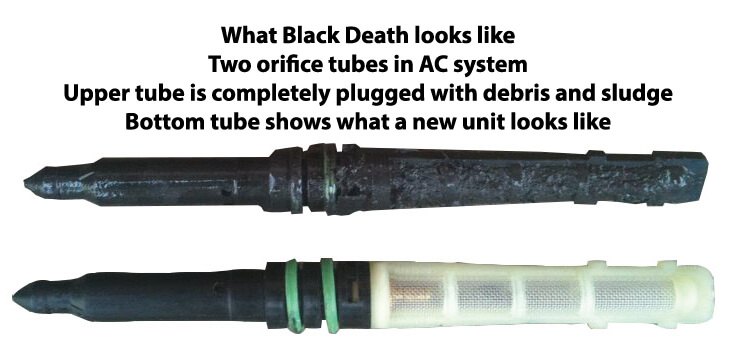
New and clogged AC orifice tube. Clogged tube shows evidence of “Black Death.”
How I Diagnose a Restriction
I compare:
• Low-side pressure
• High-side pressure
• Vent temperature
• Temperature differences across the evaporator
A restricted system often shows:
• Low low-side pressure
• Excessively high high-side pressure
• Frost forming near the restriction
• Poor evaporator cooling
A Weak or Failing Compressor
This is another extremely common cause of complaints about AC being fully charged but not cold. Many modern vehicles use variable-displacement compressors that don’t cycle on and off like older systems. Instead, they continuously adjust pumping capacity.
The clutch may engage normally, and the compressor may appear to operate, but internally worn pistons, damaged reed valves, or control valve failures prevent adequate compression.
Compressor Failure Symptoms
• High and low side pressures are nearly equal
• Poor cooling at all engine speeds
• Compressor engaged, but little temperature change
• Metallic contamination in the refrigerant oil
• Intermittent cooling
Whenever I suspect compressor problems, I compare pressure readings against manufacturer specifications and monitor pressure response as engine RPM changes.
Condenser Cooling Problems
The condenser’s job is to remove heat from the refrigerant. If airflow through the condenser is reduced, cooling performance drops dramatically.
Common causes include:
• Failed radiator cooling fan
• Damaged fan clutch
• Debris blocking condenser fins
• Bent condenser fins
• Plastic bags or leaves restricting airflow
This often creates a situation where:
• AC works while driving
• AC becomes warm at stoplights
• High-side pressure rises excessively
If your car’s AC blows warm at idle but cold while driving, condenser airflow should be near the top of your suspect list.
Blend Door Problems Inside the Dashboard
Sometimes the refrigeration system is working perfectly. The real problem is inside the HVAC housing. Modern vehicles use electric blend door actuators to control airflow across the heater core and evaporator.
If the blend door sticks or the actuator fails, heated air can mix with cooled air before it reaches the vents.
Blend Door Symptoms
• Different temperatures from different vents
• Clicking sounds behind the dashboard
• Driver and passenger temperatures don’t match
• Vent temperatures change randomly
This issue is especially common on vehicles with dual-zone climate control systems.
An overcharged system can also cause warm air
Ironically, adding refrigerant can sometimes make cooling worse.
An overcharged system:
• Raises condenser pressure
• Reduces condenser efficiency
• Increases compressor load
• Produces warmer vent temperatures
That’s why I never recommend adding refrigerant without first verifying pressures and system performance using proper gauges.
How I Diagnose A Complaint Where the AC is Fully Charged But Not Cold
Step 1: Verify Vent Temperature — Measure actual vent temperature rather than relying on how cold it feels.
Step 2: Check High- and Low-Side Pressures — Pressure readings reveal a wealth of information about system health.
Step 3: Inspect Condenser Airflow — Verify the cooling fan’s operation and the condenser’s condition.
Step 4: Evaluate Compressor Performance — Compare pressure differentials and compressor response.
Step 5: Check for Restrictions — Look for frost patterns, abnormal pressures, and temperature differences.
Step 6: Inspect HVAC Controls — Confirm proper blend door operation and actuator movement.
Step 7: Verify Refrigerant Purity — If contamination is suspected, recover and analyze refrigerant quality.
Moisture Damage and Black Death
Moisture in the system in concentrations greater than 20 ppm can cause serious damage. A single drop of water is enough to push the entire system over the 20-ppm threshold. Water in an AC system reacts with the refrigerant to form hydrochloric acid (HCI). HCI corrodes steel, iron, copper, and aluminum. As the metals oxidize, they release particles that combine with the refrigerant oil to form sludge. It’s that sludge that clogs the intake screens, orifice tubes, and expansion valves, preventing them from metering refrigerant into or out of the evaporator.
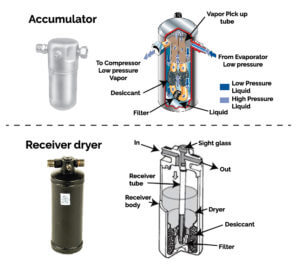
If you frequently add refrigerant from a DIY recharge kit and have finally reached the point where the system is fully charged but not cold, chances are you’ve caused the damage yourself. At this point, the only fix is to open the system, flush the lines, replace the orifice tube/expansion valve, receiver/drier or accumulator, condenser, and pull a vacuum for at least 45 minutes to pull all moisture from the system.
What to replace?
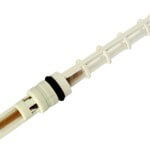
Orifice tubes are color-coded. Buy the same color if you replace yours.
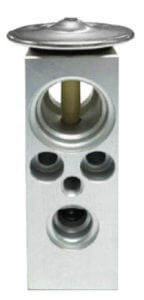
H-block style expansion valve
+
The Bottom Line
When your AC is fully charged but not cold, refrigerant quantity usually isn’t the problem.
In my experience, the most common causes are moisture contamination, air contamination, clogged expansion valves or orifice tubes, failing compressors, condenser airflow problems, and HVAC blend door failures. Simply adding more refrigerant rarely fixes the issue and can sometimes make matters worse.
The fastest path to the correct repair is to measure pressures, evaluate airflow, inspect refrigerant flow, and identify the root cause rather than guessing. That’s how professional technicians diagnose a car AC that’s not blowing cold, and it’s the same process I follow every time.
©, 2018 Rick Muscoplat
Posted on by Rick Muscoplat