
Alternator AC ripple: What it is and how to test for it
Understanding Alternator AC Ripple: What It Is, How Much Is Too Much, and How to Test It
Modern alternators/generators produce an AC voltage that’s converted into DC voltage using diode rectifiers. In simple terms, a diode rectifier is an electrical one-way valve that allows AC current to flow one way (it’s more complicated, but let’s go with this explanation). The rectifier “bridge” contains 3-8 diodes that allow only the negative portion of the AC sine way to pass to ground. However, there’s always some AC voltage left over after the conversion and that small amount is referred to as alternator AC ripple. A certain amount of ripple is acceptable. However, if the rectifier diodes start to fail, they can allow too much ripple and that can reduce battery charging and damage electronics in your vehicle. This article describes how much ripple is allowed and how to test for it.
Even after rectification, the output from the alternator is not perfectly smooth. Some small, oscillating AC voltage—known as ripple—remains. This ripple is typically low in amplitude and frequency, but if it becomes excessive, it can cause various electrical issues.
How Much AC Ripple Is Too Much?
Normal Ripple Levels: In a healthy alternator, the AC ripple voltage is usually less than 50 millivolts (mV) under normal operating conditions. Some sources might consider up to 100 mV acceptable, but anything higher can indicate potential problems.
Excessive Ripple: When AC ripple exceeds 100 mV, it can indicate that the alternat
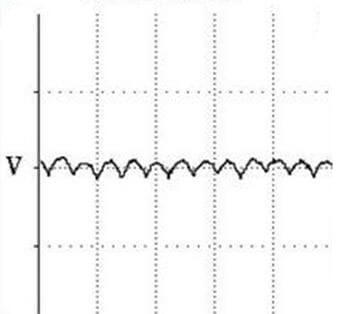
Normal AC ripple pattern captured on a scope
or’s diodes are failing or that there is an issue with the stator windings. Excessive ripple can cause several problems, including:
• Electrical Noise— High AC ripple can introduce electrical noise into the vehicle’s systems, affecting sensitive electronics, sensors, and communication networks.
• Battery Charging Issues— The battery may not charge properly, leading to a shorter battery life or frequent battery failures.
• Component Damage— Excessive ripple can cause damage to other electrical components, such as the Electronic Control Unit (ECU), due to the inconsistent voltage supply.
• Operational Symptoms— Drivers may notice flickering lights, erratic gauge behavior, or strange behaviors in the vehicle’s electrical system.
The best way to test for normal AC ripple is with a scope since you’re really looking for an abnormal pattern not just high AC voltage. But most DIYers don’t have scopes, so you can still get some idea using a multimeter.
How to Test for Alternator AC Ripple
Testing for AC ripple is a straightforward process, you just need a multimeter with a low AC setting.
Testing Procedure:
1) Set Up the Multimeter— Set your digital multimeter to the AC voltage setting. The scale should be set to a range that can detect low voltages, such as 0-2 volts.
2) Connect the Multimeter— Connect the multimeter’s positive lead to the positive terminal of the battery and the negative lead to the negative terminal of the battery. This setup allows you to measure the AC voltage present across the battery terminals.
3) Start the Engine— Start the vehicle and let it idle. Observe the multimeter reading. In a healthy system, you should see a very low AC voltage—ideally below 50 mV.
4) Rev the Engine— Slowly rev the engine to about 1,500 RPM. The AC voltage should remain relatively low and stable. If the AC ripple increases significantly with engine speed, this could indicate an alternator issue.
5) Evaluate the Results— If the AC voltage exceeds 100 mV or fluctuates wildly, it’s a sign that there may be a problem with the alternator, such as worn diodes or stator windings. In such a case, further inspection or alternator replacement may be necessary.
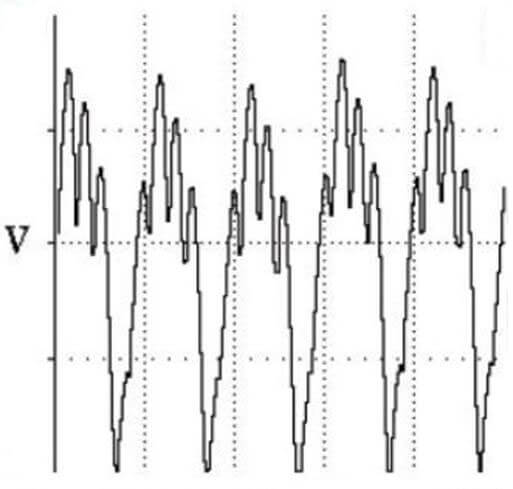
Here’s an abnormal AC ripple pattern caused by an open diode. This alternator will show that it’s charging but will constantly undercharge the battery.
What to do if your AC ripple is too high
High or irregular AC ripple can be caused by one or more open diodes in the rectifier bridge or by a fault in the stator windings. Since it doesn’t really make sense these days to replace internal components, replace the alternator with a new unit
©, 2021 Rick Muscoplat
Posted on by Rick Muscoplat