
Automotive air filters: Are amateur air filter tests accurate?
Understanding automotive air filters: Can you trust amateur air filter testing methods?
It’s certainly entertaining to watch non-experts perform tests on automotive air filters and make conclusions based on their amateurish testing. But are their results accurate? I’ll take a look at their test methods and see whether their tests mean anything or can be counted on to help you make the decision on which air filter to buy.
Some of the tests are conducted by individuals possessing laboratory experience. At first glance, the results may convince you to buy one air filter brand over another. But these home made tests are bogus because their testing methods don’t duplicate real world conditions. In other words, their results are totally worthless. Here’s why.
The air filter testing setup is wrong
Auto engineers design the air filter and air filter box
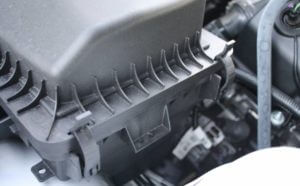
OEM Air Filter Box
to fit a certain engine. The shape of the filter, surface area, and pleat design are all engineered to reduce noise, create laminar airflow into the MAF sensor, and precipitate particles out of the air stream. Any air filter testing done without the exact factory setup is suspect from the get-go.
“Modern intake air systems such as this remove turbulence from air flowing into the MAF sensor. The difference in cross-sectional area decreases the velocity of intake air as it enters the air filter housing causing airborne debris to fall to the bottom of the housing. This increases the life of the air filter and tends to dampen the throaty resonance of air rushing into the engine. Last, and most important, this reduction in air velocity helps increase the accuracy of the MAF sensor by removing turbulence from the incoming air.”— www.knowyourparts.com/technical-articles/air-and-fuel-filter-service-tips/
When you change an air filter, the first thing you notice is an accumulation of dirt at the bottom of the air filter box. How did it get there, and why isn’t it lodged in the air filter? I mean, isn’t the air filter supposed to collect and hold dirt?
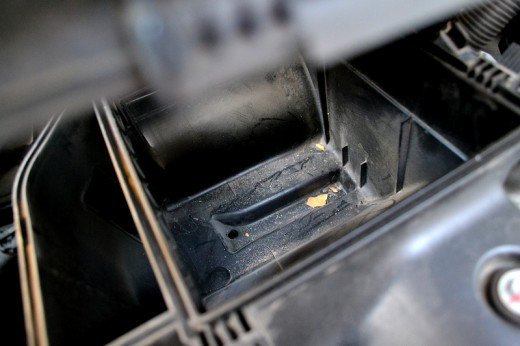
Dirt at the bottom of the air filter box
What you’re seeing is the precipitation effect of the air filter box vortex design. It causes particulate matter to drop out of the airflow to increase filter life. The results won’t be accurate if the air filter test isn’t conducted in the same air filter box.
The particulate matter is wrong
Most automotive air filter testers use fine particulate to test the filter’s ability to capture and hold small particles. Right from the start, this method is wrong. Actual road conditions generate a mix of particulate sizes.
New air filters have lots of open pores. The filters are designed so larger particles plug the large holes, increasing filter efficiency as more of those holes get plugged. In other words, brand new automotive air filters are the LEAST efficient when new. Injecting ultra-small particle matter into a new filter doesn’t provide ANY kind of reliable result. In real-world use, the larger particles in the air stream plug up the larger holes. If you start the test with the smallest particles, it’s not a real world test.
If the particle size is smaller than the filter’s pore, it’ll pass through the pore and into the next layer with smaller pores. The particle continues through the filter media until it reaches a pore that’s too small. As the smallest pores become plugged, the air filter becomes more and more efficient.
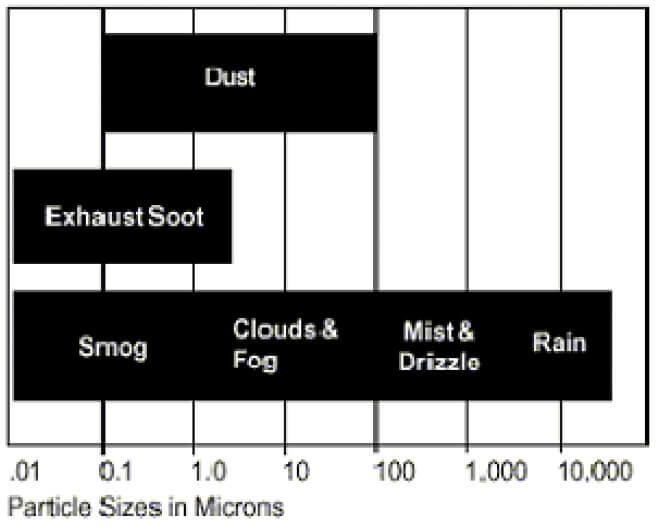
Air filter contaminant size Filter Manufacturer’s Council Technical Service Bulletin 04-3
Most of these amateur air filter tests are conducted on new filters where the smallest pores haven’t been plugged. So, the tester injects extremely fine particles and measures how many of those particles pass through the filter media’s pores. Does that result mean anything? No.
It only means that on day one of use, one filter may outperform another filter. But is the test valid in the real world, where larger particles plug the smallest pores first? If those “failed” filters had been in use for a week, their smallest pores would have been plugged and that same failed filter would be even more efficient than the “passing filter.”
Air filter manufacturers know what the testers don’t
All automotive air filter manufacturers know what the ISO and SAE tests are, and they manufacture their filters to pass those standards. They have way too much liability at risk to not pay attention to those filtration standards.
Air filter manufacturers use different filtering materials for each vehicle design. Some incorporate a mix of cellulose and synthetic fibers for a certain make and model but change the ingredients for a different engine.
If the air filter tester doesn’t use ISO or SAE testing procedures, then its tests aren’t accurate.
© Rick Muscoplat
Posted on by Rick Muscoplat