
Bad Tie Rod Symptoms Every Driver Should Know
Tie Rod and Tie Rod End Guide: How They Work, Symptoms of Failure, and When to Replace Them
Quick Summary
If your vehicle wanders on the highway, the steering feels loose, or your tires are wearing unevenly, a worn tie rod or tie rod end may be the culprit. Tie rods are a critical part of your steering system, connecting the steering gear to the front wheels and allowing you to control your vehicle’s direction.
In this guide, I’ll explain how tie rods and tie rod ends work, what causes them to wear out, how to recognize the warning signs of failure, and when replacement becomes necessary.
Key Takeaways from this article
• A tie rod transfers steering motion from the steering gear to the front wheels.
• The tie rod end uses a ball-and-socket joint that allows steering and suspension movement simultaneously.
• Worn tie rod ends can cause loose steering, tire wear, and vehicle wandering.
• A failed tie rod end can result in complete loss of steering control.
• An alignment is required whenever a tie rod or tie rod end is replaced.
What Is a Tie Rod?
As an ASE Master Technician, I’ve diagnosed thousands of steering and suspension problems, and tie rod wear is one of the most common issues I encounter.
A tie rod is a steering linkage component that connects the steering gear to the steering knuckle. Its job is to transfer the driver’s steering input from the steering wheel to the front wheels.
Without tie rods, turning the steering wheel would accomplish absolutely nothing.
Every time you steer left or right, the tie rods push or pull the steering knuckles, causing the wheels to change direction.
What Is a Tie Rod End?
The tie rod end is the flexible connection located at the ends of the tie rod assembly. Most tie rod ends use a ball-and-socket design similar to a miniature ball joint.
This design allows the front wheels to:
• Turn left and right
• Move up and down with the suspension
• Maintain proper steering geometry
Without this flexibility, the steering system would bind every time the suspension moved over a bump.
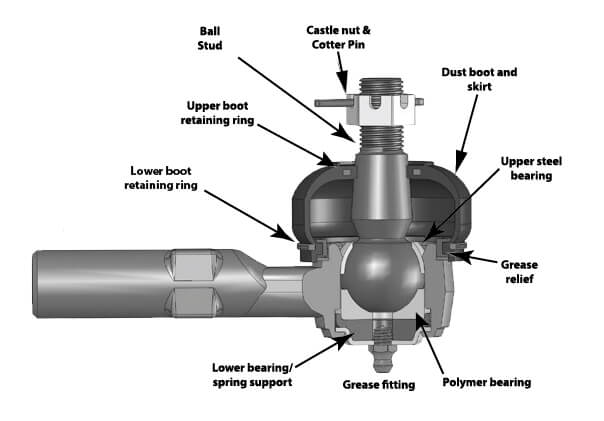
This is a cut-away view of an outer tie rod end. Notice the ball-and-socket design, which allows for up-and-down movement and left-and-right turns.
How Tie Rods Work in a Rack-and-Pinion Steering System
Most modern vehicles use rack-and-pinion steering.
• You turn the steering wheel.
• The steering shaft rotates the pinion gear.
• The pinion gear moves the steering rack left or right.
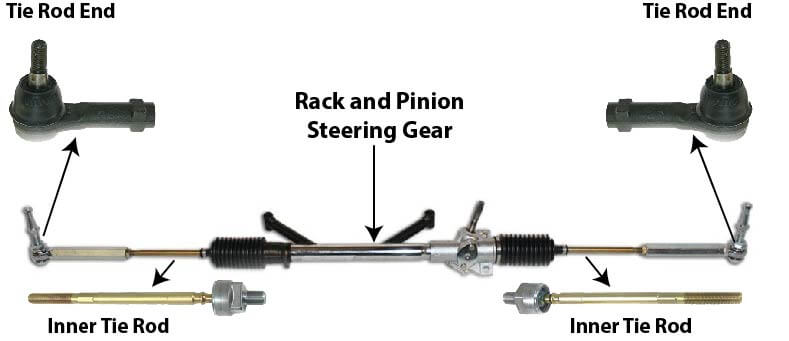
• The inner tie rod moves with the rack.
• The outer tie rod end pushes or pulls the steering knuckle.
• The wheels change direction.
The process happens instantly and with remarkable precision.
Inner Tie Rod — The inner tie rod attaches directly to the steering rack. Its primary function is to transfer the rack’s side-to-side movement to the outer tie rod.
Outer Tie Rod End — The outer tie rod end connects the inner tie rod to the steering knuckle. Because it contains a ball-and-socket joint, it can accommodate both steering movement and suspension travel.
How Tie Rods Work in Older Steering Systems
Many trucks and older vehicles use a recirculating-ball steering gear instead of rack-and-pinion steering.
These systems typically include:
• Pitman arm
• Drag link
• Center link
• Idler arm
• Tie rods
• Tie rod ends
Although the components differ, the purpose remains the same: transferring steering input from the steering wheel to the front tires.
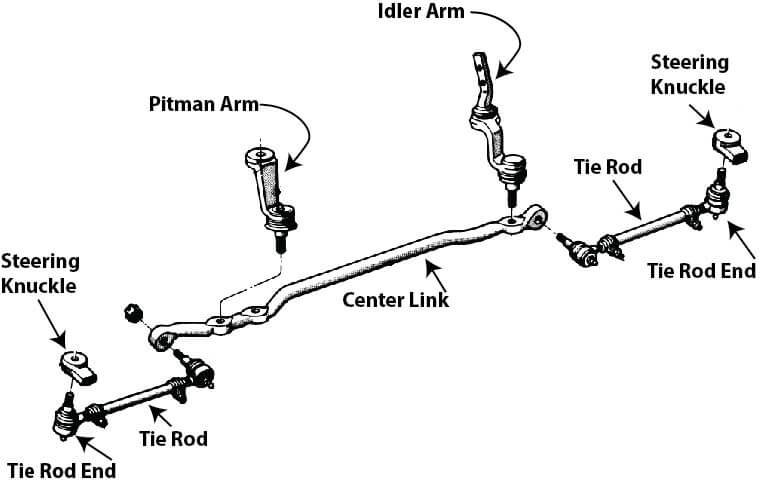
Understanding how tie rods and connecting rods work in a conventional steering gear setup
Depending on the configuration, traditional recirculating ball steering gears use many more components between the gear and the steering knuckle. Most use a pitman arm to move a drag link, center link, idler arm, and tie rods.
What Causes a Tie Rod End to Wear Out?
Interestingly, the tie rod shaft itself rarely fails. The weak point is almost always the tie rod end. The most common cause of tie rod end failure is contamination.
The ball-and-socket joint is protected by a rubber boot filled with grease. Once that protective boot cracks or tears, trouble begins.
Water, dirt, road salt, and debris enter the joint and begin wearing away the metal surfaces.
Common causes of tie rod end failure include:
• Torn grease boot
• Loss of lubrication
• Road salt corrosion
• High mileage
• Impact damage from potholes
• Improper removal techniques
• Over-greasing serviceable tie rod ends
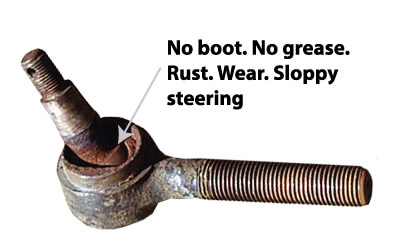
An example of a worn tie rod end that’s rusted and causing sloppy steering
Symptoms of a Bad Tie Rod End
When a tie rod end begins to wear, the symptoms often develop gradually.
Here are the warning signs I see most often.
Loose Steering — One of the first symptoms is excessive play in the steering wheel. The vehicle may feel vague or disconnected from your steering inputs.
• A worn tie rod can make it difficult to maintain a straight path.
• You may find yourself constantly correcting the steering wheel.
• This symptom is often mistaken for poor alignment.
Drivers often describe it as:
• Loose steering
• Sloppy steering
• Delayed steering response
• Vehicle Wanders on the Highway
Uneven Tire Wear — A bad tie rod end can alter wheel alignment angles. The result is abnormal tread wear known as feathering.
Common tire wear patterns include:
• Feathered edges
• Rapid inner edge wear
• Rapid outer edge wear
• Irregular tread patterns
• Clunking or Creaking Noises
As the ball-and-socket joint wears, it can produce:
• Clunking noises
• Clicking sounds
• Creaking when turning
These noises often become more noticeable at low speeds.
Steering Wheel Vibration — Excessive tie rod wear can allow the wheels to move independently of the steering system, creating vibration that can be felt through the steering wheel.
• Catastrophic failure. An extremely worn, flexible ball-and-socket joint can separate while driving, preventing you from steering. The lack of input to the wheel can cause the wheel to turn to its maximum angle, causing a crash and serious injury.
Can a Bad Tie Rod End Cause an Accident?
Absolutely. This is one steering problem that should never be ignored. If the ball stud separates from the socket, the steering linkage becomes disconnected.
When that happens:
• The affected wheel can turn freely.
• Steering control is lost.
• The vehicle may suddenly veer to one side.
I’ve seen vehicles towed into shops after complete tie rod separation, and the damage can be severe.
How Long Do Tie Rod Ends Last?
Tie rod life varies considerably. Factors that affect lifespan include:
• Driving conditions
• Road quality
• Vehicle weight
• Climate
• Maintenance practices
• Most tie rod ends last between 70,000 and 150,000 miles
• Some may fail earlier if exposed to severe road conditions or damaged boots.
How Mechanics Check Tie Rod Ends
A professional inspection typically includes:
Visual Inspection — The technician checks for:
• Torn boots
• Leaking grease
• Corrosion
• Bent components
• Movement Test — With the vehicle lifted, the technician pushes up and down on the outer tie rod end, checking for movement. There shouldn’t be any up/down movement. To check an inner tie rod end, the technician pulls the tie rod in and out. Again, there should be no movement. Any visible movement in the joint usually indicates wear.
Tie Rod Replacement Cost
Tie rod replacement costs vary depending on the vehicle and steering system design.
Typical costs include:
Outer Tie Rod End: Part: $30–$100
Labor: 0.5–1.0 hour, plus an alignment
Inner Tie Rod: Part: $50–$200+
Labor: 1–2 hours, plus an alignment
After replacement, a wheel alignment is mandatory.
Typical alignment cost: $100–$150. Failing to perform an alignment can quickly destroy a new set of tires.
Should You Replace Both Tie Rod Ends at the Same Time?
In many cases, yes.
If one tie rod end has worn out due to age and mileage, the opposite side is often not far behind.
Replacing both sides can:
• Restore steering precision
• Reduce future labor costs
• Ensure balanced wear
• Minimize future alignments
Final Thoughts
The tie rod and tie rod end are among the most important components in your vehicle’s steering system. Their job may seem simple, but they play a critical role in maintaining steering accuracy, tire wear, and vehicle safety.
If you notice loose steering, wandering, tire feathering, or unusual steering noises, don’t ignore them. A worn tie rod end isn’t just a comfort issue—it’s a safety issue that can eventually lead to complete steering failure.
Routine inspections and prompt replacement can help keep your vehicle handling properly and prevent much more expensive repairs down the road.
©, 2018 Rick Muscoplat
Posted on by Rick Muscoplat