
Brake Lights Not Working: A Step-by-Step Troubleshooting Guide
Why Your Brake Lights Are Not Working and How to Fix Them
Quick summary
Brake lights not working: Most common causes — 1) burned-out bulbs, 2) a blown fuse, 3) a faulty brake light switch, 4) a control problem in vehicles that use a body control module (BCM). Start simple, test methodically, and you can usually pinpoint why your brake lights not working without throwing parts at the car.
Article
Troubleshooting Brake Lights That Don’t Work: What I Check First
When I hear someone say their brake lights aren’t working, I immediately think “safety issue.” This isn’t like a dead radio or a burned-out dome light. If your brake lights are not working, the driver behind you has no idea you’re slowing down—and that’s how perfectly avoidable rear-end crashes happen.
Over the years, I’ve diagnosed everything from a simple blown bulb to complex module failures. The good news? Most cases of brake lights not working can be traced to a logical approach and a basic multimeter.
Let me walk you through how I do it in the real world.
How Brake Lights Actually Work (And Why That Matters)
At its core, the brake light system is simple. Press the brake pedal, lights come on. But how that command gets from your foot to the bulbs depends on the vehicle.
On older cars, the brake pedal switches directly to feed power to the brake lights. Power comes from a fuse, flows through the brake light switch, and then out to the rear lamps and the high-mount stop light. If the lights don’t come on, you follow that path until you find where the voltage disappears.
On many late-model vehicles, that’s no longer the case. The brake light switch is just an input. When you press the pedal, the switch tells the body control module, “Hey, the driver wants brake lights.” The BCM then decides whether to power the lamps. That’s why a brake light not working problem on newer cars sometimes requires a scan tool with live data instead of just a test light.
Understanding which system you’re dealing with saves a ton of time.
The First Thing I Always Check: The Bulbs
I don’t care how new the car is—if the brake lights are not working, I start with the bulbs.
Brake light bulbs can be either single-filament or dual-filament. In a dual-filament bulb, one filament handles the parking lights, and the other handles the brake/turn signal function. That’s why you’ll sometimes hear someone say, “My taillights work, but my brake lights don’t.”
Pull the bulb out and actually look at it. A broken or missing filament is obvious. A silvery, mirror-like coating inside the glass is another classic sign the bulb is toast.
I’ve seen countless cases where someone skipped this step, replaced a switch, and still had brake lights not working—because both bulbs were burned out.
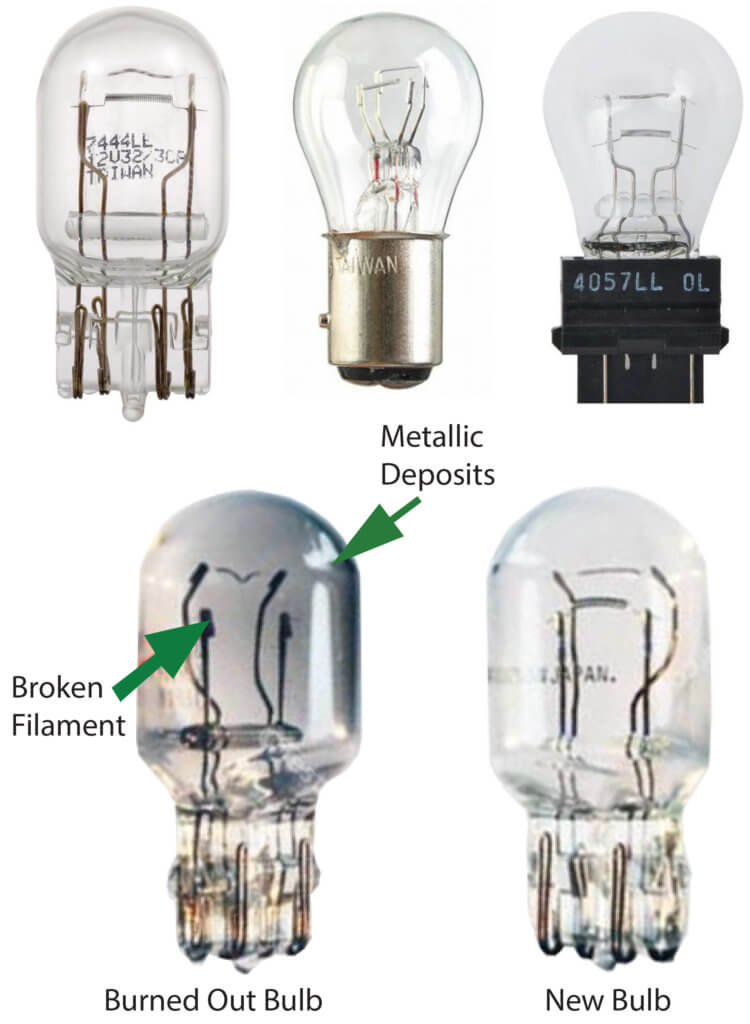
If the Bulbs Are Good, I Go Straight to the Fuse
Next stop is the fuse panel. Depending on the vehicle, the brake light fuse may live under the hood, under the dash, or both.
Here’s the key point: don’t just look at the fuse. Test it. A fuse can crack internally and still look fine.
Brake lights are usually “hot at all times,” meaning they have power even with the key off. That’s why you can step on the brake and light them up without the ignition on. If the fuse has power on one side but not the other, you’ve found your problem.
If the fuse is blown, replace it—but keep an eye on it. A fuse that blows again usually means a shorted socket or damaged wiring.
The Brake Light Switch: Simple Part, Big Role
If the bulbs and fuse check out, and you still have brake lights not working, the brake light switch is next on my list.
The switch lives on a bracket at the top of the brake pedal arm. When the pedal is released, the switch is either open or closed, depending on the design. Press the pedal, the switch changes state and sends the brake light signal.
On older, hardwired systems, the switch powers the lamps directly. On BCM-controlled systems, the switch just reports pedal movement to the module.
I back-probe the connector with a multimeter. I want to see the battery voltage at the switch, and I want to see it change when the pedal moves. If nothing changes, the switch is bad or misadjusted.
A failed brake light switch can also cause other symptoms, like a shifter that won’t come out of Park or cruise control that won’t engage—big clues when diagnosing brake light not working complaints.
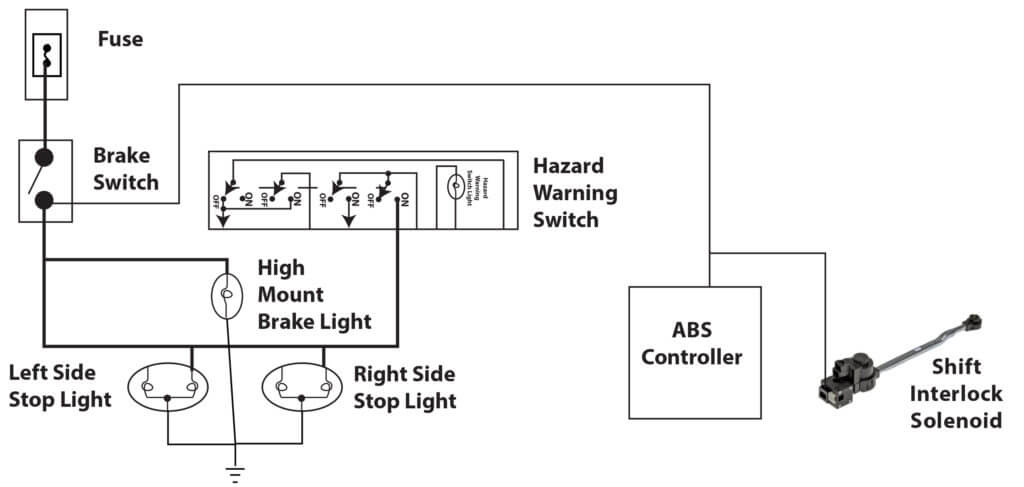
Common stop light wiring diagram
BCM-controlled brake lights
In a BCM setup, the brake light switch is an input that tells the BCM that you’re requesting brake lights. Carmakers use the BCM approach so they can operate the brake lights remotely, like with your key fob in a parking light to find your car.
Testing the Socket and Wiring the Right Way
If power is leaving the switch but the lights still aren’t coming on, it’s time to head to the back of the car.
With the bulbs removed and the brake pedal depressed, probe the terminals inside the socket. You should see battery voltage on at least one terminal. If you do, the problem may be a poor ground or corrosion in the socket.
If you don’t see voltage, you’re dealing with an open wire, damaged connector, or—on newer vehicles—a control module that isn’t commanding the lights on.
This is where methodical testing pays off. Guessing leads to wasted time and money
Final Thoughts From the Shop Floor
I’ve chased down hundreds of brake light failures, and the pattern is always the same. Most cases of brake lights not working come down to simple electrical issues—bulbs, fuses, or switches. The trick is resisting the urge to skip steps.
Start simple. Verify power and ground. Understand whether you’re dealing with a direct circuit or a BCM-controlled system. Do that, and diagnosing brake lights not working becomes a straightforward process instead of a guessing game.
Tail light bulb doesn’t work
©, 2019 Rick Muscoplat
Posted on by Rick Muscoplat