
Can You Clean an Air Filter? Here’s Why It’s a Bad Idea
Don’t Waste Time Trying to Clean Your Air Filter
As someone who’s worked on engines for decades, I’ve seen just about every quick-fix myth out there. One of the most common? The idea that you can clean an engine air filter and restore it to “like-new” condition.
Let me be blunt — you can’t. Sure, there are plenty of online tutorials showing how to clean an air filter by hitting it on the ground, using compressed air, or even washing it. But none of these methods actually restores the filter’s efficiency. In fact, most of them do the opposite — they damage the filter and make it easier for dirt to enter your engine.
If you’re wondering whether you can clean an air filter and save money, the honest answer is no — not without sacrificing protection. Let me explain why.
Why People Think Cleaning Works (and Why It Doesn’t)
Every DIY video and forum post will show you one of these four “methods” to clean an engine air filter:
1) Smacking the filter on a hard surface to knock out debris. Hitting the filter on the ground shakes out loose grit but does nothing for the deeply embedded particles. Worse, it can crack the filter frame or separate the seal.
2) Blowing it out with compressed air. Blowing air from the backside removes large particles but also spreads and weakens the fiber weave. The “cleaner” it looks, the worse it filters afterward.
3) Vacuuming the pleats. Even a powerful shop vac can only remove surface debris. The fine dust — the real enemy — stays embedded. Use too much suction and you’ll deform the pleats or rip fibers apart.
4) Washing it and letting it dry. Washing makes a filter look clean but ruins its fiber bonds. Once wet, cellulose or synthetic fibers lose stiffness, and even after drying, airflow performance is permanently reduced.
On the surface, these seem logical. If you can see dirt, removing it should improve airflow, right? Unfortunately, air filters don’t work that way. Modern paper and synthetic filters are engineered to trap and hold microscopic particles permanently — not to release them when you clean. Once those particles embed in the fibers, they stay there for good.
How Engine Air Filters Really Work
Understanding how filters trap dirt makes it clear why cleaning doesn’t help. A quality air filter has two distinct layers that work together:
The Fluff Layer – Capturing the Big Stuff
The outer layer, often called the “fluff,” captures large debris like sand, leaves, and bugs. This layer uses impingement — particles collide with fibers and stick due to surface adhesion. It’s similar to how dust clings to walls.
The Screen Layer – Trapping the Dangerous Particles
Underneath the fluff layer is the dense “screen” layer that captures microscopic dirt particles — the ones that cause real engine wear. As the filter collects dirt, those small openings begin to fill in, actually improving efficiency.
That’s right — a slightly dirty filter works better than a brand-new one. The tiny holes that once allowed fine dust through become partially blocked, creating a tighter mesh that traps even more.
When you clean an engine air filter, you destroy this structure. The embedded dust doesn’t come out — instead, air pressure or washing simply tears apart the fibers and opens up the holes, allowing more dirt into your intake system.
In other words:
• If you try to blow out the dirt with compressed air, you will remove the largest particles but also enlarge the pores of the filter. After the “cleaning,” the enlarged pores will actually let in more dirt. It won’t improve filtration efficiency, and it won’t bring efficiency back to when it was new
• If you vacuum the filter, you will remove the large particles, but not the smallest ones; they’re trapped in the screen layer. If the vacuum is strong enough, it will damage the screen layer and allow more dirt in.
• If you smack the filter on the ground, you will dislodge loosely held debris, but the shock won’t dislodge the trapped debris.
• If you wash the filter, you’ll weaken the bonds between the fibers and lower the fiber’s fluff ratio. That’ll reduce filtration efficiency.
So, cleaning an air filter doesn’t extend its life or improve filtration efficiency.
There’s really no scientifically valid way to visually determine the condition of a car’s air filter
Color is not an indication of air filter condition. Most air filters will turn grey in a very short time, but still maintain filtration efficiency.
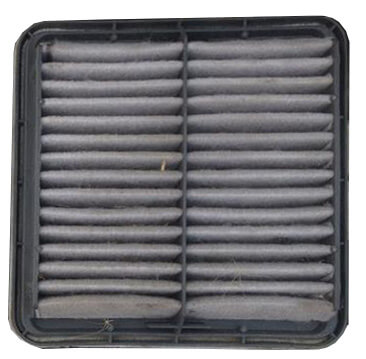
Dirty engine air filter
Some web articles will tell you to place a light behind the filter and judge what percentage of the light is blocked off by dirt in the filter. Airflow studies disprove this as a scientifically valid way to determine the filter’s condition.
Some web articles suggest checking how much debris is trapped deep in the air filter pleats. Airflow tests have also disproved this method.
In other words, you can’t judge an engine air filter’s condition visually, just like you can’t judge a furnace filter’s condition visually.
Analyzing short and long-term fuel trims can identify a dirty air filter
A dirty air filter restricts airflow. On a modern engine, the engine management system will detect the lower airflow and reduce fuel. If the airflow is restricted over a long period, it will show up as lower long-term fuel trims.
The bottom line: Don’t clean your engine air filter; replace it.
Carmakers list a mileage interval for air filter replacement, and the recommendation also includes an accelerated schedule if you drive in dusty locations. Follow it. Car air filters are cheap. Don’t waste your time trying to clean yours. Replace it.
©, 2023 Rick Muscoplat
Posted on by Rick Muscoplat