
Car Battery Tester Results Explained
Understanding Battery Test Results: What CCA, Internal Resistance, SOC, and SOH Mean
Quick Summary
When I test a car battery with a digital tester, I’m looking at three core things: state of charge, cranking ability (CCA), and internal resistance/conductance. A healthy battery will show strong Cold Cranking Amps (CCA), low internal resistance, and stable voltage under load. As a rule of thumb, internal resistance below 5 milliohms is excellent, 5–10 mΩ is acceptable, and anything higher usually means the battery is on borrowed time. For CCA, I expect the battery to deliver at least 80% of its rated CCA to be considered serviceable.
What Digital Battery Testers Actually Measure
Modern digital testers have replaced the old carbon pile
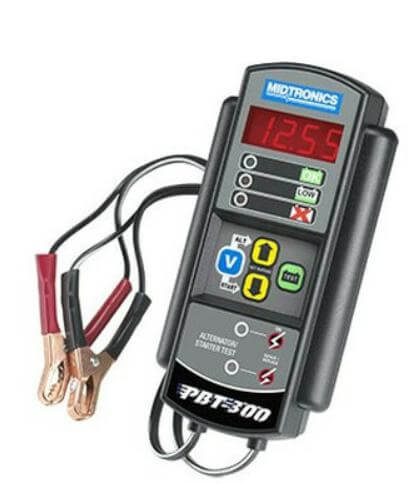
Digital Battery Tester
testers in most shops, and for good reason—they’re faster, safer, and far more informative. When I test a car battery, the tool is evaluating several parameters simultaneously:
1) Voltage (State of Charge): This tells me how “full” the battery is. A fully charged battery should read about 12.6–12.7 volts at rest.
2) Cold Cranking Amps (CCA): This tells me the battery’s ability to deliver cranking amps in cold conditions compared to the battery’s CCA rating when new.
3) Internal Resistance or Conductance: As batteries age, they develop internal resistance that’s an indicator of the battery’s internal condition. This is the real health indicator. It reflects how easily current flows inside the battery.
4) State of Health (SOH): A calculated value based on internal resistance and CCA performance.
What separates digital testers is that they don’t rely solely on brute-force loading. Instead, they use conductance testing, applying a small AC signal to measure the battery’s internal response.
What the Car Battery Test Results Mean
When you test a car battery, the numbers can be confusing if you don’t know what you’re looking at. Here’s how I interpret them in the shop:
Voltage Readings
12.6–12.7V: Fully charged, healthy
12.4V: About 75% charged
12.2V: Around 50% charged
Below 12.0V: Discharged or possibly damaged
Voltage alone doesn’t tell you battery health—it only indicates charge level. I’ve seen plenty of 12.6-volt batteries that couldn’t start an engine.
Cold Cranking Amps (CCA)
CCA is where the real story shows up. If a battery is rated at 600 CCA:
• 480 CCA or higher (80%): Acceptable
• 400–480 CCA: Marginal
• Below 400 CCA: Replace it
When I test a car battery, I always compare the measured CCA to the rating printed on the label. Anything under 80% is a red flag.
Internal Resistance (or Conductance)
This is the most overlooked but most important metric.
• Under 5 milliohms (mΩ): Excellent condition
• 5–10 mΩ: Acceptable but aging
• Above 10 mΩ: High resistance, likely sulfation or plate damage
Higher resistance means the battery can’t deliver current efficiently, even if the voltage looks good. That’s why a battery can “test good” on voltage but still fail under load.
How Digital Testers Conduct a Load Test
Unlike the old-school carbon pile tester, a digital tester performs a simulated load test. Here’s what’s happening behind the scenes when you test a car battery:
• The tester injects a small AC signal into the battery.
• It measures how the battery responds electrically.
• Using algorithms, it calculates available CCA and internal resistance.
• Some advanced testers also simulate starter draw conditions.
This method is fast and doesn’t overheat or stress the battery as a traditional load test does. However, I still occasionally use a carbon pile tester to verify borderline results.
Acceptable Results When You Test a Car Battery
When I evaluate a battery, I don’t rely on just one number. I look at the whole picture:
• Voltage: Above 12.4V before testing
• CCA: At least 80% of the rated value
• Internal Resistance: Preferably under 8 mΩ
• Load Voltage Drop: Should not fall below 9.6V during a heavy load test (classic benchmark)
If a battery passes all those criteria, I’m comfortable calling it good. If it fails one or more, I start planning for replacement.
Common Mistakes When Testing a Battery
Even experienced techs can get tripped up when they test a car battery. Here are the mistakes I see most often:
• Testing immediately after charging (surface charge skews results)
• Ignoring temperature (cold batteries show lower voltage)
• Not entering the correct battery type (AGM vs flooded matters)
• Judging by voltage alone
I always remove surface charge by turning on the headlights for a minute before testing—it makes a noticeable difference in accuracy.
AGM vs Flooded Batteries: Why It Matters
When you test a car battery, you must select the correct battery type on the tester. AGM batteries behave differently:
• Lower internal resistance than flooded batteries
• Higher CCA for the same size
• Different charging and testing parameters
If you test an AGM battery using flooded settings, you’ll get misleading results—usually a false “bad battery” reading.
When to Replace a Battery Based on Test Results
From years in the shop, here’s my rule:
• Replace if CCA is below 70–75% of the rating
• Replace if the internal resistance is consistently high
• Replace if the voltage drops excessively under load
• Replace if the tester flags “BAD CELL” or “REPLACE.”
A battery might still start the car today, but if it fails these tests, it won’t survive the next cold snap.
©, 2022 Rick Muscoplat
Posted on by Rick Muscoplat