
Why Your Car Shakes When Braking
How to Fix Brake Pulsation Permanently
Quick Summary
When your car shakes when braking, the root cause is almost always disc thickness variation (DTV)—not warped rotors. The DTV is caused by lateral runout, meaning the rotor isn’t sitting perfectly flat against the hub. When the rotor is out-of-parallel with the wheel hub or steering knuckle by as little as 0.003″, it causes the rotor to rotate in a wobble. That creates uneven brake pad contact, leading to vibration, steering wheel shake, and brake pedal pulsation.
DTV and brake pedal pulsation is the first topic covered in all professional brake seminars because the problem is so commonly misdiagnosed as brake warp. Brake rotors rarely, if ever, warp because the majority of street vehicles can’t produce the kind of heat needed to warp cast iron. In fact, brake pads would burn up and the rotors turned blue, long before rotor temperature reached the temperature required to warp.
The problem isn’t caused by rotor warp; instead, it’s caused by lateral runout and DTV. So let’s concentrate on what causes lateral runout:
Poor installation practices
1) Not cleaning rust off the wheel hub during a brake job (#1 cause)—Keep in mind that most carmakers list a maximum lateral runout of 0.003″. Leaving uneven rust deposits on the hub can easily exceed those limits and cause the rotor to rotate in a wobbly pattern.
2) Improper lug nut torque — Uneven lug nut torquing can also cause the rotor to be out of parallel with the hub or knuckle
3) Bent wheel hub — Curb impacts can bend the wheel hub enough to cause lateral run-out. If you don’t measure with a dial indicator, you’ll get car shaking with every new rotor you place on that hub.
4) Worn wheel bearing — Any wheel hub tilt from a worn bearing will cause the rotor to rotate in a wobbly pattern. ,
What’s really happening is something far more subtle—and far more common.
The Real Cause: Disc Thickness Variation (DTV)
When your car shakes when braking, you’re feeling thickness differences in the rotor, not warping.
Here’s how it works in the real world:
• The rotor doesn’t sit perfectly flat on the hub (lateral runout)
• As it spins, it wobbles slightly
• One side of the rotor contacts the pad more than the other
• That creates uneven wear or pad deposits
• Now the rotor has thick and thin spots (DTV)
• Every time the brakes are applied, you feel that variation as pulsation
It doesn’t take much. I’ve measured as little as 0.003 inches of runout, causing a noticeable shake.
If you simply replace the rotors without fixing the root cause, the problem will return in about 2,000-3,000 miles.
The Most Common Reasons Your Car Vibrates When Braking
1. Rust on the Wheel Hub (The #1 Cause)
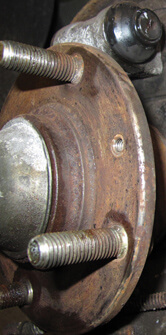
Corrosion on the wheel hub causes lateral runout
If you don’t clean the hub surface to a perfectly smooth finish before installing a rotor, corrosion can create a high spot. That prevents the rotor from sitting flat, which leads directly to lateral runout.
Even a thin layer of rust can cause your car to vibrate when braking.
2. Not using a torque wrench to tighten lug nuts is the #2 cause of lateral runout— I can’t stress this enough: using an impact gun without torque sticks or hand tightening with a torque wrench is a recipe for brake pulsation.
When lug nuts are unevenly tightened:
• The rotor gets pulled unevenly against the hub
• It “cocks” slightly
• That creates runout
This is one of the fastest ways to guarantee your car shakes when braking after new brakes.
3. The wheel hub has lateral runout— It’s pretty rare, but you can distort the wheel hub by hitting a curb or a huge pothole. If you’ve removed all the rust, used a torque wrench, and installed new rotors, and your car still shakes when braking, it’s either lateral runout on the wheel hub or a worn wheel bearing. There aren’t any other possibilities.
4. Cheap Brake Rotors — Not all rotors are created equal. Lower-cost rotors tend to be:
• Thinner
• Lighter
• Poorly balanced
• Equipped with inferior cooling vanes
That poor heat management leads to uneven pad deposits, which contribute to DTV and vibration.

See the difference between economy brake rotors and OE quality brake rotors.
4. Dirty New Rotors — This one surprises people. New rotors often come coated with oil or contain machining debris. If you don’t wash them with hot, soapy water:
• Metal particles are embedded in the pads
• Pads wear unevenly
• You get pulsation
Brake cleaner alone doesn’t remove the metallic debris, but hot soapy water does.
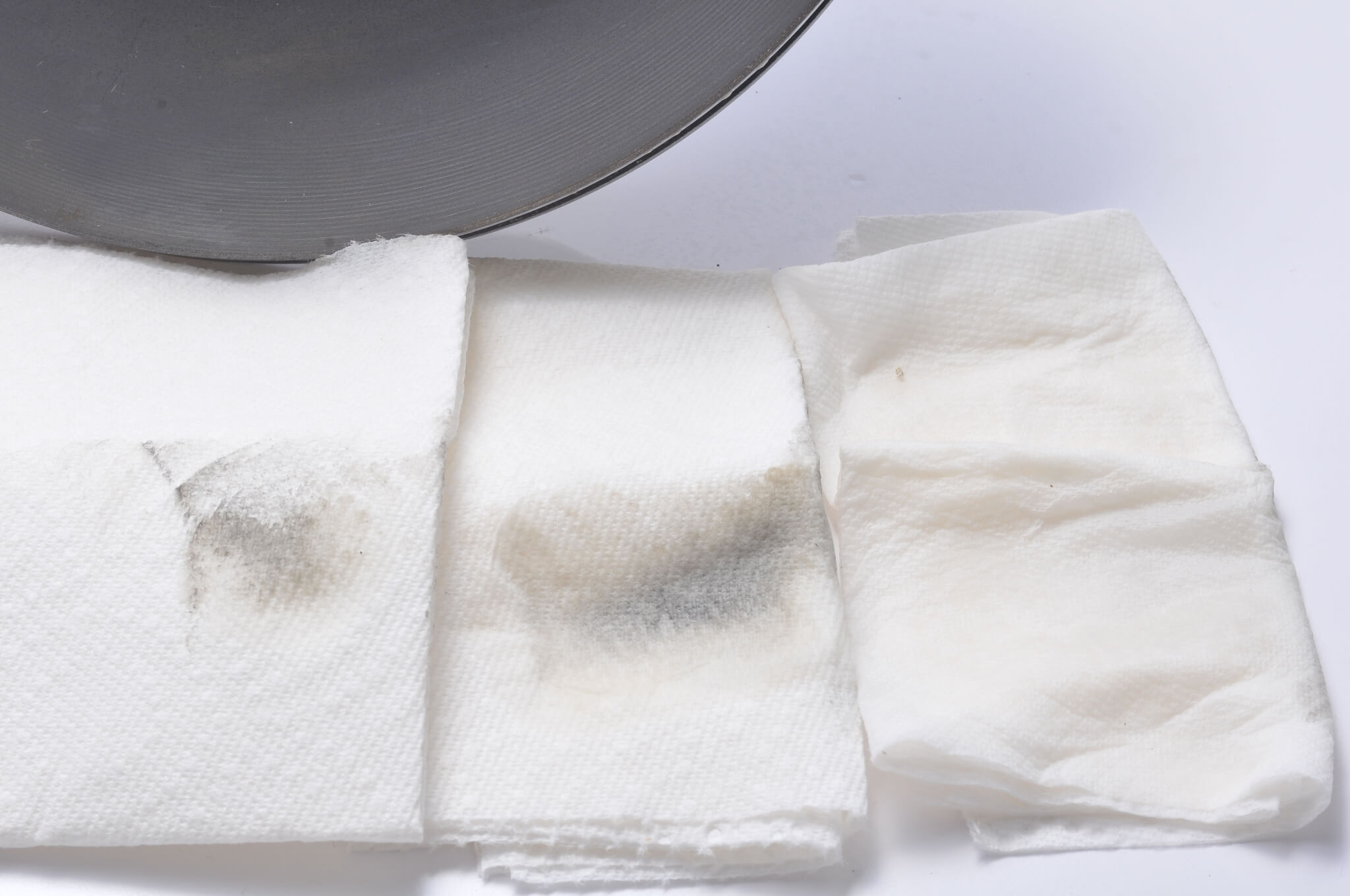
I cleaned this rotor with brake cleaner. Then I went back and cleaned them again with hot soapy water. Here’s how much metallic debris was wiped off the rotors after washing.
5. Sticking Caliper Hardware —
If the caliper pins or pad slides aren’t cleaned and lubricated:
• Pads don’t retract properly
• One pad drags
• Heat builds up
• Material transfers unevenly
That’s another reason why your car shakes when braking.
6. Improper Brake Pad Bedding — Skipping the bedding process is a big mistake.
Without proper bedding:
• Pads don’t transfer material evenly to the rotor
• Hot spots develop
• Pulsation follows
7. Less Common Causes — If everything else checks out, I look at:
• Bent wheel hub
• Worn wheel bearing
• Suspension issues (tie rods, control arms)
But these are far less common than installation-related issues.
How I Fix It So It Doesn’t Come Back
When I fix a car that shakes when braking, I don’t just slap on new parts. I eliminate the root cause.
Here’s my proven approach:
1. Clean the Hub Properly
2. Use a wire brush or abrasive disc
3. Get the surface perfectly flat and rust-free
4. Measure Runout
5. Use a dial indicator
6. Correct it before installing pads
7. Torque Lug Nuts Correctly
8. Always use a torque wrench
9. Follow manufacturer specs in a star pattern
10. Use Quality Rotors and Pads
11. OE or premium aftermarket only
12. Avoid bargain-bin parts
13. Wash New Rotors with hot water + soap
14. Dry completely before installation
15. Service Caliper Hardware
16. Clean and lubricate slide pins
17. Use synthetic brake grease, not anti-seize
Perform Proper Pad Bedding
Typical process:
1. Multiple moderate stops from 30–40 mph
2. Allow cooling between stops
3. Avoid aggressive braking initially
The Bottom Line
If your car shakes when braking, don’t fall for the “warped rotor” myth. What you’re really dealing with is disc thickness variation caused by lateral runout.
And in my experience, that almost always traces back to installation errors, poor prep, or cheap parts—not defective rotors.
Fix it the right way once, and you won’t be chasing the problem again in a few thousand miles.
© 2012 Rick Muscoplat
Posted on by Rick Muscoplat