
Car Won’t Start With a Jump — Most common causes
Why Your Car Won’t Start With a Jump Even With Cables Connected
Quick Summary
In most cases, the issue comes down to 1. poor jumper-cable connections, 2. not waiting long enough for a dead battery to absorb charge, 3. corroded battery terminals, 4. cheap jumper cables that can’t carry enough current, or 5. a battery with an internal failure. A jump start is not magic; it only works when current can flow freely and in sufficient volume.
Article
Getting the Terminology Right Before We Dive In
Before I explain why a car won’t start with a jump, I want to make sure we’re talking about the same failure. In this article, I’m referring to a situation where the engine does not crank at normal speed—or doesn’t crank at all—despite being connected to another vehicle or jump pack. If your engine cranks strongly but won’t fire and run, that’s a different diagnostic path involving fuel, spark, or air, and I’ll address it later.
Most people assume that if jumper cables are connected, the starter should spin. In reality, jump-starting is a controlled transfer of extremely high current, and even small mistakes can stop that transfer cold.
Why a Bad Clamp Connection Is the #1 Reason Your Car Won’t Start With a Jump
The most common reason I see a car won’t start with a jump is surprisingly simple: bad clamp placement. Modern engines are wrapped in plastic—plastic engine covers, plastic intake manifolds, painted brackets, and coated fasteners. None of those conducts electricity well, if at all.
When I jump-start a vehicle, I always connect the negative clamp to bare metal, preferably on the engine block or a heavy cast bracket. You’re trying to deliver more than 100 A, and that requires metal-to-metal contact. If the clamp is biting into paint, aluminum oxide, or plastic, the current never reaches the starter.
I always wiggle the clamps after connecting them. If they don’t dig in and feel solid, I fix that before even thinking about turning the key. A poor ground connection alone can explain why your car won’t start with a jump, even though everything appears to be connected correctly.
Why You Must Wait Before Cranking the Engine
Another mistake I see constantly is impatience. People connect the jumper cables and immediately try to start the dead vehicle. When that happens, the donor vehicle’s power goes straight into charging the dead battery—not directly to the starter.
That’s why I always wait five to ten minutes before attempting to crank. Allowing the discharged battery to absorb a small surface charge raises its voltage enough to support the starter motor. Skipping this step is a classic reason a car won’t start with a jump, especially in cold weather.
Cold batteries have higher internal resistance and require more time to accept a charge. Waiting isn’t optional—it’s part of the process.
How Corroded or Loose Battery Terminals Sabotage Jump Starts
Even with perfect jumper cable placement, corroded or loose battery terminals can prevent current from flowing. Corrosion adds resistance, and resistance is the enemy of starter motors. I’ve seen terminals that looked “good enough” but dropped so much voltage under load that the starter never stood a chance.
This is another scenario where people swear the jump start “should” have worked, yet the car won’t start with a jump because the electricity can’t get past the battery posts. Voltage drop at the terminals is invisible unless you test for it, which is why cleaning and tightening connections solves so many no-start complaints.
Why Cheap Jumper Cables Often Don’t Work
Not all jumper cables are created equal. One of the most overlooked reasons a car won’t start with a jump is the quality of the cable. Thin, inexpensive cables have high internal resistance. That resistance causes voltage drop, which m
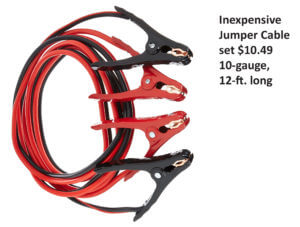
Here’s a set of inexpensive jumper cables—$10.49. Now scroll down to the chart and see what voltage they deliver to the dead vehicle.
eans the starter never receives enough current to turn.
Wire gauge matters. So does cable length. Longer cables increase resistance, and aluminum conductors have higher resistance than copper. I’ve tested cheap cables that could barely deliver half the current required to crank an engine, even when connected perfectly.
When someone tells me, “I tried jumping it, and nothing happened,” one of my first questions is, “How heavy were the cables?”
When a Battery Has an Internal Short, a Jump Will Never Work
Sometimes the problem isn’t technique or equipment—it’s the battery itself. Old batteries shed lead plate material internally. When that debris accumulates enough to contact the plates, it can cause an internal short.
In that condition, no amount of jump-starting will help. The dead battery acts like a massive electrical sponge, draining power from the donor vehicle faster than it can be supplied. In those cases, the car won’t start with a jump, no matter how long you wait or how good your cables are.
This is one of the few situations where replacing the battery is the only solution.
What If the Engine Cranks With a Jump but Won’t Fire?
If your engine cranks normally with a jump but won’t start and run, the problem isn’t why your car won’t start with a leap—it’s why it won’t combust. In cold weather, worn spark plugs are a major culprit. Plugs that work fine in summer often produce a spark that is too weak when temperatures drop.
Flooding is another issue. Repeated cold-start attempts can dump excess fuel into the cylinders. Holding the accelerator to the floor while cranking activates clear-flood mode on most vehicles, allowing additional air to help the engine start.
Fuel volatility can also matter. Summer gasoline doesn’t vaporize well in winter. If your tank is full of old fuel, the engine may crank endlessly without firing, even though the jump start itself worked.
The Bottom Line on Why Your Car Won’t Start With a Jump
When a car won’t start with a jump, the cause is almost always a current-delivery problem, not bad luck. Jump-starting only works when connections are solid, cables are capable, charging time is allowed, and the battery itself is electrically sound.
Understanding that turns a frustrating roadside moment into a logical diagnostic process—and helps you fix the problem rather than guess.
©, 2020 Rick Muscoplat
Posted on by Rick Muscoplat