
CARB Converter or FED Converter?
![]() CARB converter vs Federal Converter: What You Really Need to Know
CARB converter vs Federal Converter: What You Really Need to Know
Quick Summary
A California Air Resources Board CARB converter is legally required in certain states and must have a vehicle-specific Executive Order number, while a FED converter only meets minimum federal emissions standards. The difference between a CARB versus Federal catalytic converter isn’t cosmetic—it’s about catalyst loading, testing, durability, warranty, and legality. Install the wrong one in the wrong state, and you’re setting yourself up for a failed inspection, a check engine light, or both.
Article
CARB Catalytic Converter vs. FED Converter: What You Must Know
As a professional automotive technician, I receive more questions about catalytic converters than about almost any other exhaust component. The reason is simple: the rules aren’t intuitive and vary by your vehicle’s registration state. The debate over CARB versus Federal catalytic converter requirements usually starts when someone gets hit with a high replacement quote and wonders why a cheaper FED converter won’t do the job.
Let me walk you through this the same way I explain it in the shop—plain language, no fluff, and no myths.
FED vs CARB Certification: It Starts at the Factory
Every vehicle sold in the U.S. leaves the factory with one of two emissions certifications: Federal or California. You can confirm this by looking at the Vehicle Emissions Control Information (VECI) label under the hood. That label determines whether the vehicle was originally designed to run a CARB converter or a FED converter.
Once the replacement is needed, the law requires you to maintain the same emissions compliance level the car was certified to. That’s where the CARB versus Federal catalytic converter issue becomes critical.
The Real Physical Difference Between CARB and a FED Converter
Here’s what surprises most people: from the outside, they often look identical. Same shell. Same pipe diameters. Same mounting points.
The difference is hidden inside.
A FED converter meets minimum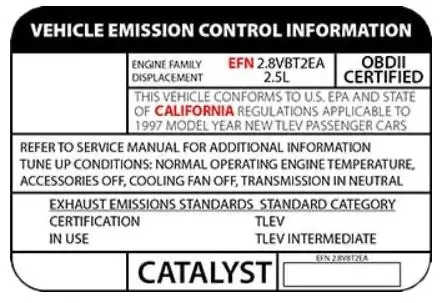 federal standards for catalyst loading and emissions reduction. It’s designed to pass emissions tests on federally certified vehicles, but only for a shorter durability window.
A CARB converter, on the other hand, contains a higher loading of precious metals and must pass rigorous third-party testing approved by the California Air Resources Board. Each approved CARB unit receives an Executive Order (EO) number tied to specific vehicles and engine families. That extra catalyst material is why a CARB converter costs more—and why it performs more consistently over time.
This internal difference is the heart of the CARB versus Federal catalytic converter debate.
What is a Catalytic Converter and what does it do?
Can You Swap Them?
This is where I have to be blunt.
If your vehicle is registered in a CARB state, installing a FED converter is illegal. Period. It doesn’t matter if the car runs fine. It doesn’t matter if the check engine light stays off. Without a valid EO number, that FED converter will fail inspection and can expose you to fines.
In non-CARB states, you can legally install a FED converter, even on a vehicle originally certified for California emissions. However, based on experience, I don’t recommend it. I’ve seen plenty of vehicles throw catalyst efficiency codes after installing a FED converter in a vehicle designed for a CARB converter.
That’s why, when customers ask me about CARB versus Federal catalytic converter choices, my answer is almost always the same: if the car came with a CARB converter, stick with one.
Where a CARB Converter Is Legally Required
This isn’t just a California issue anymore. Several states have adopted California emissions standards, so a CARB converter is required for a legal replacement.
As of now, these states also require a CARB certified converter
California
Colorado
New York
Maine
Other states periodically consider adopting the same rules, so this list can grow. If your vehicle is registered in any of these states, a FED converter is not an option. The CARB versus Federal catalytic converter decision is already made for you by law.
What Happens If You Move Between States?
This is one of the most common real-world scenarios I see.
If you move from a CARB state to a federal state and later replace the converter with a FED converter, the car may run fine—until you move back or sell it in a CARB state. At that point, the FED converter becomes a liability.
On the flip side, if you install a CARB converter in a federal state, you’re legal everywhere. That’s why I tell people to think long-term when choosing between a CARB versus a Federal catalytic converter. The upfront savings of an FED converter can evaporate fast.
Warranty Differences: Another Overlooked Factor
Federal law requires only that a FED converter carry a 2-year/25,000-mile warranty. CARB rules require a CARB unit to be warranted for 5 years or 50,000 miles.
Some manufacturers voluntarily extend warranties on FED converters, but CARB’s legal requirements are stricter. That longer warranty is another reason the CARB versus Federal catalytic converter price gap exists—and another reason I often recommend the CARB option when possible.
My Professional Take on CARB vs FED Converters
They’re designed for different regulatory environments. The problem starts when people ignore the legal and technical differences between a CARB versus Federal catalytic converter.
If your vehicle requires a CARB unit, don’t fight it—install the correct part once and be done with it. It avoids inspection failures, check-engine lights, and costly rework. In emissions work, “close enough” is never good enough
©, 2025 Rick Muscoplat
Posted on by Rick Muscoplat