
Why Catalytic Converters Fail
The Most Common Catalytic Converter Failure Causes
Quick Summary
When people ask me about the causes of catalytic converter failure, they often assume the converter simply wore out. In reality, that’s rarely the case. After decades of diagnosing check engine lights and emissions problems, I’ve found that most catalytic converters don’t fail on their own—they’re damaged by other engine, fuel, ignition, or exhaust system problems. If you replace a converter without fixing the root cause, the new converter can fail just as quickly as the original. Understanding why catalytic converters fail is the key to preventing expensive repeat repairs and avoiding recurring P0420 and P0430 trouble codes.
Why Catalytic Converters Fail: The Converter Is Usually the Victim
One of the biggest mistakes I see is replacing a catalytic converter simply because a scan tool displays a P0420 or P0430 code. Those codes indicate that the engine computer believes converter efficiency has dropped below an acceptable threshold, but they don’t necessarily prove the converter itself is defective.
In many cases, the converter is simply reacting to an upstream problem. Excess fuel, engine oil, and coolant contamination, misfires, vacuum leaks, sensor failures, and exhaust leaks can all damage the converter’s internal substrate and precious-metal coating.
That’s why I always tell vehicle owners that a catalytic converter doesn’t usually commit suicide—it gets murdered by another component.
Excessive Fuel Is One of the leading causes of catalytic converter failure
If I had to pick the most common reason for catalytic converter failure, it would be excess fuel entering the exhaust stream.
Catalytic converters are designed to process small fluctuations in the air-fuel mixture. However, when an engine runs excessively rich, the converter is forced to burn far more fuel than it was designed to handle.
Common causes include:
- Leaking fuel injectors
- Failed oxygen sensors
- Excessive fuel pressure
- Faulty mass airflow sensors
- Engine misfires
- Ignition system failures
- Incorrect spark plugs
- Faulty engine temperature sensors
As unburned fuel reaches the converter, it ignites inside the substrate. Temperatures can quickly exceed 1,600°F, causing the ceramic honeycomb structure to melt and collapse.
Once that happens, exhaust flow becomes restricted, engine performance suffers, and converter efficiency drops dramatically.
Engine Misfires Can Destroy a Converter in a Short Time
Whenever I see a flashing check engine light, I immediately become concerned about damage to the catalytic converter.
A misfiring cylinder sends raw fuel directly into the exhaust system. The converter must burn that fuel internally, generating extreme heat.
I’ve seen converters destroyed in less than an hour when drivers continued operating vehicles with severe ignition misfires.
Common misfire causes include:
- Worn spark plugs
- Failed ignition coils
- Damaged spark plug wires
- Injector problems
- Low compression
- Vacuum leaks
If your check engine light flashes while driving, stop driving and repair the misfire immediately. Ignoring it can turn a relatively inexpensive repair into a $1,500 to $3,000 converter replacement.
Oil Consumption Is a Hidden Cause of Catalytic Converter Failure
Another major reason why catalytic converters fail is oil contamination.
When an engine burns oil, phosphorus, zinc, and other additives from the motor oil coat the catalyst surface. Over time, this contamination prevents the precious metals from doing their job.
Common oil-burning causes include:
- Worn piston rings
- Worn cylinder walls
- Failed valve stem seals
- Worn valve guides
- Turbocharger seal failures
Unlike heat damage, contamination damage is usually permanent. Once the catalyst coating becomes poisoned, converter efficiency declines, and the converter often must be replaced.
Coolant Leaks Can Poison the Converter
A leaking head gasket can cause serious converter damage. When coolant enters the combustion chamber, the glycol and silicate additives leave deposits throughout the exhaust system. These contaminants coat both oxygen sensors and the catalytic converter.
Typical warning signs include:
- White exhaust smoke
- Unexplained coolant loss
- Engine overheating
- Sweet smell from the exhaust
- Repeated P0420 or P0430 codes
In these situations, replacing the converter before repairing the head gasket simply wastes money.
Physical Damage Is More Common Than Most Drivers Realize
Not all catalytic converter failures are caused by engine problems. I’ve inspected numerous vehicles where the converter was physically damaged by road debris, parking barriers, speed bumps, or off-road obstacles.
Physical damage can cause:
- Cracked substrates
- Broken ceramic bricks
- Internal rattling noises
- Restricted exhaust flow
- Loss of catalyst efficiency
A quick tap with a rubber mallet often reveals a loose substrate. If you hear rattling inside the converter, internal damage is likely present.
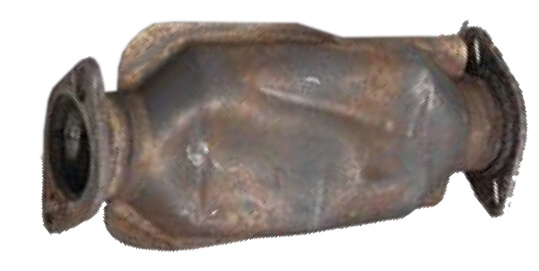
Thermal Shock Can Crack the Converter Internally
One catalytic converter failure cause that many people never consider is thermal shock. Imagine taking a hot glass baking dish and placing it in cold water. Rapid temperature changes can crack the glass.
The same thing can happen inside a catalytic converter.
When an overheated converter suddenly encounters cold water from a deep puddle or flooded roadway, the ceramic substrate can fracture.
The damage may not be visible externally, but efficiency can drop significantly.
Exhaust Leaks and Air Leaks Can Trigger Converter Codes
Not every P0420 or P0430 means the converter is bad. I’ve diagnosed many vehicles where the real problem was an exhaust leak ahead of the converter or oxygen sensors.
Leaks can introduce extra oxygen into the exhaust stream and cause the engine computer to believe the converter is no longer functioning properly.
Likewise, intake manifold leaks and vacuum leaks can alter fuel trim values and create operating conditions that eventually overheat the converter.
Silicone Contamination Can Poison a Catalytic Converter
This is one of the most overlooked causes of catalytic converter failure. Many silicone sealants release vapors when exposed to high exhaust temperatures. Those vapors can contaminate oxygen sensors and catalyst coatings.
I always use sensor-safe RTV products whenever working near engine or exhaust components.
Using the wrong sealant can create a converter problem that takes months to reveal itself.
Rust and Corrosion Can Lead to Converter Failure
In northern states like Minnesota, corrosion plays a major role in exhaust system failures.
Rust can:
- Damage converter heat shields
- Weaken support brackets
- Increase exhaust vibration
- Crack welds
- Allow converter movement
Excessive vibration can eventually fracture the ceramic substrate inside the converter.

A rusted-out catalytic converter bracket
Overheating—Look for the telltale signs of metal overheating: blue-to-purple coloring. Here’s what the colors indicate:
Brown 750ºF
Purple Brown 800ºF
Dark Purple 850ºF
Blue 1000ºF
Dark Blue 1100ºF
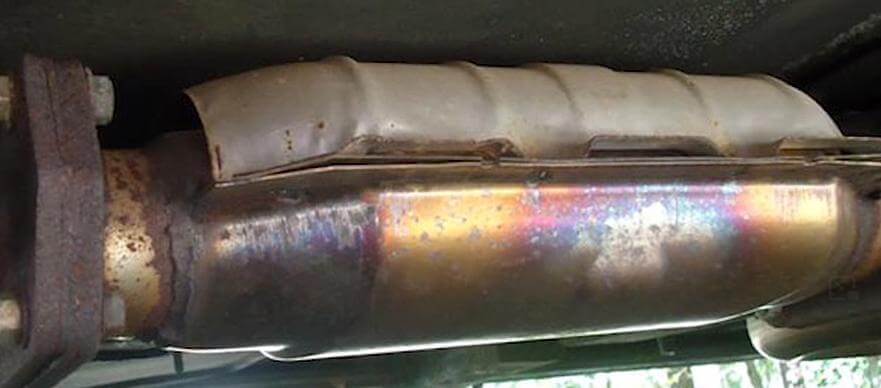
Overheated catalytic converter viewed from the outside
Flex pipe failures— Allow unmetered air to enter the converter.
If I tap on the converter with a rubber mallet and hear rattling, I know the ceramic brick has loosened—a clear sign of what causes a P0420 in these cases.
Diagnosing What Causes a Catalytic Converter Failure: My Testing Methods
Understanding P0420 Code Triggers
The P0420 code (Catalyst System Efficiency Below Threshold – Bank 1) stores when the PCM detects a failed converter. However, what causes a P0420 isn’t always converter failure. I’ve seen this code triggered by:
• Intake manifold air leaks cause the upstream oxygen sensor to report a lean condition. The ECM responds by adding more fuel, which causes the catalytic converter to overheat.
• Leaking fuel injectors cause too much fuel to enter the converter, causing overheating
• Incorrect spark plugs cause misfires that result in too much fuel entering the catalytic converter
• Ignition timing issues
• EGR problems
• Oil or antifreeze in the exhaust stream
• Oxygen sensor problems
• Road damage to the converter
• Exhaust contamination from silicone products
My Three-Step Testing Approach for Catalytic Converter Problems
When diagnosing P0420 causes, I use three primary tests:
1. Vacuum Test: I connect a vacuum gauge to the intake manifold and note the idle reading. Then I raise the engine speed to 3,000 RPM. If the vacuum reading drops and remains low, I suspect exhaust backpressure due to catalytic converter problems.
2. Backpressure Test: I remove the oxygen sensor and measure pressure at its port. Readings over 1.25 psi at idle or 3 psi at 2,000 RPM indicate exhaust restrictions—a key indicator of what causes a P0420.
3. Temperature Test: I compare inlet to outlet temperatures, though modern, efficient engines may show only a 50°F difference instead of the traditional 100°F rule.
Using Fuel Trims to Identify P0420 Causes
Reading the Signs of Catalytic Converter Problems
Fuel trims tell me what’s going on in the engine. The ECM uses fuel trim to maintain the ideal 14.7:1 air/fuel ratio. Three-way converters require the mixture to constantly cycle between rich and lean for maximum efficiency.
Rich conditions (negative fuel trim) indicate possible P0420 causes like:
• MAF sensor problems
• High fuel pressure
• Leaking fuel injectors
• Defective oxygen sensors
• Exhaust leaks before the O2 sensor
Lean conditions (positive fuel trim) suggest catalytic converter problems from:
• Clogged catalytic converter
• Vacuum leaks
• Dirty fuel injectors
• Insufficient fuel delivery
The Vacuum Leak Test That Reveals P0420 Causes
When I suspect a vacuum leak as one of the P0420 causes, I observe fuel trims at idle, then increase engine speed to 2,500 RPM. If short-term fuel trim immediately decreases to acceptable levels and long-term fuel trim starts dropping, I’ve found my leak.
Preventing Catalytic Converter Problems: Proper Break-In Procedures
Why New Converters Fail: The Break-In Factor
Many catalytic converter problems stem from improper break-in procedures. A new converter has unexpanded matting that secures the ceramic substrate. If you install a new converter and immediately drive off after installation, the matting may not expand properly, leading to substrate loosening and causing a P0420 down the road.
Here’s The Recommended Way to Break in a New Catalytic Converter:
1) Start the engine without revving
2) Allow 5 minutes of idle time for gradual warm-up
3) Smoothly increase to 2,500 RPM and hold for 2 minutes
4) Return to idle and shut off the engine
5) Allow complete cool-down to ambient temperature
6) Road test to confirm proper operation
This controlled heating promotes proper matting expansion, preventing future catalytic converter problems.
My Final Word on P0420 Causes and Catalytic Converter Problems
After years of diagnosing P0420 causes, I can tell you that the converter is rarely the true culprit. Before recommending an expensive converter replacement, I always investigate what causes a P0420 by checking upstream components, fuel trims, and system pressures.
Remember: catalytic converter problems are usually symptoms, not causes. Find the root issue, fix it properly, and your converter will likely last for years. Skip this step, and you’ll see the same P0420 causes destroy your expensive replacement converter.
The key to avoiding repeat catalytic converter problems is thorough diagnosis. Don’t let anyone sell you a converter without first proving what causes a P0420 in your specific case. Your wallet will thank you.
Posted on by Rick Muscoplat