
Change Oil Based On Time versus Mileage — Why Time Matters
Why do carmakers want you to change oil on a time versus mileage schedule?
Drivers are often confused about why carmakers want you to change oil on a time versus mileage schedule. Why does time matter? It’s not like motor oil spoils. Or does it? There is a reason behind the recommendation to change oil on time versus mileage, whichever comes first. Understanding the nuances of each approach can help you make informed decisions, ensure your engine runs smoothly, and potentially save you from costly repairs.
Motor oil doesn’t degrade in the bottle, but it does degrade in your engine over time
Oil companies say that fresh oil in the bottle has a five-year shelf life. It’s not so much that the oil goes bad as much as the fact that during the five years, oil specs often change and there are better motor oils on the market during that time period.
However, once you put oil in an engine, the clock does start ticking. Here’s why:
Let’s take a typical carmaker’s recommendation to change oil every 5,000 miles or six months, whichever comes first. Carmakers know that average drivers put on 10,000 to 15,000 miles per year and they take that into account when recommending oil changes. If you’re not reaching the 5,000-mile mark within six months, it means you’re not an average driver, and you’re most likely taking short trips. Short trips of less than 5 miles in summer or 10 miles in winter degrade the oil’s protective additives faster than driving longer trips.
That’s why carmakers recommend that you change oil based on time versus mileage, to ensure the oil still contains all the additives needed to protect your engine. Here’s what happens to your oil if you drive less than 5,000 miles in a six-month period.
• Short trips cause acid, soot, and sludge formation in your oil— All engines create blow-by gasses that escape past the piston rings and enter the crankcase. Blow-by gasses contain fuel, water, exhaust gasses, and soot. If you drive short trips, the oil never gets hot enough to evaporate the water and fuel from the oil, and the doesn’t circulate long enough to filter out the soot. So those contaminates stay in the oil and form Formic and Nitric acids and sludge.
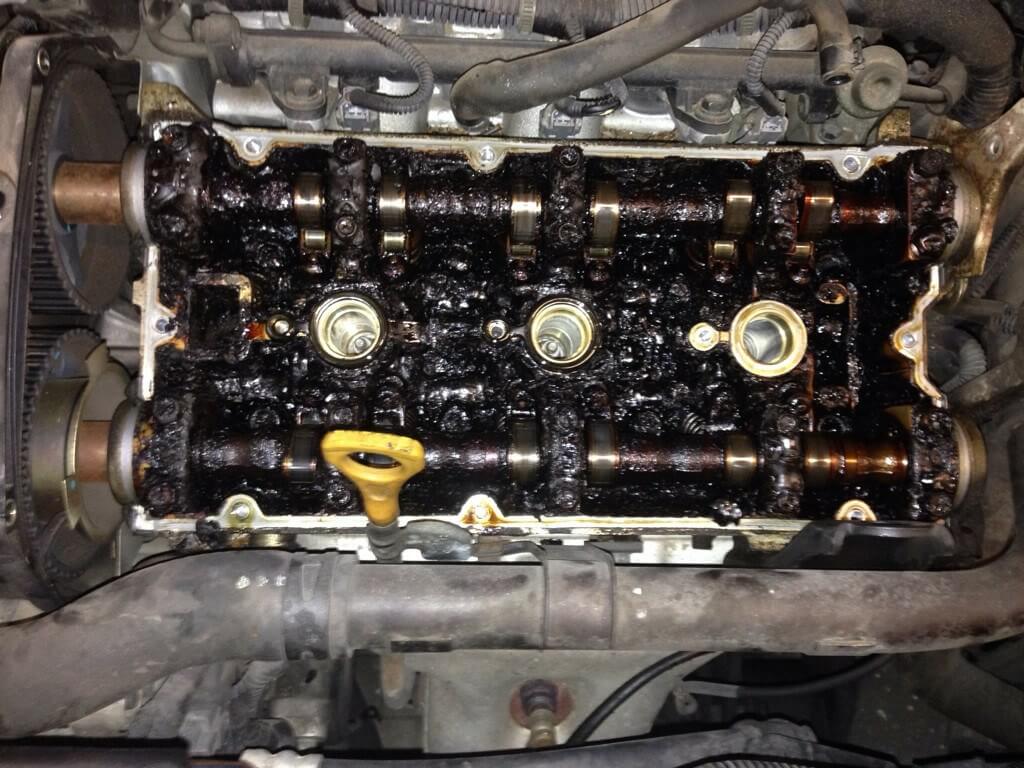
Example of sludge buildup when you don’t change your oil on time. (PHOTO reddit.com/r/Justrolledintotheshop/)
• The contaminated oil degrades the oil additives— When you start the engine, it circulates the contaminated oil throughout the engine, causing corrosion. That degrades the anti-corrosion and the pH-balancing additives in the oil more rapidly. In addition, engine heat and oxygen exposure causes the oil additives to oxidize and degrade. The longer the engine sits with a partially or fully degraded additive package, the more the engine is exposed to corrosion and further oil degradation.
In other words, even if you don’t drive much, you’ve still exposed the oil to heat, acids, and oxygen, and started the degradation process. After sitting in the crankcase for six months, your oil has lost a significant portion of its protective additives.
That’s why carmakers want you to change oil based on time versus mileage.
Understanding oil specifications: What the numbers mean. See this post for more information.
In addition, most owners don’t follow the proper oil change schedule
Most owners follow oil change intervals based on “Normal” driving conditions. However, studies show that the vast majority of drives operate their vehicles under the conditions listed in the “Severe Service” section of their owner’s manual.
What are Normal driving conditions?
• You check your oil level regularly and top off when needed
• You do predominately highway driving with occasion short trips
• You keep your engine tuned and follow all maintenance schedules.
• You use the recommended oil and install a premium-quality oil filter
• You change the air filter according to the carmaker’s recommendations
Many drivers think that their vehicles operate under ideal conditions, and thus justifying extended service intervals, when in fact they are operating under severe conditions in respect to the oil in the crankcase and need more frequent oil changes. Stop-and-go driving, frequent short trips, very cold
or very hot weather generally fall into the severe category. — Auto Service Professional Publication
Severe driving conditions:
• You never check your oil level or top off when it’s low, so you regularly drive while low on oil
• You take short trips of less than 5 miles in warm weather or less than 10 miles in cold weather.
• You frequently drive in stop-and-go traffic.
• You drive in dusty or extremely hot weather conditions.
• You have a Turbo-charged engine.
• You tow or haul heavy loads.
Severe driving conditions increase the amounts of fuel, oil, water and soot that’s added to the oil. That contributes to early oil exhaustion and contamination, corrosive acid formation, sludge buildup, viscosity shearing, depletion of the oil’s additive package and oil oxidation.
Most carmakers want you to change your oil every six months regardless of mileage
The whole point of time-based oil changes it to remove the degraded oil and replace it with fresh oil that contains a full additive package.
©, 2020 Rick Muscoplat
Posted on by Rick Muscoplat