
CV Joints — How they work and why they fail
Why a Torn CV Boot Spells Trouble
When it comes to understanding your car’s drivetrain, nothing is more critical than the CV joint and drive axle. Over the years, I’ve diagnosed and repaired hundreds of these systems, and I can tell you from experience that a failing CV boot or worn drive axle isn’t something you want to ignore. In this article, I’ll break down exactly how a CV joint works, why it’s used, what causes it to fail, and what you can do to prevent costly damage.
Understanding the Drive Axle and CV Joint Assembly
The drive axle assembly, often called the half-shaft, consists of three key components:
• The inner plunging tripod-style CV joint
• The solid drive shaft
• The outer fixed ball CV joint
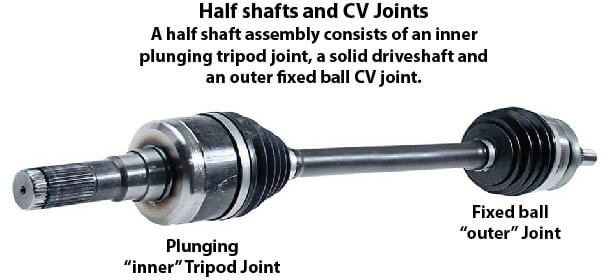
Half shaft with inner CV joint, driveshaft and outer CV joint
A half-shaft assembly consists of an inner plunging tripod-style CV joint, a solid driveshaft, and an outer fixed ball CV joint. All vehicles use a short arm/long arm (SLA) control arm arrangement that moves the wheel in an arc pattern during up/down movement, as opposed to a semi-circular movement. If the wheel moved in a semi-circular pattern, the driveshaft length wouldn’t need to change at all, since the radius of a semi-circle is constant at the top, middle, and bottom of the semi-circle.
However, since the wheel moves in an arc, the driveshaft length must be allowed to shorten as the wheel moves toward the top of the arc, lengthen as it reaches the middle, and shorten again as the wheel moves to the bottom of the arc. That’s where the plunge joint comes into play because it allows the shaft to lengthen and shorten.
This design allows your wheels to move up, down, and side to side while still transferring consistent power from the transmission to the wheels. Without this flexibility, your suspension geometry wouldn’t function properly, and your tires wouldn’t maintain proper road contact during turns or bumps.
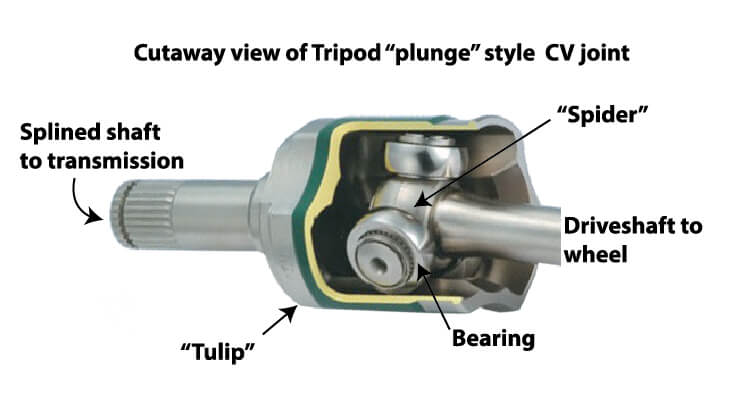
This image shows a cutaway view of a tripod-style plunge CV joint
Why CV Joints Outperform U-Joints
A CV joint provides something a universal joint (U-joint) can’t — smooth, constant velocity. U-joints, by design, create changes in rotational speed as they turn, especially at sharper angles.
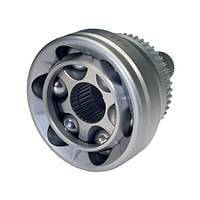
Fixed ball Rzeppa style “outer” CV joint
That’s why they’re unsuitable for most front-wheel-drive systems and many independent rear suspensions.
Modern drive axles use fixed ball, or Rzeppa-style, outer CV joints that can handle angles up to 48 degrees. This increased flexibility is critical for smooth steering and suspension travel, making them the ideal choice for front-wheel-drive and many all-wheel-drive vehicles. Meanwhile, the inner plunging tripod-style CV joint allows the axle to shorten and lengthen slightly as the wheel travels through its suspension arc.
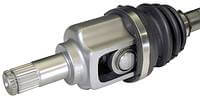
“Inner” Tripod plunging CV joint
Universal joints (U-joint), on the other hand, don’t turn at an even speed. The greater the angle, the greater the speed or velocity changes as the driveshaft turns. As the U-joint rotates around its outside angle, it slows down. Then, when traveling through the inside of the angle, it speeds up. The greater the operating angle, the greater the speed difference is.
To compensate for the speed difference, it’s essential to have the U-joint at the same, but opposite, operating angle, so the joints cancel out this speed difference and minimize noise harmonics.
Although U-joint designs differ somewhat, most are limited to a maximum turn angle of 28° to 37°. That’s usually not enough for Front Wheel Drive vehicles.
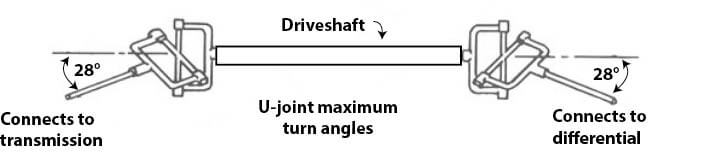
Maximum U-joint turn angles
What a CV Boot Does and Why It’s So Important
Every CV joint is packed with specialized grease to lubricate its internal components. The CV boot, a heavy-duty rubber cover, keeps that grease in and road debris out. Without the CV boot, your drive axle would be destroyed in no time.
But here’s the problem: CV boots don’t last forever. Over time, road debris, weather, or simple wear and tear can cause the CV boot to crack or tear. Once that happens, grease leaks out, dirt and grit get in, and the CV joint quickly starts grinding itself apart.
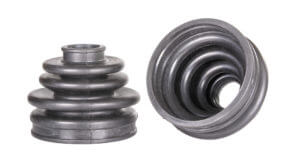
CV boot
Symptoms of a Failing CV Joint
I’ve seen every stage of CV joint failure, and the warning signs are easy to spot if you know what to look for:
• A torn or leaking CV boot
• Grease splattered around the inside of the wheel or suspension components
• Clicking or popping noises during tight turns
• Vibrations during acceleration or while turning
Once you notice these symptoms, the clock starts ticking. The longer you drive with a compromised CV boot, the higher the risk of catastrophic drive axle failure.
How Long Can You Drive After a CV Boot Fails?
The short answer? Not long. Once grit enters the CV joint, it begins grinding away the precision-machined surfaces inside. If you wait too long, the drive axle can separate entirely, potentially damaging your suspension, engine mounts, or even the transmission housing. I’ve seen repairs balloon from a few hundred dollars for a simple boot replacement to several thousand dollars because the driver ignored the problem.
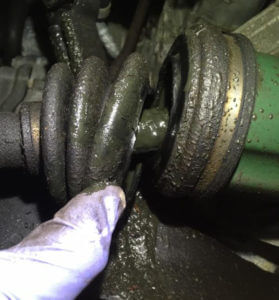
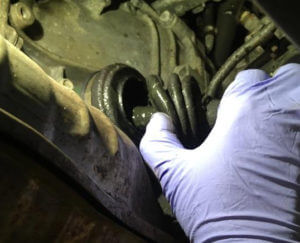
Torn inner CV boot. Notice the grease has leaked out
Can you prevent joint failure?
If you catch a torn CV boot early — before dirt contaminates the grease — you can often get away with a simple boot replacement. This relatively inexpensive repair can save the original CV joint and extend the life of your drive axle. On the other hand, if the joint is already contaminated, replacing the entire half-shaft assembly is the only reliable fix.
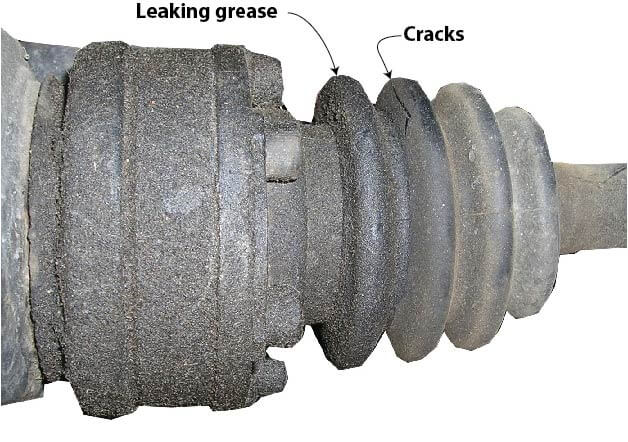
This CV boot has just started to leak grease. Replacing it now can save the joint
Key Takeaways From This Article
From my experience, the best way to protect your drive axle and CV joint is regular inspection. Any time you’re in for routine maintenance or an oil change, ask your mechanic to check the condition of your CV boots. Spotting a leak or tear early is the easiest way to prevent a major repair bill down the road.
©, 2018 Rick Muscoplat