
Engine Air Filter Replacement: When Is It Really Necessary?
How Long Does an Engine Air Filter Last?
Quick Summary
If you’re wondering when to change your car’s air filter, the answer depends on where and how you drive. While many manufacturers recommend replacement every 12,000 to 30,000 miles, mileage alone doesn’t tell the whole story. The best way to determine how long an engine air filter lasts is through regular inspections. A slightly gray filter isn’t necessarily dirty, and replacing it too early wastes money. In this article, I’ll explain how long an air filter really lasts, how to inspect it properly, and the signs that it’s time for a replacement.
When to Change Your Engine Air Filter: What Most Drivers Get Wrong
Most automakers recommend replacement intervals somewhere between:
• 12,000 to 15,000 miles under severe conditions
• 15,000 to 30,000 miles under normal driving
• Once per year for vehicles driven infrequently
However, those are general guidelines.
The real answer to how long an engine air filter lasts depends on:
• Local dust levels
• Road conditions
• Construction zones
• Rural driving
• Seasonal pollen levels
• Wildfire smoke exposure
• Frequency of vehicle use
I’ve seen filters that needed replacement at 10,000 miles and others that were perfectly serviceable at 25,000 miles.
Signs Your Engine Air Filter Needs Replacement
Although visual inspection remains the best method, several signs may indicate a restricted air filter.
1) Reduced Engine Performance — A severely clogged filter can restrict airflow enough to reduce engine power.
You may notice:
• Sluggish acceleration
• Reduced throttle response
• Lack of power during passing
• Lower Fuel Economy
Modern engines compensate for airflow restrictions, but a heavily clogged filter can still affect fuel economy in some vehicles.
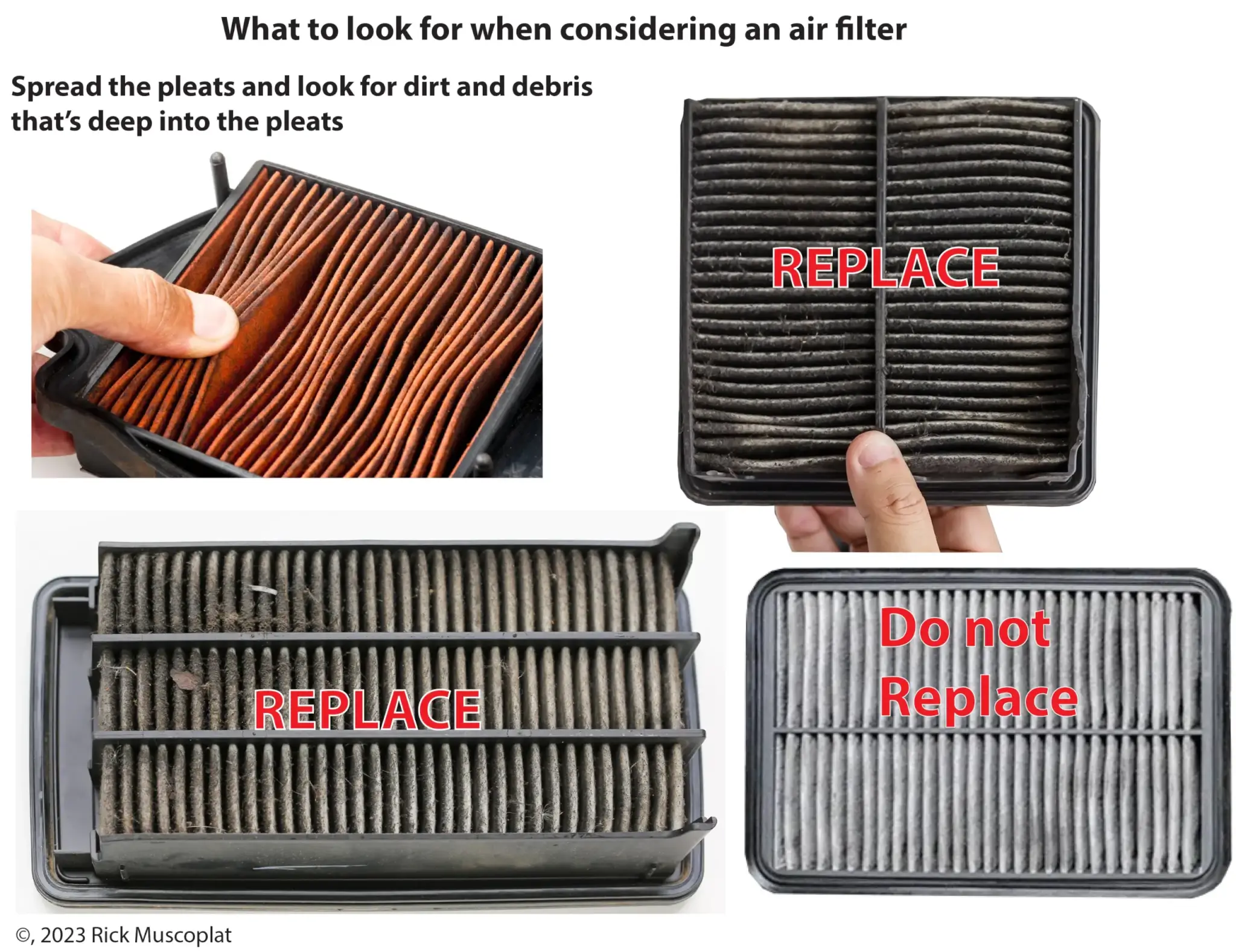
2) Excessive Dirt in the Pleats — This is the most reliable indicator. When dirt accumulates deep inside the pleats and fills roughly half the pleat depth, replacement becomes necessary.
Let’s take a look at these two air filters. The one on the left is new, and the one on the right would be called dirty” by every shop on the planet. But is it really dirty enough to justify changing?
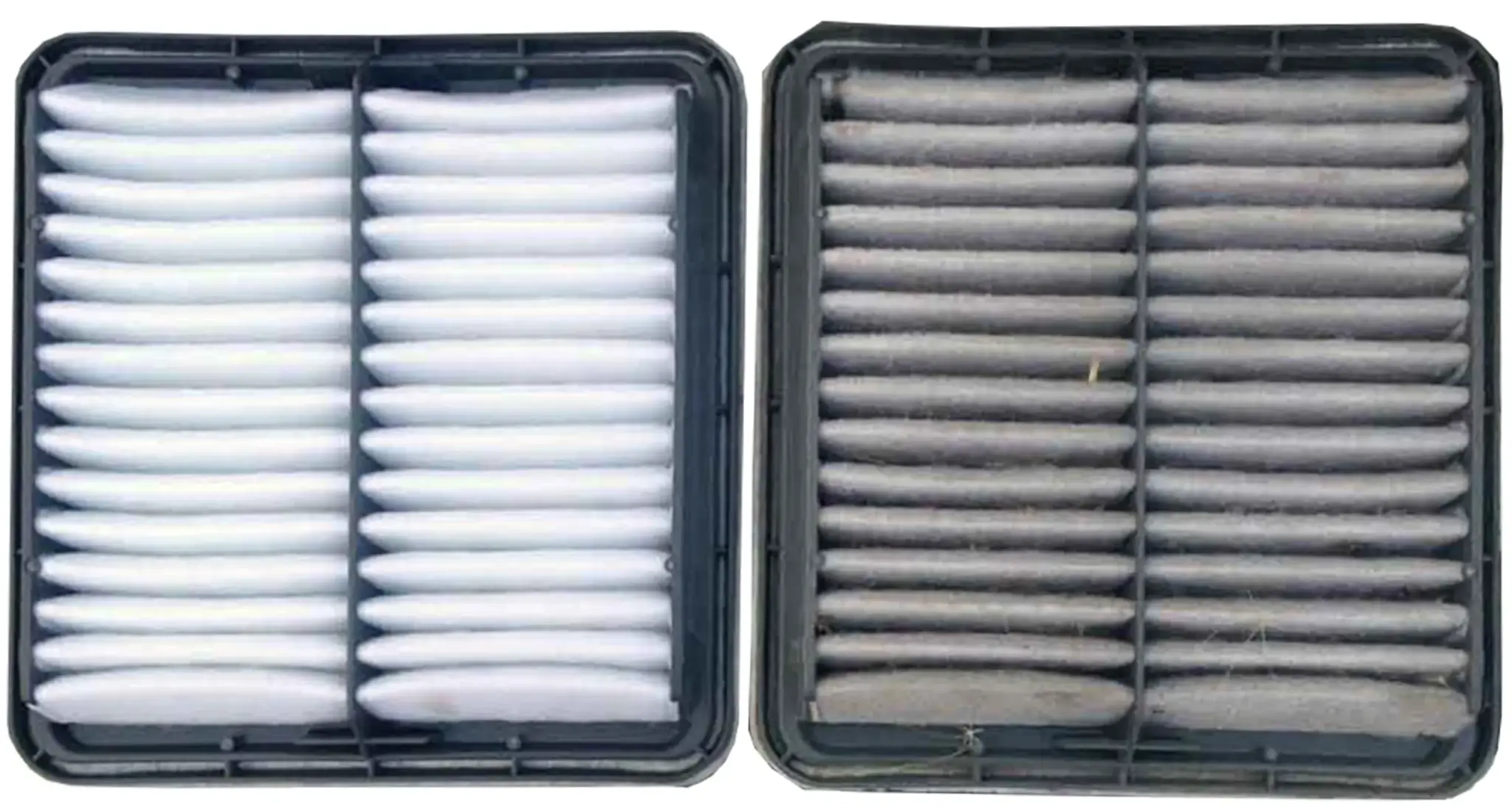
The truth is, the filter on the right is fine. I opened the pleats on this filter, and there was no dirt buildup at the bottom. All you see on this “dirty filter” is a light dusting on the top of the pleats. That’s not enough reason to change it. In fact, it has a LOT of air filtering capacity left. This filter will allow all the air your engine needs to flow through. So don’t get talked into a filter change just because it’s slightly grey.
3) Oil Contamination — If the filter contains oily spots or saturated areas, replacement is recommended.
Oil contamination may indicate:
• Excessive crankcase blow-by
• PCV system problems
• Engine wear issues
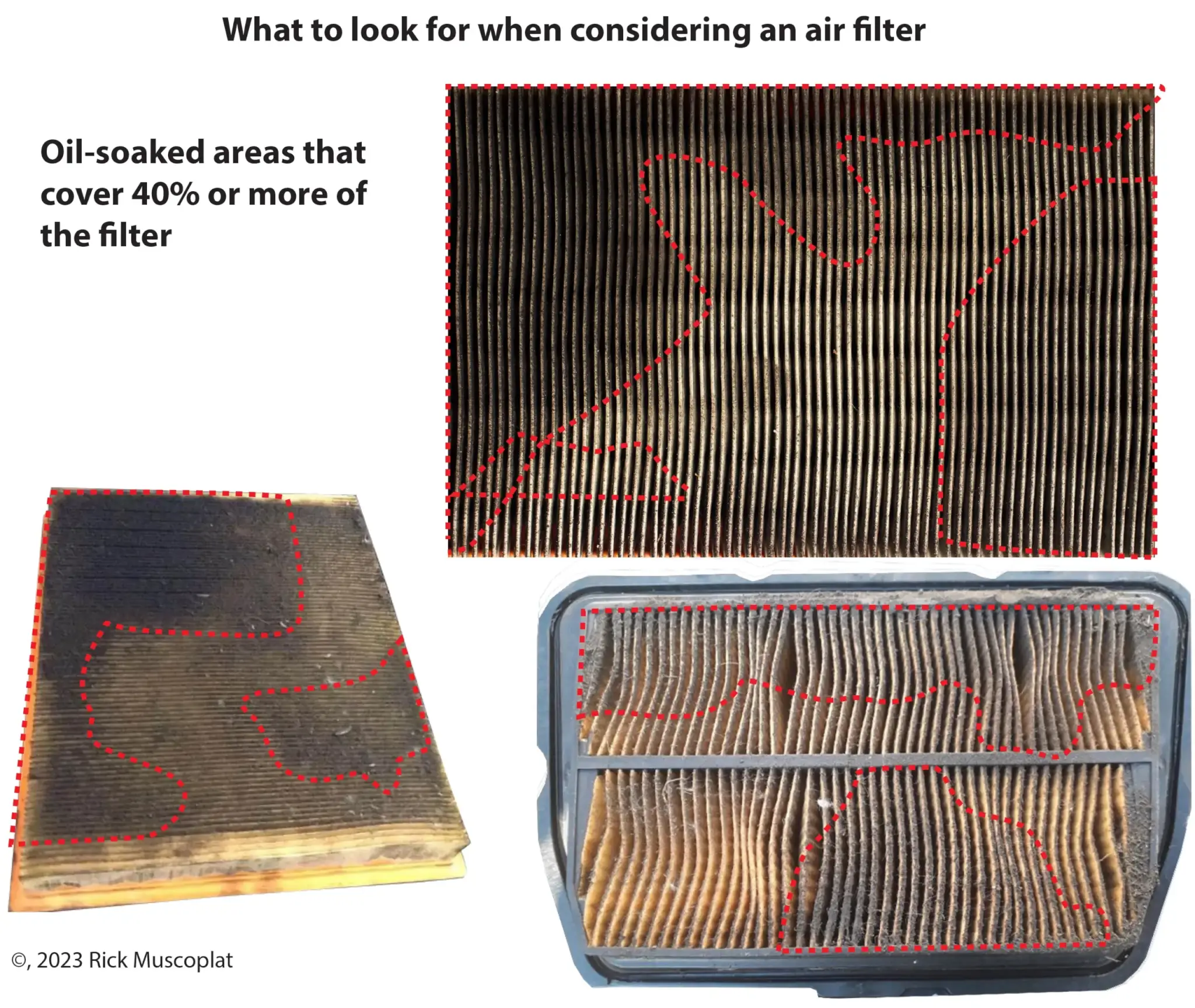
These filters have large areas of oil that comprise 25%-40 % of the filter, so they’re not allowing airflow through those areas. Technically speaking, these filters can probably flow enough air through the non-soaked areas, but those areas will clog up much faster since the rest of the filter is oil-soaked. I’d replace each of these filters.
How to Check It Correctly
Here’s an approved process for checking the condition of any engine air filter.
Step 1: Remove the Filter — Open the air filter housing and carefully remove the filter element.
Step 2: Open the Pleats — Don’t just look at the surface, spread the pleats apart and see how much dirt has accumulated deep inside the folds. There’s no hard-and-fast rule about how much dirt is acceptable. But when I see crud buildup 1/8″ – 1/4″ from the bottom of the pleat, I replace it.
Step 3: Look for Damage — Check for:
• Tears
• Holes
• Cracked seals
• Water damage
• Oil contamination
Any of these conditions justifies immediate replacement.
Step 4: Reinstall or Replace — If the pleats still have plenty of open space and there is no damage, reinstall the filter.
Filter Myths That Need to Die
Over the years, I’ve heard plenty of bad advice about air filters. Here are the myths I wish would disappear.
The Light Test — In this fake test, you’re supposed to hold a shop light under the filter to see how much light passes through. Actual lab tests prove that there is no scientific basis to this “test.” In fact, there is absolutely no correlation between light transmission and air transmission.
The Tap Test — If a filter looks dirty, some people smack the filter against a hard surface to knock dirt loose. If the dirt comes out, they figure they’ve “cleaned it” and can re-use it. Not true. Smacking the filter only removes the loose dirt. The trapped dirt is mostly still in the filter. The worst part of this “test” is that knocking large particles of dirt out of the filter damages the fibers that are designed to hold particles in place. So the filter is then less effective at trapping dirt.
Blowing It Out with Compressed Air — This is one of the worst practices because it makes the user feel good while causing substantial damage to the filter, compromising its ability to capture and hold dirt.
Compressed air:
• Tears filter fibers
• Creates microscopic holes
• Reduces filtration efficiency
• Allows dirt into the engine
Once the filter media is damaged, it can no longer protect the engine properly.
Why a Slightly Dirty Filter Isn’t a Problem
Here’s something that surprises many drivers.
A lightly dusted air filter is more efficient at capturing dirt than a brand-new filter — As fine particles accumulate within the filter media, filtration efficiency actually improves.
• The goal isn’t to keep the filter looking clean.
• The goal is to maintain airflow while trapping contaminants.
• A light gray appearance does not mean replacement is necessary.
To learn more about how engine air filters trap dirt, read Signs Your Engine Air Filter Needs to Be Replaced
What Carmakers Say
Each carmaker publishes its own schedule, but they all emphasize one thing: the replacement interval depends heavily on driving conditions. Here’s a summary of common guidance:
Toyota and Honda: Every 15,000 miles or 12 months, whichever comes first. Replace more often in dusty areas.
Ford and GM: Typically, every 30,000 miles, but inspect at every oil change.
Hyundai and Kia: Every 15,000 miles under normal driving; 7,500 under severe conditions.
Subaru: 12,000 to 15,000 miles under normal conditions; more often in dusty environments.
My Professional Recommendation
If you want the simplest answer to when to change your car’s air filter, here’s what I recommend:
• Inspect the filter at every oil change.
• Replace it only when dirt buildup significantly fills the pleats.
• Replace immediately if oil contamination or damage is present.
• Ignore scare tactics based solely on appearance.
• Follow the owner’s manual, but adjust for your driving conditions.
A properly maintained air filter protects your engine, supports fuel economy, and saves money by preventing unnecessary replacements.
Final Thoughts: Don’t Replace Too Early
The key takeaway about when to change your engine air filter is that it’s not about looks—it’s about how much debris has filled the pleats. When you learn how to check the engine air filter correctly, you’ll avoid premature replacements and keep your engine breathing freely without wasting money.
Can you clean a car’s air filter? Find out here
How to choose a car air filter
©, 2023 Rick Muscoplat
Posted on by Rick Muscoplat