
Fram oil filters: Are they good filters?
Learn the truth about Fram oil filters: Most of what you read online is wrong
There are many Internet oil filters “tear down studies” on the Internet and Youtube. Most of them downrate Fram oil filters. However, not a single one of those studies is based on actual testing. They’re just visual observations that have no bearing on how the filters actually perform.
Does pleat count have any bearing on a filter’s performance?
No. Pleat count is totally irrelevant to gauging an oil filter’s efficiency or quality. For example, a filter manufacturer can use a more efficient filter material in their filter, and it will have less surface area and fewer pleats, yet be far more efficient than a filter with more surface area and more pleats. The truth is, back in the 60s, filter manufacturers could choose from 8 types of filtration media. But today, they can choose from over 80 different types of filter media in use today, types of filter media in use today.
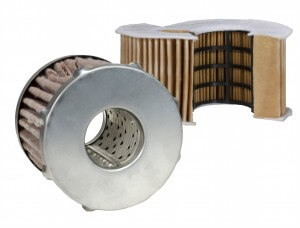 So, surface area and pleat count don’t tell you anything about a filter’s capacity or filtration efficiency.
Does end-cap material choice have any effect on an oil filter’s performance?
Fram gets roasted online because its entry-level filters use resin-impregnated end caps. Some people claim that “cardboard end caps” aren’t any good. However, if you understand the role of the end cap, you’d know that end cap material is irrelevant when judging a filter’s ability to filter oil.
What exactly is the job of the end cap?
The sole purpose of the end cap is to prevent oil from flowing around the ends of the pleats and back into the engine without being filtered. That’s it—ends caps have no other job.
Forty years ago, most filter manufacturers constructed their spin-on oil filters using resin-impregnated fiberboard. It’s less costly than metal and bonds easier to the filter media pleats. In fact, it bonds better than a metal end cap!
In the case of Fram’s 3,000-mile filter, Fram has chosen to stick with the fiberboard end caps. They apply heat-activated glue to bond the pleats to resin-impregnated fiberboard end caps. The glue works, the fiberboard isn’t porous, and the oil can’t make an end run around the pleat ends; there’s no harm, no foul.
What has changed to make end caps such a big deal?
Marketing. That’s what’s changed.
Some filter manufacturers started using metal end caps and advertised that fact to make consumers think that metal is better. But really, it’s much harder to bond the filter pleat material to metal than to resin-impregnated fiberboard. To make sure the pleats bond to the metal, the manufacturer fills the metal trough with hot melt adhesive and then pushes the end pleats into the hot glue. Does that hold the pleats any better than the fiberboard caps? Nope.
Quite the contrary.
Let’s look at these filters for the Toyota 4-cylinder engine. These engines don’t use spin-on filters. They use cartridge filters. See any end caps?
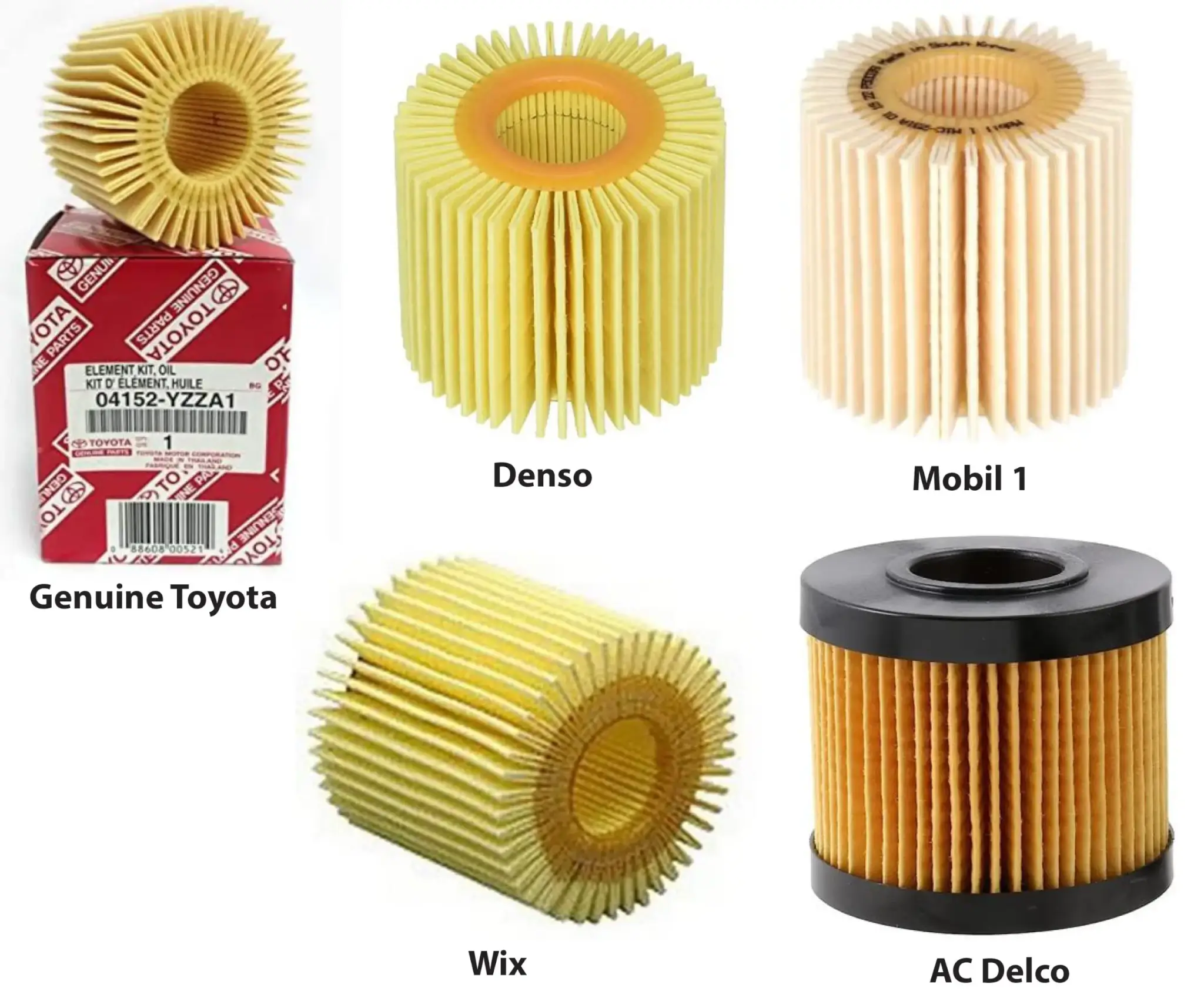
If metal end caps are so important, why doesn’t Toyota use them? Or Denso, or Mobil 1, or Wix?
In other words, judging a filter based on end cap material is a red herring because it has no relationship to the filter’s actual performance.
A Filter’s Dirt Holding Capacity isn’t as important as you think
Some filter companies rate their filters based on the number of grams of particulate matter they capture. Unfortunately, a filter’s dirt-holding capacity is just one aspect of proper oil filtration, and it’s often used to confuse consumers.
Here’s an example: If you have one filter constructed from older cellulose media and buy a filter twice that size and made with the same cellulose media, it will get you twice the dirt-holding capacity. However, if you instead install a filter made with more modern filter media, it can hold more particulate matter than a cellulose filter twice its size. That’s why you shouldn’t compare filters based on their dirt-holding capacity.
A Filter’s Efficiency Rating Is Far More Important Than it’s Dirt Holding Capacity
A filter’s efficiency rating is based on the filter’s ability to trap and hold a certain percentage of particles of a minimum size. For example, using the ISO 4548-12 specification, an older cellulose filter media typically has an average filtration efficiency of 40% at 15 microns, meaning it captures 40% of particles in the 15-micron range. However, if you substitute a paper/synthetic glass filter media, you can reach an 80% efficiency at the 15-micron level.
One GM study found that particles smaller than 10 microns generated 3.6 times more wear on rods, rings, and main bearings than particles larger than 20 microns.
There are particles, and then there are particles
Engine oil sees lots of different particles, such as soot, dirt, metallic wear, debris alumina, and silica. Of these, silica and alumina are considered the most harmful to engines. Both enter your engine through the engine air filter because they’re often smaller than 10-microns. That’s why carmakers recommend more frequent engine air filter changes if you drive in dusty conditions.
Anti-drainback valve material is important, but keep it relevant to the filter’s projected use
The choice of anti-drain back valve material is important. There are two materials used to construct the valve: Nitrile (NBR) and silicone. Filter price and oil change intervals determine which material the manufacturer uses.
Economy filters built for 3,000-mile oil changes usually use a nitrile bypass valve. However, since nitrile is less resistant to heat and acid, it can harden and crack after 3,000 miles. Silicone remains flexible for the extended oil change intervals used with synthetic oil.
If you are doing 3,000-mile oil changes, the nitrile check valves will work fine. If you’re doing extended oil change intervals, you shouldn’t be installing an economy filter rated for 3,000 miles.
End plate thickness — give me a break!
Many tear-down testers berate Fram for using thinner metal in their end plates, referred to as a tapping plate. End plate thickness is irrelevant. The thickness of the plate, the number of inlet holes, and the size of the holes are completely meaningless to filtration performance.
The only fact that’s relevant is whether the total area of the intake holes equals the total area of the drain hole. More holes or larger holes don’t improve performance at all. And, as long as the end plate is sturdy enough to hold the filter onto the mounting boss, it’s good enough. More is not better.
The oil filter can design is also irrelevant
Some filters are made from thicker metal, but that’s just because they include a welded-on hex nut for removal. The purpose of the hex nut is to make quicker oil filter changes when the vehicle is used for off-roading. Period. As long as the can withstands normal oil pressure, thicker is not better.
So, which is the best oil filter brand?
Fram gets a bad rap from make-believe reviewers. But if all the claims were true, we’d be seeing class action lawsuits every day. The truth is, Fram isn’t owned by either Allied Signal or Honeywell. They’re now owned by First Brands LLC, which also owns filter manufacturer Champion Labs.
First Brands and Fram and Champion Labs are Tier 1 suppliers to major carmakers
Fram makes more oil and air filters than almost any other filter manufacturer worldwide. In fact, many of the “best” oil filters in the bogus tear-down studies are manufactured by Fram or Champion Labs.
Most filter manufacturers make several quality levels of oil filters: one for the price-conscious crowd and one for engines rated for extended oil changes. All filter manufacturers’ high-end filters are built to go the distance. If you buy the high-end filter from Bosch, Purolator, Fram, Wix, Hastings, and Mann, you’re getting a great filter. All the other brands, to the best of my knowledge, are made by these same companies.
For a more detailed rebuttal of those oil filter studies, read this post
NOTE: I do not work for Fram and have absolutely no affiliation with Fram or any other filter manufacturer. I have no horse in this race.
©, 2016 Rick Muscoplat
Posted on by Rick Muscoplat