
How a MAF Sensor Determines Air Volume and Density
Learn how a MAF sensor works and how they fail
A MAF sensor, short for Mass Air Flow sensor, is an important component in modern fuel-injected engines. Its primary function is to measure the amount of air entering the engine’s intake system. This information is crucial for the engine control unit (ECU) to calculate the proper amount of fuel to inject into the combustion chambers, ensuring optimal air-fuel mixture, efficient combustion, and reduced emissions.
How a MAF Sensor Works
The MAF sensor measures the mass flow rate of air entering the engine, which is essential for accurate fuel delivery. There are two main types of MAF sensors: hot wire and vane meter.
• Hot Wire MAF Sensor— This is the most common type. It uses a thin wire (usuall
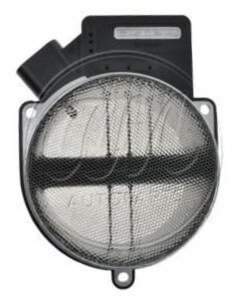
This image shows a hot wire Mass Airflow Sensor
y made of platinum) heated by an electric current. As air flows past the wire, it cools the wire down. The sensor’s electronics increase the current to maintain the wire’s temperature, and the amount of current needed is proportional to the mass of the air flowing over the wire. The sensor converts this current measurement into an electrical signal that the ECU interprets to determine the amount of air entering the engine.
• Vane Meter MAF Sensor— This older type uses a spring-loaded vane or flap that moves in response to airflow. The position of the vane is directly related to the volume of air entering the engine.
A potentiometer attached to the vane converts its position into an electrical signal, which the ECU uses to determine the air flow rate.
How the ECM uses data from the MAF
The hot wire MAF provides a far more accurate measurement of how much air is entering the engine than a Manifold Absolute Pressure (MAP) sensor. While a MAP sensor tells the ECM the difference between manifold vacuum and barometric pressure, a MAF tells the ECM the volume of air and its mass. The ECM has to impute the air’s mass when using a MAP sensor, while a MAF provides a precise measurement of the air’s mass.
Knowing the incoming air’s mass and volume and the engine temperature, the ECM can calulate the following:
• How Much Fuel To Deliver to the Cylinders— Once the ECM knows the air’s volume and mass, it simply calculates the correct amount of fuel to inject for efficient combustion and maintain the ideal air-fuel ratio, typically around 14.7:1 (stoichiometric ratio) for gasoline engines.
• Ignition Timing— By knowing the amount of air entering the engine, the ECU can adjust the ignition timing to optimize combustion and power output.
• Emissions Control— Accurate air flow measurement is essential for controlling emissions. The ECU uses MAF data to ensure complete combustion, reducing harmful pollutants like hydrocarbons, carbon monoxide, and nitrogen oxides.
• Load Calculation— The MAF sensor helps determine the engine load, which is crucial for managing various engine functions, including transmission shifts and turbo boost control (in turbocharged engines).
What goes wrong with a MAF sensor?
Hot wire contamination
The #1 cause of mass airflow sensor failure is debris accumulation on the hot wire or hot plate. This can be caused by using an aftermarket oiled air filter or neglecting to change a traditional air filter.
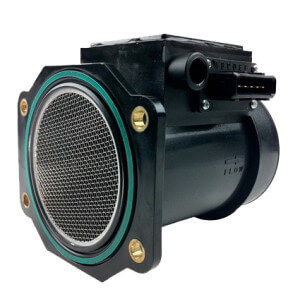
A mass airflow sensor detects the amount and density of air coming into the engine
In the case of an aftermarket “cold air intake” style filter, the filter media is often made of cotton saturated in oil. Oil-soaked cotton fibers break off and attach to the hot wire or hot plate, which is then baked on due to the high heat. This debris forms an insulated coating that throws off the MAF sensor readings, causing the PCM/ECM to think the incoming air is warmer than it really is. In response, the PCM/ECM commands a leaner fuel mixture, causing poor performance, engine misfire, a check engine light, and even poor shifting (in an automatic transmission).
Signs of a failing MAF sensor
• The engine cranks but takes a long time to fire up, especially in cold weather or at the start of the day.
• Engine stalls shortly after starting.
• You feel a hesitation as you accelerate, especially when the engine is under load.
• Rough idle
• Poor MPG
• Harsh transmission shifting
Can you clean it?
Sometimes, you can clean a lightly soiled MAF. At least one company sells an aerosol spray MAF sensor cleaner. Read this post for step-by-step instructions on how to clean a MAF sensor. Just about any DIYer can do this as long as they exercise care; the hit wire and temperature sensors are very delicate. Never scrub the wire or temperature sensor.
Replacement cost of a new sensor?
MAF sensor cost varies based on year, make, model, and engine style but ranges in price from $100 to $300. The MAF sensor is located between the air filter box and the throttle body in the intake manifold. To replace an MAF sensor, disconnect the electrical connector, loosen the hose clamps, and swap in the new sensor, paying attention to the airflow directional arrows shown on the old sensor. Then, tighten the clamps and reinstall the electrical connector.
©, 2018 Rick Muscoplat
Posted on by Rick Muscoplat