
How Do I Know If I Have a Bad Wheel Bearing
Bad Wheel Bearing Symptoms Every Driver Should Know
Quick Summary
If you’re hearing a humming, growling, grinding, or rumbling noise that gets louder with speed, there’s a good chance you’re dealing with a bad wheel bearing. However, the diagnosis isn’t always straightforward because tire noise, CV joints, and even differential problems can mimic a failing bearing. The most accurate diagnosis combines a road test, a wheel-bearing play test, a visual inspection, and, ideally, an electronic chassis ear. In this guide, I’ll show you exactly how to identify the symptoms, determine which wheel bearing is bad, and decide whether it’s safe to keep driving.
Key Takeaways
• A humming noise is often the first symptom.
• It usually gets louder as vehicle speed increases.
• It usually changes in pitch when changing lanes or turning left or right.
• It can trigger an ABS warning light.
• Excessive bearing play confirms internal damage.
• Tire noise is commonly mistaken for bearing failure.
• Driving too long on a failed bearing can create a serious safety hazard.
How Do I Know If It’s Bad?
This is one of the most common questions I hear from DIYers and vehicle owners. Unfortunately, many people replace the wrong wheel bearing because they rely solely on internet shortcuts, such as rocking the tire or listening for noise while driving.
Over the years, I’ve learned that diagnosing wheel bearing failure requires a combination of tests. The good news is that once you understand the symptoms, finding the problem becomes much easier.
What Does a Bad Wheel Bearing Sound Like?
The classic bad wheel bearing sound is a low-pitched humming, growling, rumbling, or droning noise that changes with vehicle speed.
Many drivers describe it as:
• A distant airplane sound
• Aggressive tire noise
• A grinding sound
• A roaring sound from one corner of the vehicle
As the bearing deteriorates, the noise typically becomes more noticeable.
Common Bad Wheel Bearing Sounds
Humming Noise — This is the most common early symptom. The humming often starts around 30-40 mph and becomes much louder at highway speeds.
Grinding Noise — Once internal rollers or races become damaged, the noise can progress into a grinding or growling sound.
Noise Gets Louder — A failing bearing almost always gets louder over time. The noise may initially appear only at highway speed but eventually becomes noticeable at lower speeds as well.
Noise When Turning — One of the most useful diagnostic clues is how the noise changes during turns. When you turn, the vehicle’s weight shifts onto one side of the suspension.
Noise Only When Turning Left — If the noise gets louder when turning left, the problem is often on the right side, as that wheel carries more load.
Noise Only When Turning Right — If the noise increases while turning right, the left-side bearing is often the culprit.
Notice I said “often.”
This rule isn’t foolproof because vibrations can travel through suspension and chassis components, making the direction of the sound misleading.
Noise Front vs Rear — Determining whether the noise comes from the front or rear can be difficult.
Front versus Rear Diagnosis
Front wheel bearings often create:
• Steering wheel vibration
• Noise transmitted through the floor
• Changes in steering feel
• ABS warning lights
• Rear Wheel Bearing Noise
Rear bearings typically create:
• Humming from the rear of the vehicle
• Less steering wheel feedback
• Noise that sounds like aggressive tires
Many rear wheel bearing failures are initially mistaken for tire noise.
Wheel Bearing Noise vs Tire Noise
This is where many diagnoses go wrong. Cupped or unevenly worn tires can sound almost identical to a failing wheel bearing.
Tire Noise Usually:
• Changes with road surface
• Appears on certain pavement types
• Remains fairly constant during turns
Wheel Bearing Noise Usually:
• Changes with vehicle loading
• Gets louder during specific turns
• Increases steadily with speed
If you’re unsure, rotate the tires and see whether the noise changes location.
Bad Wheel Bearing vs CV Joint
Another common misdiagnosis involves CV joints.
Bad CV Joint Symptoms
• Clicking when turning sharply
• Popping noises
• Noise during acceleration
Bad Wheel Bearing Symptoms
• Humming
• Grinding
• Growling
• Vibration
Constant noise regardless of steering angle
How to Check Your Bearings at Home
Many DIYers ask me how to test the condition of their wheel bearings in their garage.
Step 1: Safely Jack Up the Vehicle — Before performing any inspection:
• Park on level ground
• Set the parking brake
• Chock the wheels
• Lift the vehicle using approved lift points
• Support it securely with jack stands
Step 2: Perform a Wheel Bearing Play Test — Once the wheel is off the ground:
Place your hands on the tire at the 12 and 6 O’Clock position and rock it in and out. Then, do the same test, moving your hands to the 3 and 9 O’Clock positions
Any noticeable movement may indicate:
• Bearing wear
• Ball joint wear
• Suspension component damage
If you don’t feel play, use a dial indicator on the wheel hub
• Remove the brake rotor and clean all rust off the wheel hub.

Dial indicator on a wheel hub
• Mount a dial indicator and place the tip on the outer edge of the wheel hub.
• Rotate the hub and note how much the needle moves.
Most carmakers specify no more than 0.002″ to 0.004″ of wheel bearing play measured at the hub flange or rotor surface.
Anything beyond that typically indicates bearing wear or internal damage.
0.000″–0.002″ — Excellent condition. The bearing is tight and properly preloaded.
0.003″–0.004″ — Acceptable for many older designs or serviceable tapered roller bearings, but watch for noise or roughness.
More than 0.005″ (five thousandths) — Excessive play. On most modern sealed hub assemblies, this amount of movement means the bearing is bad and must be replaced
However, here’s something many people don’t realize: A wheel bearing can be noisy long before it develops detectable play. So the “play” test is NOT dispositive! If you don’t notice play, that doesn’t mean the bearing is good. It takes a LOT of wear to feel play in the bearing.
The Most Accurate Test
When I absolutely need to determine which wheel bearing is bad, I use an electronic chassis ear. Systems like the Steelman Chassis Ear use microphones mounted near each wheel.
• During a road test, you simply switch between channels and listen.
• The loudest channel identifies the failing bearing almost instantly.
• In my experience, this is the most reliable method available outside a professional shop.
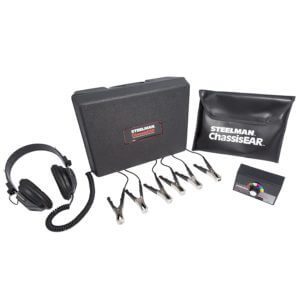
Steelman Chassis Ear wired version
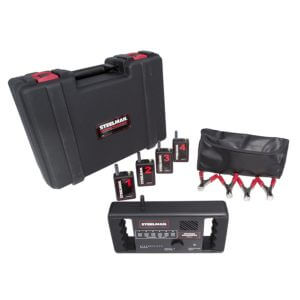
Steelman Chassis ear wireless version
Step 3: Take a test drive
To diagnose a bad wheel bearing on the road, find a flat, quiet stretch. Drive at various speeds and gently shift weight by moving the steering wheel slightly between 10:00 and 2:00. Don’t make hard turns—you’re only transferring vehicle weight.
A bad wheel bearing noise usually grows louder with speed or when turning away from the failing side. On 4WD trucks, you might also notice heavier steering in long sweeping turns, even before any noise appears.
Can a Bad Wheel Bearing Cause Vibration?
Absolutely.
A bad wheel bearing vibration may be felt:
• In the steering wheel
• Through the floor
• In the seat
• Throughout the vehicle
The vibration often becomes more noticeable at highway speeds.
Some drivers mistake it for a tire balance issue.
Can a Bad Wheel Bearing Cause Uneven Tire Wear?
Yes.
Excessive bearing play allows the wheel to tilt slightly.
That can create:
• Feathered tread wear
• Uneven shoulder wear
• Tire cupping
Bad wheel bearing, uneven tire wear often becomes noticeable only after significant bearing deterioration.
How Long Can You Drive on a Bad Wheel Bearing?
I don’t recommend pushing your luck. A slightly noisy bearing may survive for thousands of miles. A severely damaged bearing can fail unexpectedly.
Potential consequences include:
• Wheel lockup
• ABS system malfunction
• Hub damage
• Steering instability
• Wheel separation in extreme cases
The longer you wait, the more expensive the repair becomes.
Wheel Bearing Replacement Cost
Average wheel bearing replacement cost varies by vehicle.
Typical ranges:
• Economy vehicles: $250–$500 per wheel
• SUVs and trucks: $400–$800 per wheel
• Luxury vehicles: $600–$1,500+ per wheel
Hub assemblies generally cost more than serviceable bearings but require less labor.
Final Thoughts
When someone asks me, “How do I know if my wheel bearing is bad?” my answer is always the same:
Don’t rely on just one test.
Listen for humming, grinding, and growling noises. Perform a wheel bearing play test. Pay attention to changes in noise when turning. Check for ABS warnings and vibration. Most importantly, confirm the diagnosis before replacing parts.
Wheel bearings are expensive enough that guessing can quickly become a costly mistake. A careful diagnosis saves money, prevents unnecessary repairs, and keeps your vehicle safe on the road.
*Expanded and adapted from the uploaded wheel bearing diagnostic guide.
©, 2018 Rick Muscoplat
Posted on by Rick Muscoplat