
How Serious Are Cracks in Control Arm Bushings?
How to Evaluate Cracked Control Arm Bushings: When to Replace Them
Not every set of cracked control arm bushings needs immediate replacement. After inspecting thousands of suspension systems during my career, I’ve found that many shops recommend replacement simply because they see surface cracks in the rubber. In reality, light surface cracking is a normal part of aging. The real concern is tears in control arm bushings that separate the rubber from the inner spindle or outer collar. Knowing the difference can save you hundreds of dollars while keeping your vehicle safe.
This guide explains how serious cracks in control arm bushings are, what to look for during an inspection, and when replacement is actually necessary.

This image shows the rubber tearing away from the sleeve, the collar and complete bushing failure
How Serious Are Cracks in Control Arm Bushings?
People often ask me: “How serious are cracks in control arm bushings?”
Here’s how I explain it.
Not serious if you only see:
• Small surface checking
• Shallow age cracks
• Weathering
• Cosmetic cracking
…the bushings are probably still functioning normally.
These are signs of aging—not failure.
Moderately serious
Replacement should be planned soon if you find:
• Beginning rubber separation from the inner spindle or outer collar
• Slight movement during inspection
• Steering beginning to feel loose
These bushings still work but are nearing the end of their service life.
Serious
Immediate replacement is recommended when you find:
• Rubber torn completely through around the inner spindle
• Rubber separating from the outer collar
• Excessive movement with a pry bar
• Loud clunks
• Unstable steering. At this point, the suspension geometry is changing every time the vehicle accelerates, brakes, or corners.
Are Cracked Control Arm Bushings Dangerous?
This is probably the most-searched question on the internet about suspension bushings. The answer depends entirely on what kind of cracks you’re seeing.
Minor surface cracks are usually harmless — The rubber still supports the control arm exactly as designed. You may continue driving without any noticeable change in steering or ride quality.
Deep tears — This is where replacement becomes necessary. When tears in control arm bushings begin separating the rubber from the inner sleeve or outer collar, the control arm starts moving farther than engineers intended.
That movement changes wheel alignment and eventually causes handling problems.
For more on control arm bushing symptoms, see this post.
Surface Cracks vs. Torn Bushings
This is where many inspections go wrong. I’ve seen countless technicians shine a flashlight on a suspension, notice tiny cracks, and immediately recommend replacing the entire control arm. That’s not how manufacturers evaluate bushings.
Instead, they look for structural separation.
Think of an old leather baseball glove. Small cracks don’t mean the glove is unusable. But if one of the fingers tears off, the glove has failed. Control arm bushings work the same way.
Surface cracking isn’t failure, but separation is.
This is what cracked control arm bushings look like

These control arm bushings have just started to crack and don’t impose a safety risk at this point. They don’t need replacement now.

The image on the left shows minor cracks in the rubber bushing. The rubber had not torn away from the collar or the sleeve, so it’s still good. The second image shows how the control arm rotates around the axis. The open areas are not tears. They’re built into the bushing on purpose, so the bushing can bend.
How to Inspect Control Arm Bushings Yourself
If you like doing your own maintenance, you can perform a surprisingly accurate inspection in your garage.
Here’s the process.
Step 1 — Raise the vehicle safely— Support the suspension according to the manufacturer’s lifting points. Never inspect underneath a vehicle supported only by a jack.
Step 2 — Clean the bushing — Road grime hides damage. Spray the area with brake cleaner or suspension cleaner and wipe away dirt.
Step 3 — View the bushing from the underside; most serious tears start on the underside where they’re impossible to see without changing your viewing angle.
Step 4 — Use a small pry bar or flat blade screwdriver. Gently apply pressure to the control arm bushing.
Step 5 — Look for separation— This is the biggest warning sign. If the rubber has detached from:
• The inner sleeve
• The outer shell
…the bushing has failed regardless of how many surface cracks are visible. What you don’t want to see is the rubber peeling away from the steel sleeve.

The bushings in this image are starting to tear and should be replaced soon. But the rubber is still connected to the steel collar and internal sleeve. Plan for replacement in the future, but they don’t pose an immediate threat.

The tear in the rubber means the control arm bushings should be replaced

This bushing should be replaced soon
Subaru issues a service bulletin clarifying when bushings need replacement
Subaru has issued a service bulletin #03-94-24 detailing an inspection and measurement procedure to determine when a control arm bushing requires replacement. The bulletin warns dealers not to replace bushings based on cracks and then details how to inspect the underside of the bushing to measure the width of tears.
The TSB says, “Small surface cracks located on the rubber will not have any effect on the performance of the bushing. It is important to review the inspection information supplied in this bulletin prior to the replacement of front transverse link bushings.”
Rubber tears that separate the rubber from the outer collar or the inner spindle indicate wear that might require replacement. The tears start on the underside of the bushing.
Subaru recommends using a screwdriver or small pry bar to push the rubber aside so you can measure the tear. Tears longer than 1/2 inch will have an impact on the vehicle ride quality and will require replacement. Cracks with a width of 13mm (1/2 inch) or less will not cause any functional concerns and will NOT require replacement.
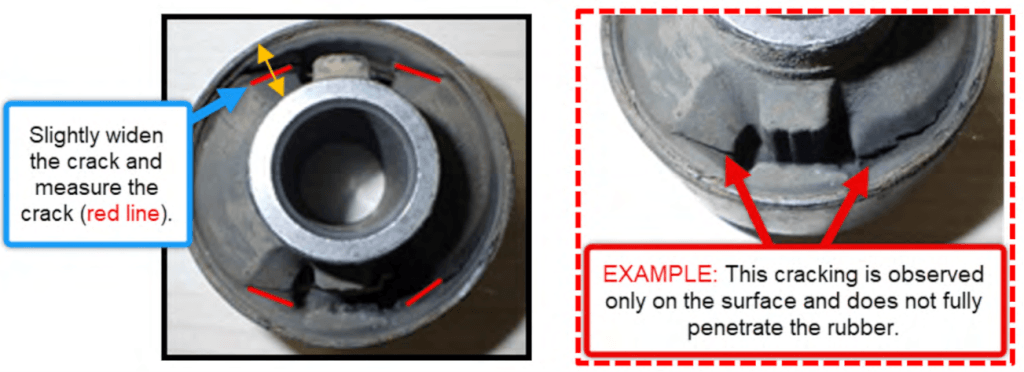
Images from the Subaru TSB on control arm bushing tears
Common Signs of Torn or Failed Bushings
Here’s what to look for before the problem gets worse:
• Clunking or knocking noises when going over bumps.
• Steering that feels loose or inconsistent.
• Vibrations through the steering wheel.
• Uneven tire wear, especially on the inner or outer edges.
• Vehicle pulling to one side during acceleration or braking.
If you notice these symptoms, have your suspension inspected by a reputable technician who can physically test for bushing movement—not just look for cracks.
Why Do Control Arm Bushings Crack?
Rubber is a wear item. It begins aging the day the vehicle leaves the factory.
Over time it’s attacked by:
• Heat from brakes and the engine
• Oxygen
• Ozone
• Road salt
• Oil contamination
• UV exposure
• Thousands of suspension movements every mile. Eventually the rubber hardens. Then tiny surface cracks begin appearing. That’s completely normal.
What Do Control Arm Bushings Actually Do?
Control arm bushings are thick rubber cushions bonded between an inner steel sleeve and an outer metal shell.
Their job is surprisingly important— They allow the suspension to move through its travel while:
• absorbing road vibration
• reducing harshness
• maintaining wheel alignment
• preventing metal-to-metal contact
• keeping the suspension quiet
Without them, every bump would be transmitted directly into the vehicle frame, steering precision would suffer, and suspension components would wear much faster.

See where the control arm and control bushings are located in the suspension. You can purchase the bushings separately or buy a new control arm with the bushings and ball joint.
How Long Do Control Arm Bushings Last?
Factory bushings often last 100,000 miles, depending on climate, road conditions, and driving habits. Vehicles driven in hot, dry climates tend to experience earlier cracking. On the other hand, cars exposed to salt and moisture may develop corrosion around the bushing collars, accelerating deterioration.
How Torn Bushings Affect Vehicle Handling
Many people don’t realize that the control arm determines the exact location of the wheel. When the bushings begin tearing, the control arm can move several millimeters farther than it should.
That may not sound like much, but it changes critical alignment angles such as:
• Caster
• Camber
• Toe
As those angles change while you’re driving, you’ll notice:
• Less precise steering
• Increased body movement
• More tire scrub
• Reduced braking stability
• Faster tire wear
In severe cases, the vehicle can feel unstable during emergency lane changes or hard braking.
Symptoms of Torn Control Arm Bushings
When cracked control arm bushings develop actual tears, the suspension can no longer keep the control arm in its proper position. That’s when you’ll begin noticing changes in how your vehicle drives.
Watch for these common bad control arm bushing symptoms:
• Clunking or knocking over bumps
• Loose or wandering steering
• Steering wheel vibration
• Vehicle pulls during acceleration or braking
• Uneven front tire wear
• Feathered tire tread
• Poor braking stability
• Steering that requires constant correction
• Squeaking from the suspension
• Changes in wheel alignment shortly after an alignment has been performed
One symptom by itself doesn’t necessarily confirm bad bushings, but several together should prompt a thorough suspension inspection.
Can You Drive with Cracked Control Arm Bushings?
This is another question I receive almost every week. The answer depends entirely on the condition of the rubber.
Safe to drive if:
• Only small surface cracks are present
• The rubber is still bonded to the steel sleeve
• There are no suspension noises
• Steering feels normal
• Tire wear is even
These bushings are simply showing their age.
Monitor the tears and start saving for the repair if you find:
• Small tears
• Minor separation beginning
• Slight steering looseness
• Occasional clunks
The vehicle is usually still safe, but you should plan repairs before the damage progresses.
Repair immediately and stop driving if:
• The rubber has torn completely through.
• The control arm moves excessively during inspection.
• Steering becomes unpredictable.
• Alignment won’t stay within specifications.
• Tire wear becomes rapid.
• The vehicle feels unstable while braking or cornering.
At that point, the bushings are no longer supporting the suspension as designed.
Replacement Options: Bushings vs. Complete Control Arm
Both options solve the problem, but not all shops offer just bushing replacement.
Option 1: Replace Only the Bushings
This is usually the least expensive parts option.
Advantages
• Lower parts cost
• Keeps the original control arm
• Good choice if the ball joint is still excellent
• Less waste
Disadvantages
• Requires a hydraulic press
• More labor
• Some aftermarket bushings can be difficult to install correctly
• Rusty control arms can complicate the repair
Many DIY mechanics don’t have access to the specialized press equipment needed for this repair.
Option 2: Replace the Complete Control Arm
This has become the most common repair in professional shops. A new control arm typically includes:
• New bushings
• New ball joint
• New hardware (on many applications)
Advantages
• Faster installation
• New ball joint included
• Eliminates rusted or bent control arms
• Usually more reliable long-term
Disadvantages
• Higher parts cost
• Slightly more expensive overall on some vehicles
For vehicles with more than 100,000 miles, I generally lean toward replacing the complete control arm. You’re already paying the labor to remove it, so installing new bushings and a new ball joint at the same time often provides better long-term value.
How Much Does Control Arm Bushing Replacement Cost?
Actual prices vary by vehicle.
Typical repair costs are:
Replace bushings only
• Bushings: $25–$60 each
• Labor: 1–2 hours per side
Total: $200–$450 per side
Replace complete control arm
• Control arm assembly: $150–$400
• Labor: 1–2 hours
• Wheel alignment: $100–$180
Total: $350–$800 per side
Luxury vehicles and trucks can cost considerably more.
My Professional Advice
Whenever someone tells me they were advised to replace cracked control arm bushings, I ask one question:
• “Did they show you the tears?” If the answer is no, ask to see them.
• Don’t confuse cosmetic weather cracking with structural failure. Surface cracks are normal.
• Tears in control arm bushings that separate the rubber from the steel sleeve or outer shell are not. That’s when replacement becomes necessary.
The best technicians don’t sell repairs based on appearance—they diagnose based on function.
If your vehicle has only light surface cracking and drives normally, chances are you still have many thousands of miles left before replacement is necessary. If the rubber is separating or the vehicle exhibits loose steering, clunking noises, or abnormal tire wear, it’s time to schedule the repair. That approach is consistent with manufacturer guidance such as Subaru’s inspection procedure, which emphasizes evaluating the extent of tearing rather than replacing bushings solely because of visible surface cracks.
Final Thoughts: Don’t Fall for the Fear Factor
Cracks alone don’t mean catastrophe. Torn bushings, on the other hand, do. As a rule of thumb, always confirm the diagnosis with visual proof or a second opinion. Your wallet—and your suspension—will thank you.
To learn about the cost of replacing control arm bushings versus the control arm, see this post
©, 2024 Rick Muscopalt
Posted on by Rick Muscoplat