
How to buy the right oil for your car
Learn about motor oil so you can buy the right oil for your car
When it comes to buying the right engine oil for your car, knowledge is power. There are many types of motor oil in many different viscosity combinations, and using the wrong oil can cause accelerated engine wear. That’s why it’s so important to buy the right one for your vehicle. This guide will help you understand the differences in soil types, viscosities, and service ratings.
Understanding Oil Types
There are four major types of motor oil: Conventional, Synthetic Blend, Full Synthetic, and High Mileage
Conventional Oil: This used to be the most common type of oil, derived from crude oil. It is suitable for older cars with low to average mileage and simple engine designs.
Synthetic blend: This is a combination of conventional oil and full synthetic. Many carmakers switched to synthetic blends because they offer better protection than conventional oil alone, but because it’s a blend, it’s more affordable. As the price for full synthetic oil has come down, most carmakers have switched over to recommending full synthetic. If your owner’s manual recommends a synthetic blend, you can switch over to full synthetic and get even better protection. However, you should not switch back to conventional oil
Full Synthetic Oil: Synthetic oil can be made from crude oil using a highly specialized process, or it can be made from chemical compounds. Synthetic oil provides superior lubrication and performance. It is required for most late model vehicles and is especially important for engines equipped with turbochargers.
High-Mileage Oil: Designed for vehicles with over 75,000 miles, high-mileage oil contains additives that help reduce oil burn-off and prevent leaks. It helps in extending the life of older engines.
The right oil for your car is listed in your owner’s manual
Your car’s owner’s manual is the most reliable source of information about the type of oil you should use. It will specify the recommended type, viscosity, and service classification. Following the carmaker’s recommendation will ensure your engine gets the right protection and performance. The manufacturer’s recommendations are based on extensive testing and should be followed to maintain your vehicle’s warranty and performance.
The importance of following the carmaker’s recommendations and not some “self-proclaimed” expert on the internet
Modern engines are equipped with variable valve timing (VVT), gasoline direct injection (DI), a variable displacement oil pump, and turbochargers that place more demands on oil. For example, DI requires fuel
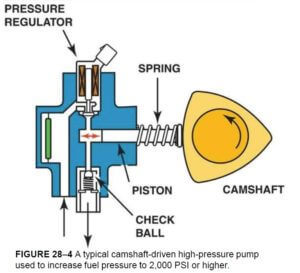
The high-pressure fuel pump runs off a triangular lobe on the camshaft. Using the wrong oil can accelerate camshaft wear, which can cost thousands to repair.
pressure of up to 2,000 psi. So your car has two fuel pumps—one in the tank to deliver fuel to the engine pump and a second high-pressure pump. The high-pressure pump runs off the triangular lobe on the camshaft. If you use the wrong oil; either the wrong viscosity or the wrong service rating- you can damage the camshaft.
• Turbochargers spin up to 200,000 revolutions per minute, and the bearings are cooled by oil flow and engine coolant. So those engines require an oil that won’t break down under high heat conditions.
Variable valve timing mechanisms have their own unique operating conditions. The engine computer changes valve timing with a hydraulic actuator. The actuator moves based on pulsed oil pressure from a pulsing solenoid. The computer commands valve timing changes based on factory-recommended oil viscosity.
If you change to a different viscosity or a different service rating the actuator won’t respond properly. That’ll set a check engine light and affect engine performance and emissions. And because it’s pulsed, the oil can develop air pockets and foam. Foam doesn’t cool metal – it actually insulates, so the oil runs hotter and degrades faster.
Understanding Viscosity Ratings
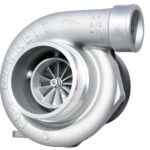
A turbocharger runs hot and can degrade oil faster. If you have a turbo, don’t go beyond the car maker’s oil change recommendations
An oil’s viscosity rating is indicated by numbers and letters on the oil container (e.g., 5W-30). The first number, followed by ‘W’ (which stands for winter), indicates the oil’s ability to flow at cold temperatures, while the second number represents its flow at operating temperatures.
Always follow the carmaker’s recommended viscosity for your engine.
Modern engines are equipped with variable valve timing (VVT), gasoline direct injection (DI), and turbochargers
Understanding oil service classifications
Your owner’s manual lists the recommended oil viscosity for your engine. But viscosity is just the starting point. Next, you have to know the minimum service rating for your motor oil. That can be listed as an American Petroleum Institute (API) service classification, International Lubricants Standardization and Approval Committee (ILSAC), and ACEA.
API
The API program certifies that an oil meets certain Original Equipment

Look for these symbols on the motor oil you buy
Manufacturer (OEM) quality and performance standards. The service rating is shown in the API “Service Symbol Donut” on the product label. The label shows the motor oil’s viscosity and service classification. The current API classification is “SP.” “S” stands for gasoline engines. The first API service classification was “SA.” That motor oil was designed to work in cars built before 1930. As oil requirements changed, so did the API service classifications, from SB, SC, SD, SE, SF, SG, SH, SJ, SL, SM, SN, and SN+ to its current level of API SP.
ILSAC
ILSAC was formed in 1992 by the American Automobile Manufacturers Association and the Japan Automobile Manufacturers Association to develop an international service classification for oil.
For example, ILSAC GF-1 was created in 1990 and upgraded in 1992. It was the minimum requirement for motor oil used in American and Japanese automobiles.
GF-6A and GF-6B are the most current ratings
GF-6A – The attributes of GF-6A include the following:
Backward compatible with older engines
Better durability to mitigate LSPI
Good fuel economy, as measured by Sequence VIE
Covers SAE 0W-20, 5W-20, 0W-30, 5W-30 and 10W-30 viscosity grades
For XW-20, min HTHS = 2.6; for XW-30, min HTHS = 2.9
GF-6B – The attributes of GF-6B include the following:
Not backward compatible with older engines
Better durability to mitigate LSPI
Better fuel economy, as measured by Sequence VIF
Covers only SAE 0W-16 viscosity grade with min HTHS = 2.3
ACEA and European Vehicles
Many European vehicles require oil that meets ACEA specifications or the car maker writes their own specifications based on the exact requirements of a particular engine setup. In other words, application-specific oil. Let’s start with the ACEA system.
First, ACEA-rated oil is NOT backward compatible. If your car maker specifies a certain ACEA-rated oil and newer oils are available, you CANNOT substitute those motor oils for use in your engine without causing substantial damage. Second, ACEA oils are generally designed for extended drain intervals, as opposed to the fuel economy issues that drive many API and ILSAC-rated oils.
How to choose the right oil for older cars.
This is pretty simple. Your older car was designed for an older oil. Those older oils are no longer available, so you’ll have to choose a more current replacement, like API SP.
In addition to choosing an oil with a current service rating, you might also want to consider the advantages of a High Mileage Oil. High Mileage Oil contains more additives that an older engine needs, like:
• Seal conditioners to soften hardened rubber components
• More anti-wear additives
• More viscosity index improvers to deal with the added shear in an older engine
• More anti-corrosion additives to combat the corrosive effects of added blow-by.
• More dispersant additives to carry soot and particulate matter to the oil filter.
For more information on high-mileage oil, see this post
©, 2014 Rick Muscoplat
Posted on by Rick Muscoplat