
How to Fix a Coolant Leak in Your Car
Expert Guide to Fixing Coolant Leaks
Quick Summary
If you’re dealing with a coolant leak, here’s what you need to know:
• First, identify where the antifreeze leak is coming from—stop-leak products only work on certain components.
• For tiny radiator or heater-core pinholes, Bar’s Leaks pellets (as opposed to the liquid sealers) can sometimes stop the leak (read the warnings below)
• In my experience, once the leak is more than a pinhole, especially in a radiator or heater core, stop-leak rarely provides a lasting fix.
• Stop-leak products will not fix a coolant leak coming from a water pump or a damaged hose—those require real repairs.
• Long-term reliability comes from replacing the faulty part, not relying on additives.
Article
I’ve diagnosed hundreds of coolant leaks throughout my career, and if there’s one thing I’ve learned, it’s this: not every antifreeze leak can be fixed with a magic bottle. A coolant leak can ruin an engine if ignored. But trying to fix large leaks with stop-leak products can cause other, even more expensive problems. So you’ve got to approach this smartly. Let me walk you through the real-world way to fix a coolant leak—whether it’s a quick temporary cure or a permanent repair.
The Different Types of Coolant Stop-Leak Products
1) Fiber-Based Stop-Leak (Bar’s Leaks Pellets, etc.) — These products use wood fibers, cellulose, and sometimes ginger root powder that circulate with the coolant. When those particles encounter a low-pressure leak — like a radiator pinhole — they lodge and swell, forming a physical plug.
They’re best for:
✓ Tiny holes in the radiator or heater core
✓ Slow seeps at gasket joints
But there’s a downside:
The fibers can collect in small passages in the heater core if you exceed the recommended dose.
2) Sodium Silicate (“Liquid Glass”) Stop-Leak —Sodium silicate stays liquid and circulates throughout your cooling system until it’s exposed to hot oxygen at a leak site (usually where coolant escapes). Then the product hardens into glass-like crystals. These products are often used in head-gasket sealer kits.
Best for:
✓ Sealing combustion-to-coolant leaks
✓ Radiator leaks
✓ Some head gasket cracks
Downside:
Can harden inside the engine if instructions aren’t followed precisely
Absolutely temporary for head gasket issues
3) Polymer-Based Sealers (“high-tech polymers” or “nano-polymers”) — The polymers are tiny rubber-like particles that bond under heat and pressure. They adhere to leak surfaces and build up over time until the leak seals.
Best for:
✓ Plastic end tank leaks
✓ Porous castings
✓ Multi-material joint leaks
Downside:
Sensitive to coolant chemistry — must match OAT, HOAT, or IAT formulas
Overuse → sludge/blockage risks
4) Copper/Metallic Stop-Leak — Finely ground copper or aluminum particles migrate toward the leak, where heat fuses them and bonds with the surrounding metal.
Best for:
✓ Radiators with metal cores
✓ Small cracks in aluminum parts
Downside:
Not recommended for plastic tanks
Metallic particles can wear water pump seals
5) Coolant Seal Conditioners (Rubber Seal Swellers) — These are often marketed as water pump or O-ring conditioners. They soften and swell rubber seals and O-rings, improving sealing pressure in low-wear conditions.
Best for:
✓ Slight seepage from pump shaft seals
✓ Gasket shrinkage in older cars
Downside:
Not effective if the seal is torn, cracked, or the bearing is worn
Very temporary fix
Coolant Stop Leak Recommendations
For pinhole leaks in the radiator or steel tubing, use fiber pellets, polymer, or liquid glass —
For pinhole heater core seep, use crushed pellets (low dose)
For plastic end tank seam leaks, use a polymer-based product
Water pump leak: No stop leak product works with a water pump leak. None of the products work well on rotating parts, under high pressure, or with swiftly moving coolant.
Cracked or warped cylinder head: Sodium silicate works best, but even then, sealant works less than 50% of the time on head gasket leaks.
Here’s my recommendation for the best way to stop minor coolant leaks
For small leaks, I like Bar’s radiator stop leak pellets. Just follow the dosing instructions for the number of pellets to use with your system.
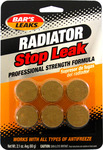
Radiator stop leak pellets
Crush the pellets inside a rag and dump them into the radiator (not the coolant reservoir). Drive the vehicle to circulate the particles. Remember that if you change the coolant down the road, you must re-dose the system, or the leak will return.
For medium leaks, use one of Bar’s liquid products. But read the label and get the right formula for your particular coolant. All coolant formulas are different, and the stop leak must be compatible with your coolant.
More stop leak product is NOT better
Most people think that more is better—if a single dose doesn’t stop the leak, a double dose will. If you use more than the label recommends, the stuff can do more harm than good. If you overdose, the concentration of particles is so high that they tend to settle in the smallest spaces, and that’s usually in the heater core. If you’ve ever had a clogged heater core on any vehicle made since 1980, you know that it’s usually a $1,500 repair. A radiator costs about 1/3 that price. Why risk ruining a perfectly good heater core to salvage a $300 radiator?
© 2012 Rick Muscoplat
Posted on by Rick Muscoplat