
How to Grease U Joints to Extend their Lifespan
The Importance of Greasing U-Joints in Your Car and How to Do It
Universal joints, commonly known as U-joints, are critical components in a vehicle’s drivetrain. They allow for the transfer of power from the transmission to the drive shaft and ultimately to the wheels, accommodating changes in angle between these components. Proper maintenance of U-joints is essential for ensuring the longevity and smooth operation of your vehicle. One key aspect of this maintenance is regular greasing. This article will discuss why it’s important to grease U-joints and provide a step-by-step guide on how to do it.
Why it’s important to routinely grease your U-joints
• To reduce friction and wear— U-joints are packed with grease during installation and the joints have rubber seals to retain the grease. However, over time, that grease can deteriorate and the seals can leak. Pumping new grease into the joint restores the original lubricity and extends the life
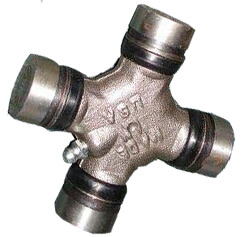
U joint with zerk grease fitting located in the cross
of the needle bearing and the joint.
• New grease flushes out the old, along with any contaminants — Fresh grease helps to flush out old, contaminated grease. It creates a barrier against dirt, water, and other harmful elements that can cause corrosion and damage to the U-joint.
• Greasing Help You Spot Early Problems— Regular greasing allows you to inspect the U-joints closely. This can help you detect potential issues early, such as loose bearings or excessive play in the joint.
• Prevents Corrosion— U-joints are often exposed to harsh conditions, including water, dirt, and road salt, especially in off-road or winter driving scenarios. Grease acts as a barrier, protecting the metal components from rust and corrosion. This is particularly important for vehicles operating in humid or coastal areas where salt and moisture can accelerate corrosion.
Step-by-step guide to grease U-joints yourself
Step 1: Support the vehicle on jack stands
Step 2: Locate all the U-joints on your vehicle and determine if they’re fitted with zerk grease fittings. If not, you’ll have use a needle injector (see below).
Step 3: Clean off an old grease
Step 4: Fill the Grease Gun with the proper grease— Use NLGI #2 GC-LB lithium complex EP grease to grease U-joints. Synthetic grease is best.
Step 5: Connect the zerk connector or use a needle injector to the fittings
Pump the grease gun until you see fresh grease emerging from the U-joint seals. This indicates that the U-joint is fully lubricated.

This image shows a U-joint with a flush type grease fitting
Wipe away any excess grease with a clean rag.
Step 6: Inspect and Repeat
Inspect the U-joints for any signs of damage or excessive wear. If everything looks good, move on to the next U-joint and repeat the greasing process. Ensure that all U-joints are adequately lubricated.
Step 7: Final Check
Once all U-joints have been greased, lower the vehicle (if it was raised) and ensure everything is securely in place. Perform a final check to ensure there are no leaks or issues.
If your grease gun connector won’t fit, purchase one of these grease gun adapters.
Grease gun needle adapters come in two basic styles: screw-on and snap-on. The screw-on styles require you to remove the coupler from the end of your grease gun hose or tube so you can screw on the needle adapter. The snap-on style has a zerk fitting on one end, so it snaps right onto your couple.
The screw-on style is more rigid and won’t leak grease, while the snap-on style is prone to leaking grease at the coupler/zerk connection. It’s not as rigid as the screw-on style, but it’s a lot more convenient.
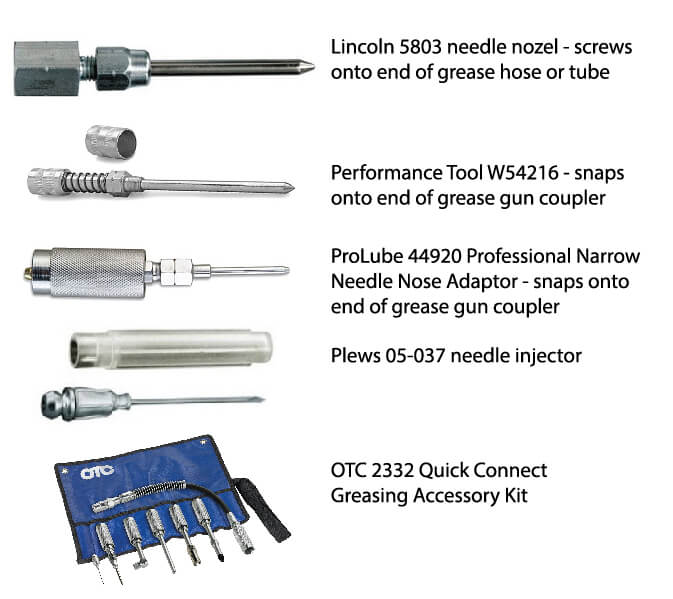
Grease gun needle adapters and kit
Choose grease gun needle adapter needle length.
The most common needle adapters have a 4-in. needle, but some adapters are about 1-in. Choose a needle adapter that can reach into the U joint.
Or, purchase a specially designed U-joint grease gun coupler
The OKYOUK couple is specifically designed for snapping onto zerk fitting in the tight cross of a U-joint. Find it on amazon.
How often should you grease U-joints?
At every oil change.
©, 2017 Rick Muscoplat
Posted on by Rick Muscoplat