
How to Test a Fuel Injector Like a ProLike a Pro
How to Test a Fuel Injector: Expert Tips to Diagnose Performance Issues
Fuel injectors play a critical role in delivering the right amount of fuel into each combustion chamber at precisely the right time. A clogged or faulty fuel injector can cause misfires, poor fuel economy, hesitation, rough idling, a check engine light and even a flashing check engine light. Fortunately, if you’re experiencing any of these symptoms, it’s not too difficult to determine whether the injector is the problem. In this guide, I’ll explain how to test a fuel injector using several simple, effective diagnostic methods. I’ll also show you how to test a fuel injector with a multimeter, as well as how to find a bad fuel injector using sound and fuel pressure checks.
What You Need to Know About Fuel Injectors Before You Begin
Port fuel injectors are mounted in
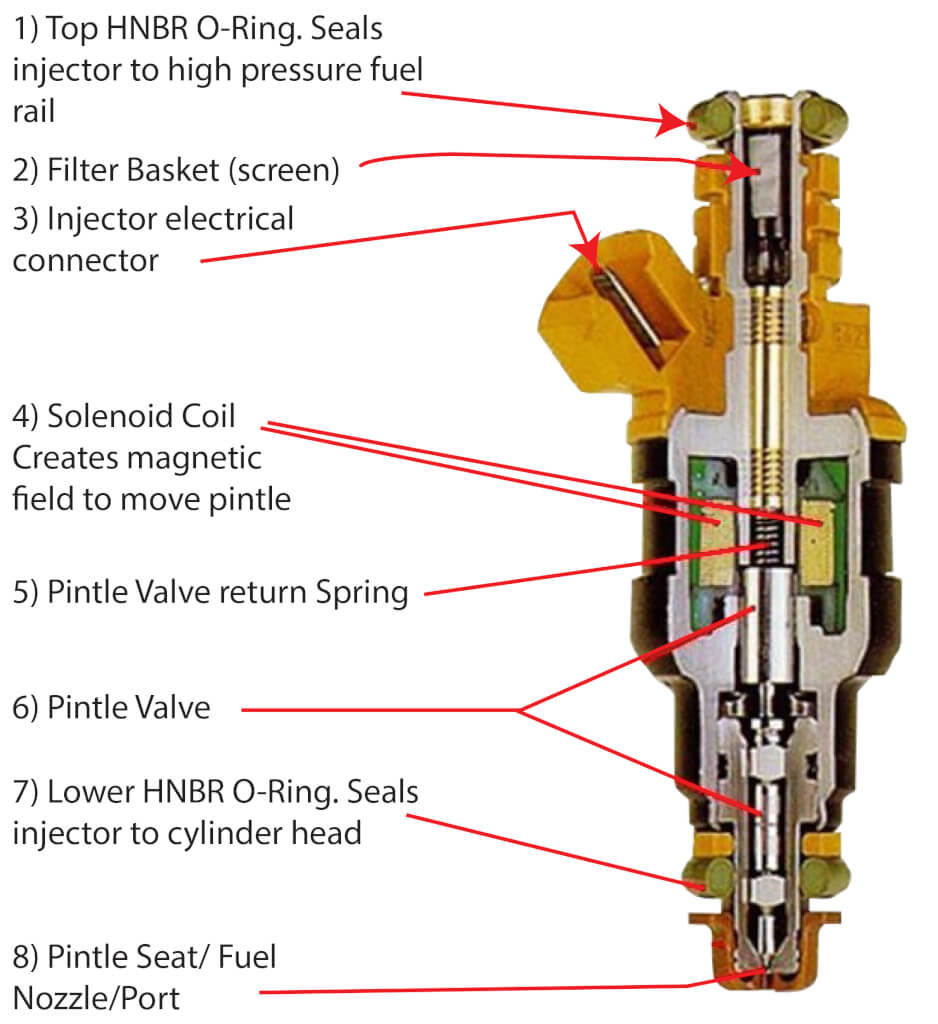
Components of a port fuel injector
the intake manifold just upstream of the intake valve. The term “fuel injector” is somewhat of a misnomer because a fuel injector doesn’t actually inject fuel as if it were a syringe. Instead, it simply opens and closes, allowing high fuel pressure provided by the fuel pump to flow through the fine spray nozzles at the end of the injector, thereby atomizing the fuel and directing it into the intake manifold.
The engine control unit (ECU) determines the precise timing and duration of each injector’s open/close timing, based on inputs from sensors measuring air flow, engine temperature, throttle position, and more.
How a Fuel Injector Works
The vehicle provides battery voltage power to all the fuel injectors. The ECM controls the ground side of the circuit. Based on input from the crankshaft position sensor, the ECM provides a pulse-width-modulated ground connection when it wants the injector to fire.
In simpler terms, firing the injector isn’t a simple on or off operation. Instead, the ECM connects and disconnects the ground side of the circuit rapidly, causing the solenoid coil to energize/de-energize rapidly. Here’s an example: If the ECM determines it wants a 50% duty cycle on the fuel injector, based on driver input, it will provide ground to energize the solenoid coil in alternating 1/10-second bursts for 5-10 seconds of on time and 5-1/10-second bursts of off time. When energized, the pintle lifts off the seat. When de-energized, the pintle spring pushes the pintle back toward the seat. However, since the timing is so fast, the pintle fully closes off fuel flow. Instead, it typically “dances between fully open versus fully closed, depending on the duty cycle.
Understanding What Causes a Fuel Injector to Fail
Fuel injectors can fail for several reasons
• The most common is carbon deposits on the nozzle, causing restricted fuel flow
• Carbon deposits on the pintle seat, causing the injector to leak fuel
• Fuel tank sediment that clogs the filter basket at the top of the injector.
• An electrical failure at the connector or the solenoid coil, causing high resistance. Or, an open or short to ground condition in the solenoid coil, preventing the injector from firing.
How NOT to test a fuel injector
You’ll see this procedure on lots of DIY forums. They recommend swapping the injector from one cylinder to another to see if the misfire moves to the new cylinder. That might sound reasonable at first, however, if the injector has a short to ground condition, swapping it to another cylinder can damage the injector driver in the ECM, toasting an otherwise good computer. Instead, perform the resistance, open, and short to ground tests listed below and forget about swapping.
Step-by-Step: How to Test a Fuel Injector
Use a Multimeter to Check For Power To Each Injector— Remember, the ECM doesn’t pulse power; it only pulses the ground side of the circuit. You should see full battery voltage at each injector when the key is in the run position. Checking for voltage and voltage drop at each injector is your first step.
Use a Mechanic’s Stethoscope to Check for Injector Pulse— One of the easiest ways to check whether a fuel injector is functioning is to listen for the clicking sound it makes while operating. Here’s how:
• Start the engine and let it idle.
• Place a mechanic’s stethoscope (or a long screwdriver) against the body of each injector.
• Listen closely—each good injector should produce a rhythmic clicking sound. Compare the sound of each injector with the others. A failing injector will sound different than the others. A dead injector won’t make any sound at all.
If you don’t hear a click from one or more injectors, chances are the solenoid coil has failed, or it’s not receiving power or ground. So your next step would be to check for power to the injector and a pulse width modulated ground.
Test for Solenoid Coil Integrity Using a Multimeter— Turn off the engine and disconnect the fuel injector’s electrical connector.
• Set your multimeter to the Ohms (Ω) setting.
• Place one probe on each of the two terminals of the injector.
• Read the resistance values of every injector.
Most fuel injectors should have a resistance between 12 and 16 ohms; however, always consult your vehicle’s repair manual for the exact specification. Any reading that’s too high, too low, or completely open (infinite resistance) means that the injector has failed. Learning how to test a fuel injector with a multimeter is one of the most effective ways to detect internal coil failure or short circuits in the injector.
Test the solenoid coil for a short to ground condition. Set the meter to ohms and touch one probe to one terminal at the connector and the other probe to the metal case of the injector. If you get a reading, the injector has a short to ground problem.
Test for a Clogged Fuel Injector by Measuring Pressure Drop—For this test, you’ll need a fuel pressure gauge and a fuel injector firing device. The goal is to turn the key to prime the fuel pump, note the fuel pressure, and then fire one fuel injector. Note the fuel pressure drop. Then turn the key again to reprime fuel pressure and repeat with each additional fuel injector. A clogged fuel injector will cause less of a pressure drop than a good injector.
What If All Injectors Pass?
Sometimes, each individual injector may seem fine in isolation, yet the engine still misfires. In such cases, it’s essential to consider:
• Injector balance testing with a scan tool
• Checking for wiring or ECU signal faults
• Verifying fuel pressure and filter condition
Knowing how to test a fuel injector is just one part of the diagnostic process. You must also make sure the injectors are receiving the proper pulse signal from the ECU. Noid light testers are inexpensive tools that can help confirm this.
Posted on by Rick Muscoplat