
How to Use Fuel Trim Diagnostics to Solve Engine Problems
Common Causes of High Positive and Negative Fuel Trim
Quick Summary
Understanding fuel trim diagnostics is one of the most powerful diagnostic skills you can learn. Fuel trim data tells you whether the 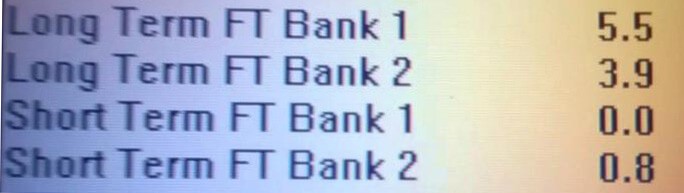 engine computer is adding or subtracting fuel to maintain the correct air/fuel ratio. By learning how to read fuel trim data, understanding short-term vs. long-term fuel trim, and knowing what causes positive or negative corrections, you can quickly identify vacuum leaks, fuel delivery problems, faulty MAF sensors, faulty oxygen sensors, and intake leaks. Fuel trim isn’t just data—it’s a roadmap that tells you exactly where to look next.
Fuel Trim Diagnostics Explained: The Secret Diagnostic Tool Most DIYers Ignore
After decades of diagnosing drivability problems, I’ve found that one of the most misunderstood—and most valuable—scan tool parameters is fuel trim.
Many technicians immediately jump to trouble codes when diagnosing an engine problem. I do the opposite. I look at fuel trim first. Why?
Because fuel trim tells me what the engine computer is thinking.
The fuel trim numbers reveal whether the computer believes the engine is running rich or lean and how hard it’s working to compensate. In many cases, fuel trim data points me directly to the root cause before I ever touch a wrench.
If you want to diagnose modern vehicles faster and more accurately, you need to understand fuel trim.
What Is Fuel Trim?
The engine control module (ECM) constantly calculates how much fuel to inject based on incoming air. But no engine remains perfect forever. To compensate, the ECM continuously adjusts fuel delivery. Those adjustments are called fuel trim.
In simple terms, Fuel trim is the percentage of fuel the computer adds or subtracts from its base fuel calculation
Over time:
• Fuel injectors wear
• Vacuum leaks develop
• Sensors age
• Fuel pressure changes
• Engine components accumulate deposits
What Do Fuel Trim Numbers Mean?
Fuel trim is displayed as a percentage.
Positive Fuel Trim — Positive numbers mean:
• The computer is adding fuel
• Because the Oxygen sensors are reporting a lean condition in the exhaust
• More fuel is needed to achieve the correct mixture
Example: A +10% fuel trim means the computer is adding 10% more fuel than originally calculated.
Negative Fuel Trim — Negative numbers mean:
• The computer is removing fuel
• Because the Oxygen sensors are reporting a rich condition in the exhaust
• Less fuel is needed
Example: A -10% fuel trim means the computer is reducing fuel delivery by 10%.
Understanding fuel trim positive vs negative is the foundation of accurate diagnosis.
Short Term Fuel Trim vs Long Term Fuel Trim
One of the most important concepts is understanding the difference between short-term and long-term fuel trim.
Short-Term Fuel Trim (STFT) — STFT is the computer’s immediate correction. Think of it as real-time fuel adjustment. The oxygen sensors detect whether combustion was rich or lean, and the ECM immediately responds by adjusting the injector pulse width.
STFT constantly moves:
+2%
-4%
+6%
-3%
This is completely normal.
Long-Term Fuel Trim (LTFT) — LTFT represents learned corrections. When the computer notices STFT consistently adding or subtracting fuel, it stores that adjustment in memory.
For example:
If STFT repeatedly adds 8% fuel, the ECM eventually moves that correction into LTFT. Then STFT can return closer to zero. This is why LTFT is often more valuable diagnostically. It tells you what the computer has been seeing over time.
STFT LTFT Meaning in Real Life
Think of STFT as: Immediate reaction
Think of LTFT as: Long-term adaptation
Together they provide a complete picture of engine operation.
Fuel Trim Normal Range
One of the most common questions I hear is: “What is a normal fuel trim reading?”
Fuel Trim Normal Range
Ideal:
STFT = 0%
LTFT = 0%
Real-world acceptable values:
±5% = Excellent
±10% = Generally acceptable
±15% = Indicates a developing problem
Greater than ±20% = Significant fault likely present
Always evaluate:
STFT + LTFT together
For example:
STFT = +5%
LTFT = +12%
Total correction = +17%
That engine is running lean.
How to Read Fuel Trim Data
Understanding OBDII fuel trim interpretation requires observing data under different operating conditions.
I always fuel trimcheck:
• At Idle
• At 2,500 RPM
• During Cruise
• During Acceleration
The pattern often identifies the problem immediately.
Fuel Trim Diagnostics Strategy
This is where fuel trim becomes incredibly powerful. The key isn’t just reading numbers. The key is knowing what the numbers tell you to test next.
High Positive Fuel Trim at Idle Only
Example: STFT + LTFT = +20% at idle., but drops to +5% at 2,500 RPM. This almost always suggests:
Vacuum Leak
Possible causes:
• Intake manifold leak
• Vacuum hose leak
• PCV system leak
• Brake booster leak
Why?
A vacuum leak has the greatest effect at idle when airflow is low.
Next Tests
• Smoke test the intake system
• Inspect vacuum hoses
• Check PCV valve operation
High Positive Fuel Trim at All RPMs
Example:
+18% at idle
+16% at cruise
+20% under load
Possible causes:
• Fuel Delivery Problems
• Weak fuel pump
• Restricted fuel filter
• Low fuel pressure
• Partially clogged injectors
• Fuel Trim MAF Sensor Problems
A contaminated MAF sensor may under-report airflow. The computer thinks less air entered the engine and injects too little fuel.
Next Tests
• Fuel pressure test
• Fuel volume test
• MAF sensor data analysis
• Injector balance test
Negative Fuel Trim at Idle and Cruise
Example: STFT + LTFT = -15%. This indicates the ECM is removing fuel.
Possible causes:
• Rich Condition
• Leaking fuel injectors
• Excessive fuel pressure
• Saturated charcoal canister
• Faulty fuel pressure regulator
Next Tests
• Fuel pressure measurement
• Injector leak-down test
• EVAP purge valve inspection
• Fuel Trim and Oxygen Sensor Diagnosis
Many people assume abnormal fuel trim automatically means a bad oxygen sensor.
Usually it doesn’t. The oxygen sensor is often reporting correctly. However, a faulty sensor can create misleading fuel trim data.
Fuel Trim O2 Sensor Clues
If:
• Fuel trim is extreme
• O2 sensor voltage is fixed
• Sensor switching is slow
Then sensor testing becomes necessary.
Next Tests
• Observe sensor switching speed
• Compare upstream and downstream O2 activity
• Check heater circuit operation
• Fuel Trim Rich Lean Correction Explained
The ECM constantly aims for a 14.7:1 air/fuel ratio.
When oxygen sensors detect excess oxygen:
• Fuel trim increases
When oxygen sensors detect too little oxygen:
• Fuel trim decreases
Using Fuel Trim Live Data to Diagnose Faster
The biggest mistake I see is checking stored trouble codes without viewing fuel trim live data.
Live fuel trim often reveals:
• Vacuum leaks
• MAF errors
• Fuel pressure problems
• Exhaust leaks
• Injector issues
before a code even sets. That’s why fuel trim is one of the first scan tool parameters I review.
What Causes High Fuel Trim?
Common causes include:
Lean Fuel Trim Causes
• Vacuum leaks
• Intake leaks
• Dirty MAF sensor
• Low fuel pressure
• Restricted injectors
• Exhaust leaks ahead of O2 sensor
Rich Fuel Trim Causes
• Leaking injectors
• High fuel pressure
• Faulty purge valve
• Contaminated MAF sensor
• Incorrect fuel pressure regulator operation
Final Thoughts
If you truly want to become better at diagnostics, learn fuel trim. Understanding what fuel trim is, interpreting STFT and LTFT meanings, and mastering OBD2 fuel trim interpretation allows you to pinpoint problems faster than simply chasing trouble codes.
Fuel trim doesn’t tell you exactly what’s broken—but it tells you where to look next. Once you understand the patterns, fuel trim becomes one of the most valuable diagnostic tools available on any scan tool.
Learn more about fuel trim
What is long term fuel trim and how to diagnose a problem
What is adaptive memory and how to clear it
©, 2018 Rick Muscoplat
Posted on by Rick Muscoplat