
How to Visually Inspect a Timing Belt Safely
When to Replace a Timing Belt If You Don’t Know Its History
Quick Summary
If you don’t know whether the timing belt was last changed, here’s how to conduct an inspection.
• Remove the timing cover and check for belt cracks, tears, edge fraying, etc.
• Check for missing cogs on the belt.
• Check the shape of the cogs; rounded edges mean more wear
Article
Over the years, I’ve seen far too many engines ruined simply because people weren’t sure when to replace a timing belt and decided to wait. A timing belt is one of the most critical components in your engine, and when it fails, the damage can range from inconvenient to catastrophic. If you’re driving a used vehicle, or you can’t find any documentation, you must treat the belt as overdue.
In this guide, I’ll explain how to check a timing belt, how to interpret timing belt condition, and how to safely visually inspect a timing belt—as well as what you should replace at the same time.
When to Replace a Timing Belt Based on Mileage
Every manufacturer publishes a mileage interval for timing belt replacement, usually between 60,000 and 100,000 miles. Honda, Toyota, Lexus, and Acura often specify the upper end of that range, while VW, Subaru, and Hyundai frequently fall toward the lower end.
If you don’t know the mileage since the last replacement, assume the interval has already passed. Guessing wrong is the fastest way to destroy an engine.
When to Replace a Timing Belt Based on Age
Rubber degrades over time. Even if you drive very few miles, the belt still deteriorates due to heat cycles, ozone exposure, oil vapor saturation, and simple aging. Most professionals (myself included) consider the timing belt condition unsafe after 7-10 years, regardless of mileage.
How to Check a Timing Belt When You Aren’t Sure of Its Age
You can’t always see internal failures, but you can visually inspect a timing belt for surface-level damage. Here’s how to check a timing belt properly:
Signs the belt must be replaced immediately
• Cracks across the ribs or on the smooth back
• Missing teeth
• Fraying along the edges
• Glazing or shininess
• Coolant or oil contamination
• Rubber dust around the timing cover
• Belt deflection (slack) caused by tensioner wear
If the belt shows any of these, the timing belt condition is unsafe and requires immediate replacement. But understand this: even if the belt looks good, that doesn’t mean it is good. Surface inspections have limits. That’s why I emphasize replacing the belt if the maintenance history is uncertain.
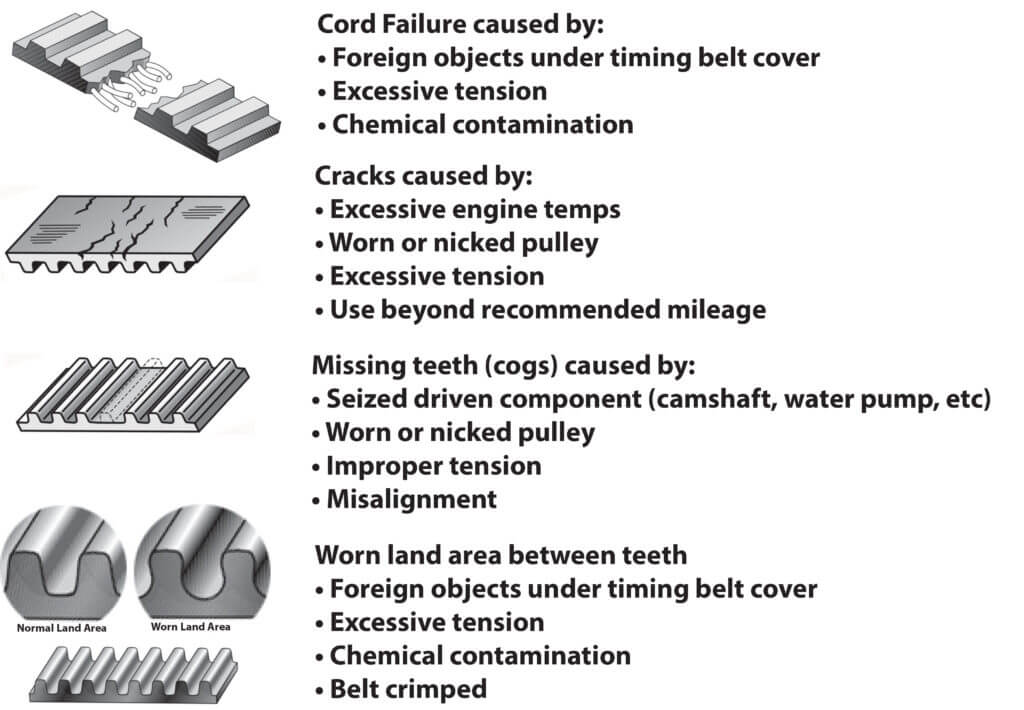
Conditions that require you to replace a timing belt outside of the mileage recommendation

Notice the cracks on the backside of the timing belt. Regardless of time or mileage, this belt must be replaced immediately.
Interference vs. Non-Interference Engines — Why It Matters
If you’re unsure when to replace a timing belt, consider the ramifications of a belt failure on an interference versus a non-interference engine.
Interference engines — If the belt breaks, the pistons strike the valves. This b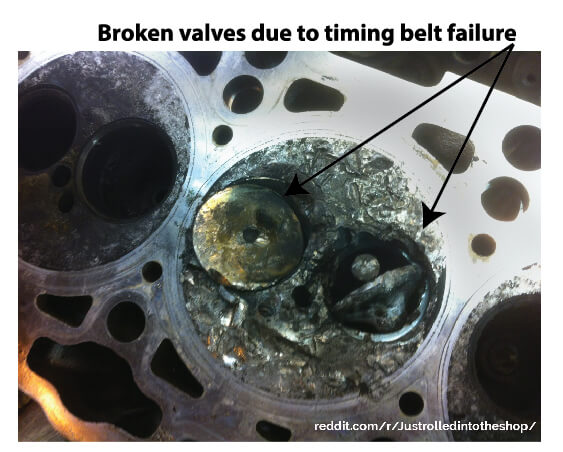 ends valves, cracks pistons, and often destroys the head. Repairs typically cost $3,500–$5,000.
Non-interference (freewheeling) engines — The belt can break without causing internal damage. But the engine will immediately stall, requiring a tow. You’ll still pay for a timing belt job—plus towing.
Regardless of engine type, delaying belt replacement offers no benefit.
What Else should you replace With the Timing Belt?
1. Tensioner — A weak tensioner can let a good belt slip, jumped t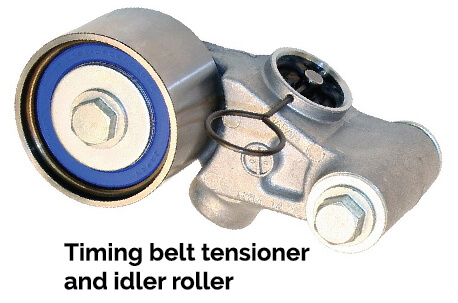 iming, and cause the same damage as a snapped belt.
2. Idler pulleys — All idler pulleys have a center bearing that wears with age and miles. If a worn bearing seizes, it will damage the belt and your engine.
3. Water pump — If the timing belt drives your water pump, replace it. If the pump fails later, you’ll have to redo the entire job, paying twice for the timing belt labor.
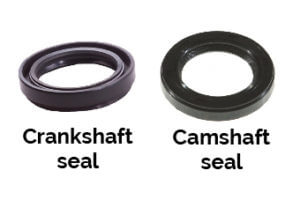
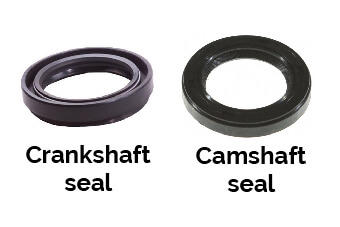
4. Camshaft and crankshaft seals — The seals are cheap, and they’re easy to replace while the belt is off. If they’re leaking, replace them. If not, they’re optional—but still recommended.
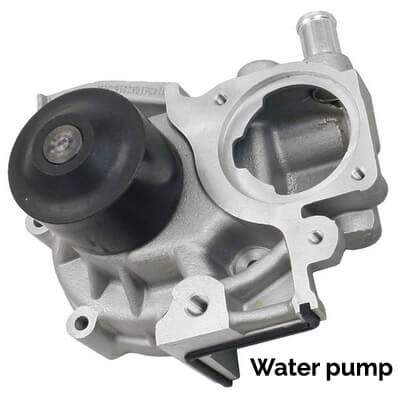
This is a typical timing belt-driven water pump. The smooth backside of the timing belt drives the round black pulley.
5. Coolant service — If the water pump is replaced, you’re already paying for a cooling system drain. A discounted coolant flush is a smart add-on.
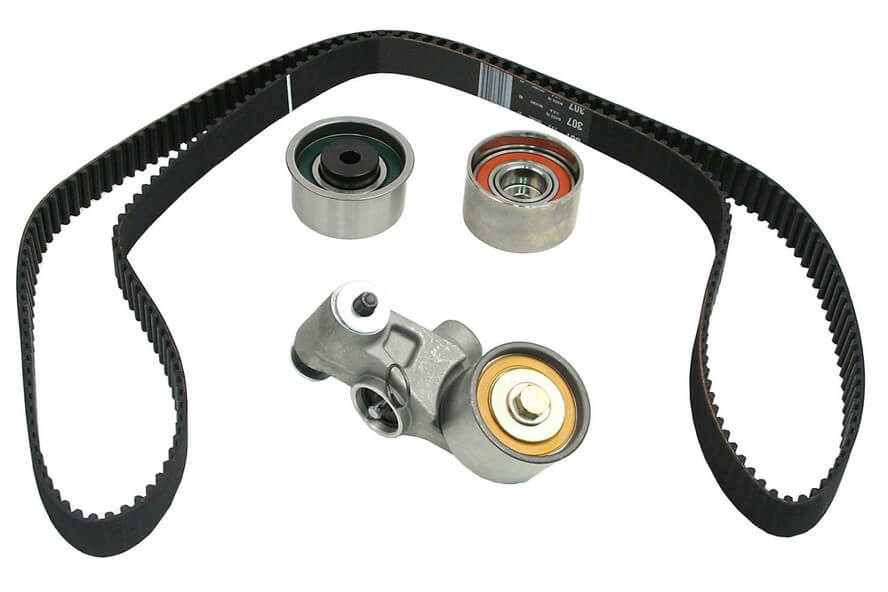
This is a typical timing belt kit. The kit includes the belt, idler rollers, and a new belt tensioner.
 How to Avoid Being Overcharged for Timing Belt Work
Some shops double-charge for labor that overlaps. For example:
• Replacing the water pump with the timing belt should add 0.7 hours, not 3.0 hours.
• Replacing serpentine belts during the timing belt job should not include extra labor—they must be removed anyway.
• Always ask for a printed labor breakdown. A reputable shop won’t hesitate.
• Replacing a timing belt is costly; get a second quote from a reputable shop
©, 2016 Rick Muscoplat
Posted on by Rick Muscoplat