
Is tire rotation necessary? Factual data says yes
Learn why tire rotation is important
Tires wear unevenly on every vehicle, making tire rotation necessary to maintain the best traction and stopping power and increase the life of your tires. Here’s an explanation of why tires wear unevenly, how often you should have them rotated, and a cost/benefit analysis.
Tire rotation is important to reduce uneven tie wear
It doesn’t matter whether you drive a front-wheel drive, rear-wheel drive, all-wheel drive, or four-wheel drive vehicle: 60% of the vehicle’s weight is carried by the front tires. That fact alone means the front tires wear faster than the rear tires. Plus, the front tires perform all steering maneuvers, causing more rubber to “scrub” the tire in turns. Also, about 70% of the vehicle’s braking is done by the front tires since the vehicle’s weight shifts forward during a stop (although that’s changed on newer vehicles with electronic brake force distribution safety features). When you factor in the extra weight and wear from steering and braking, it’s no wonder that front tires wear faster than rear tires.
Finally, front tires are subject to more impacts from potholes and parking lot barriers. Those impacts can result in a 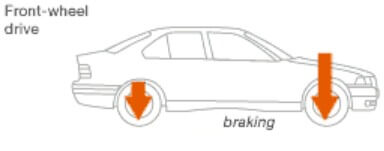 momentary air pressure loss that causes underinflation. Underinflated tires wear faster than tires that have the correct air pressure. See this post to understand why the correct air pressure is so important to tire life.
Why not skip costly tire rotations and just replace the front tires when they wear out? First, that may not be an option if you own a 4WD or AWD vehicle. Some models require all tires to be within a certain circumference or tread depth to prevent damage to the center differential. Depending on the year and brand, you may have to replace the two rear tires if their tread depth varies by more 2/32″ from the new ones you’re replacing.
What tire rotation accomplishes
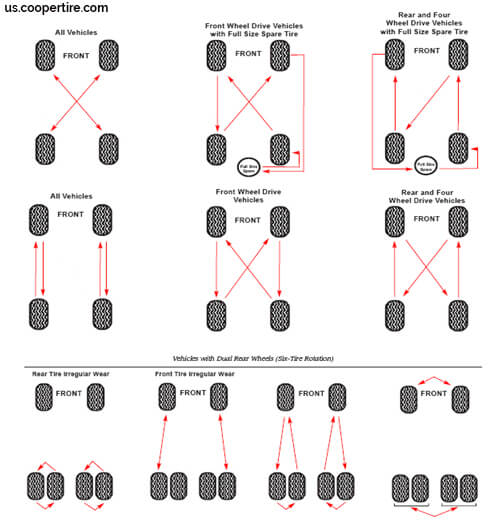
Tire rotation spreads the wear evenly across all four tires, increasing overall tire life and safety. In addition, tire rotation evens out any wear patterns that have developed in the tires.
What are typical tire rotation patterns?
The cost/benefit analysis of tire rotation
Many tire shops sell a mounting and lifetime tire rotation and balancing package for about $20 per tire.
However, most independent repair shops and dealers charge about $25 each time they rotate your tires.
If you buy the lifetime rotation/balance package from a tire store, you’ll spend an extra $80 up-front on a set of four tires. If you have a dealer rotate your tires every 5,000 miles at $25 each time you’ll spend $300 during the life of a set of 4 60,000 mile tires.
Failing to rotate your tires can shorten the life of the front tires by 50%.
Tire rotation is important because it saves you money
Let’s use a 2010 Mazda CX-7 crossover/SUV for our comparison. It’s typical of many late crossover/SUV model vehicles with low-profile tires. A low-cost tire for this vehicle costs around $240.
Cost per mile with tire store rotation package
4 tires at $240 each plus $20/each rotation/balance add-on. $1,040 ÷ 60,000 miles = 0.0173/mile
Cost per mile with rotations done every 5,000 miles at $25 each
4 tires at $240 each plus $300 for rotation. $1,260 ÷ 60,000 miles = 0.0210/mile
Cost per mile with NO rotations
4 tires at $240 =$960, plus 2 new tires at 30,000 to replace the worn out front tires. +$480= $1,440
$1,440 ÷ 60,000 miles= 0.024/mile
The net result is that failure to rotate your tires costs you 39% more.
In addition, buying tires from a dealer or independent repair shop and paying for rotation each time will cost you 21.5% more than buying the same tires from a tire store that offers a lifetime rotation/balance package for $20/tire.
Additional benefits of tire rotation
• Longest tread life
• Better handling in turns and better braking due to even tire tread depth at all four wheels
• Lower overall cost
How often should you rotate your tires?
As a general rule, you should rotate your tires every 5,000 to 7,000 miles, depending on the advice of the tire manufacturer or tire store service manager. Choose the lower interval if you routinely carry a heavy load in your vehicle, have a heavy foot like jack-rabbit starts, and like to brake hard.
©, 2016 Rick Muscoplat
Posted on by Rick Muscoplat