
Knock Sensor Symptoms: Signs Your Knock Sensor Is Failing
What Causes a Knock Sensor Code?
Quick Summary
If you’re experiencing engine performance problems, reduced power, poor fuel economy, or a check engine light that indicates a knock sensor trouble code, a failing sensor may be the culprit. The most common symptoms include:
• Sluggish acceleration
• Engine hesitation
• Poor gas mileage
• Trouble codes such as P0325 or P0330.
While a bad sensor won’t leave you stranded, it can reduce engine performance and, in some cases, allow engine-damaging detonation to go undetected.
In this guide, I’ll explain what a knock sensor does, the most common signs of a bad sensor, how to test it, and whether you can drive with a bad sensor.
What Does a Knock Sensor Do?
Before discussing symptoms, it’s important to understand the sensor’s purpose.
The sensor is essentially the engine’s “ears.” It’s designed to detect abnormal combustion, commonly called spark knock, pinging, or detonation.
When detonation occurs, it sends a signal to the powertrain control module (PCM). The PCM responds by adjusting ignition timing to prevent engine damage.
Without a functioning knock sensor, the engine computer may not be able to properly detect harmful combustion events.
That’s why modern engines rely heavily on sensor feedback to maximize power, fuel economy, and reliability.
What is Engine Knock?
Before exploring the workings of a knock sensor, it is essential to understand what engine knock is. Engine knock, also known as pre-ignition, ping, or detonation, occurs when the air-fuel mixture in an internal combustion engine’s cylinder ignites prematurely or unevenly. Instead of a smooth, controlled burn initiated by the spark plug, knock results in a rapid, uncontrolled explosion. This creates shock waves within the cylinder, producing a characteristic pinging or knocking sound.
How it works
The sensor receives a quick bias voltage from the ECM at startup. That’s a test voltage to prove that the wiring harness and sensor are working. From that point on, the sensor doesn’t require any voltage.
Inside the sensor, you’ll find a piezoelectric crystal that generates an AC voltage when it’s compressed by engine vibrations. The vibrations occur if the engine encounters preignition or detonation. The sensor is tuned to the discrete frequency range of preignition and detonation, so it doesn’t falsely alarm from normal engine noise.
Why does the engine need a knock sensor?
To maximize power from each combustion event, engineers have determined that combustion should occur at around 14° after top dead center (TDC). To make sure the air/fuel mixture reaches maximum force at that point, the ignition system initiates the spark early so the flame front can grow. The timing of the spark varies with engine RPM, so it may occur a few degrees before top dead center (BTDC) at idle but advance to as much as 20° BTDC at 3,000 RPM. The car’s ECM monitors the knock sensor readings to ensure combustion occurs as planned.
If the sensor detects knock, the ECM adjusts ignition timing, often retarding the spark to shorten burn time. If that doesn’t work, the ECM can adjust the air/fuel mixture. If the knock continues, the ECM will switch to SAFE MODE. At that point, it uses the misfire monitor to track engine performance. The driver will often notice a lack of power when the engine is in safe mode.
How does it fail?
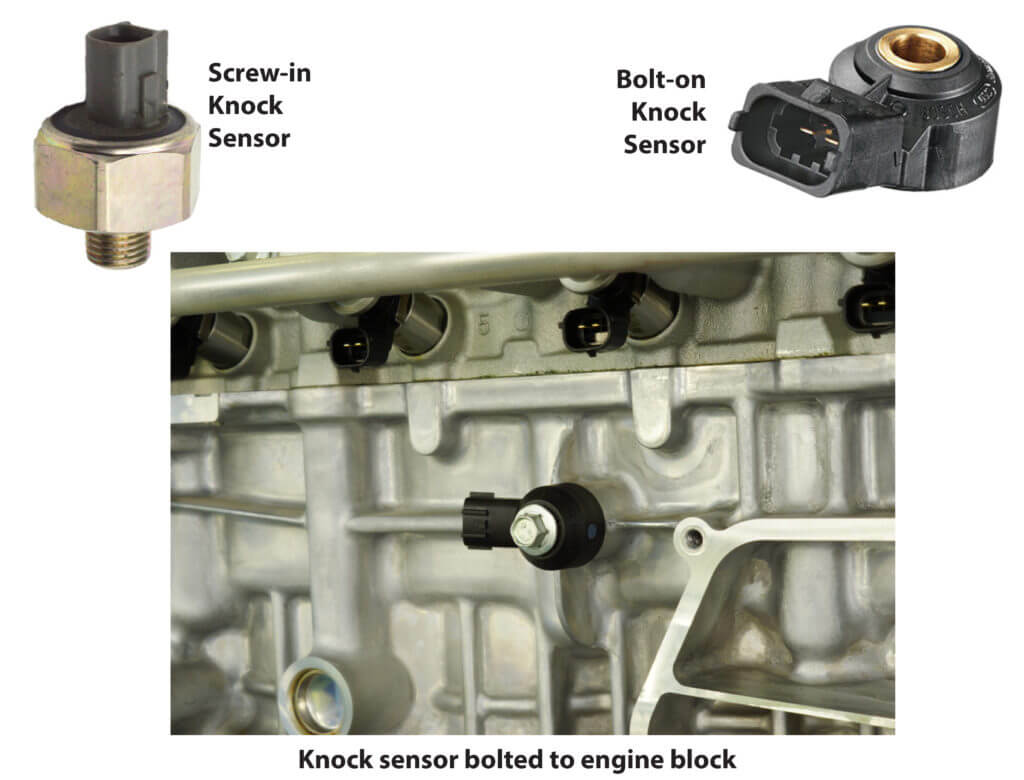
The knock sensor can be mounted in the valley of a V-style engine or on the side of the engine block. It’s exposed to strong vibration, oil, and moisture. Due to its mounting location, it can be exposed to moisture, which can prevent the piezoelectric crystal from producing an AC voltage. If that happens, the sensor must be replaced.
Types of knock sensors?
They can be screw-in or bolt-on. If you’re installing a bolt-on-style sensor, tightening to the correct torque is critical; always use a torque wrench. In addition to the proper torque, many carmakers specify a particular orientation to capture vibrations. Orienting the sensor at the wrong angle can render it useless in detecting knock.
What Causes a Knock Sensor Code?
Several issues can trigger a knock sensor code.
Common causes include:
Failed Sensor — The sensor itself may fail internally due to age, heat, or vibration.
Wiring Problems — Damaged wiring is surprisingly common.
Look for:
• Corrosion
• Rodent damage
• Broken wires
• Loose connectors
• Knock Sensor Circuit Malfunction
A knock sensor circuit malfunction may result from:
• Open circuits
• Short circuits
• Poor grounds
• Connector failures
• Engine Noise
Sometimes the sensor is functioning correctly and detecting legitimate engine noise caused by:
• Worn rod bearings
• Excessive carbon buildup
• Improper fuel octane
• Mechanical engine problems
How to Test It
If you’re wondering how to test a knock sensor, here’s the procedure I use.
Step 1: Check for Trouble Codes — Use a scan tool to identify stored codes. Common knock sensor-related codes include:
P0325
P0326
P0327
P0328
P0330
Step 2: Inspect the Wiring — Visually inspect:
• Harness routing
• Connector condition
• Corrosion
• Broken wires
Step 3: Check Sensor Resistance — Many sensors can be tested with a digital multimeter. Compare measured resistance to factory specifications.
Step 4: Monitor Live Data — A professional scan tool allows you to monitor knock retard activity and sensor response under load.
Step 5: Verify Engine Mechanical Condition — Excessive engine noise can mimic a sensor failure. Always rule out mechanical problems before replacing parts.
Replacement Cost
The cost of replacing a knock sensor varies widely depending on the sensor’s location.
Typical costs include:
• Sensor only $40-$200
• DIY replacement $40-$250
• Professional replacement $150-$800
• Intake manifold removal required $400-$1,200+
Some engines require extensive disassembly, making labor the largest expense.
Most Common Symptoms
After diagnosing hundreds of sensor-related problems over the years, I’ve found these to be the most common signs of a faulty knock sensor.
1. Check Engine Light — The most common symptom is an illuminated check engine light. A failing sensor often triggers codes such as:
P0325 Knock Sensor Circuit Malfunction
P0326 Knock Sensor Performance
P0327 Knock Sensor Low Input
P0328 Knock Sensor High Input
P0330 Knock Sensor Bank 2
These knock sensor code symptoms usually appear before any noticeable drivability issues.
2. Reduced Engine Power — One of the most noticeable knock sensor symptoms is reduced engine power. When the PCM loses confidence in knock sensor data, it often enters a protective strategy by retarding ignition timing.
The result:
• Sluggish acceleration
• Reduced horsepower
• Poor throttle response
• The engine feels less responsive
Many drivers describe this as driving with the parking brake partially engaged.
3. Poor Acceleration — A knock sensor causing poor acceleration is extremely common. Modern engines rely heavily on optimized ignition timing for performance. When the PCM can’t accurately detect detonation, it often pulls timing to protect the engine.
Symptoms include:
• Slow acceleration
• Hesitation during passing maneuvers
• Reduced highway performance
• Lack of power when climbing hills
4. Poor Fuel Economy — A knock sensor causing poor fuel economy is another common complaint. Retarded ignition timing reduces combustion efficiency. Many drivers notice their fuel costs increase long before the check engine light appears.
The result is:
• Lower miles per gallon
• Increased fuel consumption
• Reduced engine efficiency
5. Engine Hesitation — Another common symptom is hesitation during acceleration. These symptoms occur because the PCM cannot properly optimize spark timing.
You may notice:
• Delayed throttle response
• Flat spots during acceleration
• Engine is stumbling under load
6. Engine Pinging or Spark Knock — What happens when a knock sensor goes bad? In some cases, actual engine knock becomes more noticeable. This symptom should never be ignored because prolonged detonation can damage pistons and valves.
You may hear:
• Metallic pinging
• Rattling under acceleration
• Spark knock while climbing hills
7. Rough Idle — Although less common, some vehicles develop rough idle conditions due to ignition timing adjustments caused by faulty sensor inputs.
Can it Cause Misfires?
One of the most common questions I receive is: Can a bad knock sensor cause misfires? The answer is usually no. A failed knock sensor generally doesn’t create a true ignition misfire.
However, excessive timing retard can make the engine feel rough enough that drivers mistake it for a misfire. If you’re seeing actual misfire codes such as P0300 through P0308, look for ignition, fuel delivery, compression, or vacuum leak issues.
Can You Drive With a Bad Knock Sensor?
Usually, yes. Most vehicles remain drivable. However, I don’t recommend postponing repairs because:
• Fuel economy may suffer
• Engine performance decreases
• Detonation may go undetected
• Long-term engine damage is possible
The longer you wait, the greater the risk of additional problems.
How Long Do They Last?
Most sensors last:
• 100,000 to 150,000 miles
• Often, the life of the vehicle
Factors that shorten sensor life include:
• Engine heat
• Vibration
• Oil leaks
• Coolant leaks
• Corrosion
Final Thoughts on Knock Sensor Symptoms
When I diagnose knock sensor issues, I don’t immediately replace it. I first verify wiring integrity, check for related trouble codes, inspect engine performance data, and rule out mechanical engine noise.
A failed sensor can cause reduced power, poor acceleration, poor fuel economy, and a check engine light, but many knock sensor codes are actually caused by wiring problems or engine issues.
A proper diagnosis saves money and prevents the replacement of parts that aren’t actually defective.
©, 2019 Rick Muscoplat
Posted on by Rick Muscoplat