
Mode $06 Explained: How to Diagnose Problems With It
Best Ways to Use Mode $06 for Engine Diagnostics
Quick Summary: What You Need to Know About Mode $06
Mode $06 is one of the most powerful—but most misunderstood and underutilized diagnostic tools built into OBDII. For example, Mode $06 can show you the actual test data from the vehicle’s onboard monitors—data that’s been building over time but hasn’t gotten bad enough yet to trigger a trouble code. In other words:
• While trouble codes tell you what has already failed, Mode $06 data tells you what’s about to fail.
If you know how to interpret it, Mode $06 can dramatically shorten diagnostic time and eliminate guesswork.
Mode $06: The Hidden Diagnostic Tool Most Techs Ignore
When I’m diagnosing a stubborn engine or transmission issue, especially one without a clear trouble code, I go straight to Mode $06. This is where the real data lives—the data the vehicle uses internally to decide whether to set a fault code.
Mode $06 isn’t a basic scan tool feature for beginners. It’s raw, unfiltered diagnostic information. But once you understand it, you gain an edge that most technicians simply don’t have.
Mode $06 is part of the OBDII system that reports the results of onboard self-tests. These tests run continuously in the background while the vehicle operates. Instead of just telling you “pass” or “fail,” Mode $06 shows you the actual measured values and limits.
Each test result includes:
• Test ID (TID) – identifies the system being tested
• Component ID (CID) – identifies the specific component
• Measured value – what the system recorded
• Minimum/maximum limits – acceptable range
If the measured value is approaching the limit, you’ve found a problem before it becomes a code. The image below shows Mode$06 misfire data by cylinder.
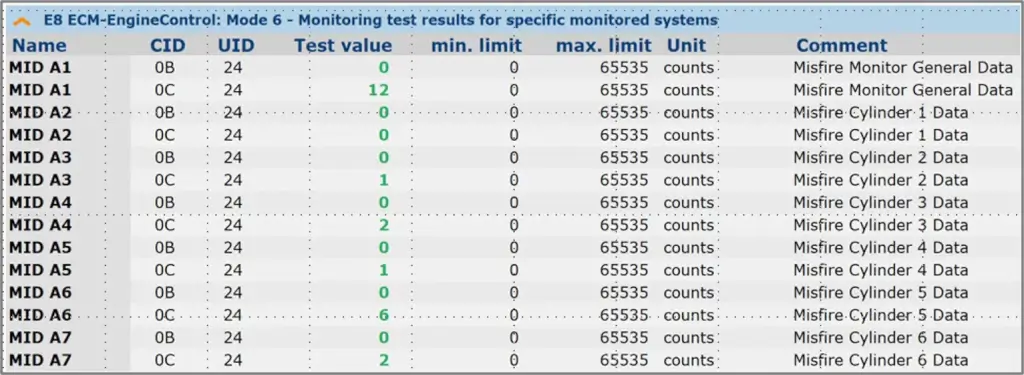
Mode$06 misfire data
Why Mode $06 Is So Valuable for Diagnosis
I use Mode $06 when:
• There’s a driveability complaint, but no codes
• A code is intermittent
• I want to confirm a repair actually worked
• I suspect a borderline sensor or actuator
If you start using Mode $06 regularly, you’ll:
Diagnose faster
Replace fewer unnecessary parts
Catch problems earlier
Mode $06 allows me to see weak components that haven’t completely failed yet.
For example, I’ve diagnosed:
• Weak ignition coils before a misfire code sets
• Catalytic converters losing efficiency before P0420
• Oxygen sensors slowing down but still “passing”
Without Mode $06, those problems can easily be missed.
How I Interpret Mode $06 Data
Here’s where most people get lost—interpretation. Mode $06 doesn’t say “bad part.” It gives you numbers. You have to compare:
• Measured value vs. maximum/minimum limits
• Trends over time
• Differences between cylinders or components
What I look for:
• Values that are close to failure limits, but haven’t exceeded the limits
• One cylinder or component behaving differently than others
• Gradual degradation patterns
For example:
If one cylinder shows higher misfire counts than the others—even if it’s still within limits—that’s your problem area.
Real World Examples of How Mode$06 Data Helps You Diagnose Engine Problems
Symptom: Rough Idle but no trouble codes stored
Mode$06 allows you to see which cylinders are misfiring, even when the misfires haven’t surpassed the threshold to set a single-cylinder misfire code. By comparing the misfires cylinder-by-cylinder, you can get an idea of which cylinder might be causing the rough idle. Then you can check the spark plug, coil, and fuel injector for that particular cylinder without having to remove all the plugs/coils.
Symptom: High Fuel Consumption and Lack of Power, but no trouble codes
Read Mode$06 oxygen sensor data to see each O2 sensor’s response time and switching activity to detect a lazy O2 sensor that hasn’t reached the point of setting a code.
Symptom: Code for EVAP Leak
Use it to see the actual vacuum pressure the system lost during the test, telling you how. That helps you narrow down the size of the leak.
Using Mode$06 to Verify Repairs
This is one of my favorite uses. After replacing a component, I check:
• Has the test value improved?
• Is it now well within limits?
• Are all cylinders/components consistent?
This eliminates guesswork and comebacks.
The Limitations of Mode $06
It isn’t perfect.
• The data can be hard to interpret without experience
• Test IDs vary by manufacturer
• Some scan tools don’t display it clearly
• Not all systems are fully supported
That said, once you learn how to read it, these limitations become manageable.
Final Thoughts: Why Mode $06 Should Be Part of Every Diagnostic Routine
If you’re serious about diagnostics, you need to be using Mode $06. It’s one of the most underutilized tools in modern vehicles, yet it provides some of the most valuable insight.
I don’t rely on trouble codes alone. By the time a code sets, the problem has already progressed. Mode $06 lets me see issues developing in real time—before they become failures.
That’s the difference between guessing and diagnosing.
©, 2026 Rick Muscoplat
Posted on by Rick Muscoplat