
No Heat in Car? Why Your Car Heater Blows Cold
The Most Common Reasons There’s No Heat in Your Car
Quick Summary
Your car’s heater is blowing cold air. Here are the most common causes:
Low coolant level — Check the coolant reservoir level.
Stuck Open Thermostat — The engine temp should be in the middle of the range. If it’s lower, suspect a bad thermostat.
Clogged Heater Core — A clogged heater core reduces coolant flow and heat transfer
Failed Blend Door Actuator or blend door — The blend door controls cabin temperature. If the door can’t move properly, you get cold air
Article
Few winter problems get drivers more irritated than discovering no heat in the car just when they need it most. I’ve diagnosed this complaint thousands of times, and despite the wide range of vehicles, the causes are surprisingly consistent. Most people assume the heater itself is broken, but that’s rarely true. When a car heater blows cold, it’s usually doing exactly what it’s told—it just isn’t being given heat to work with.
A car heater doesn’t make heat. It steals heat from the engine. When there’s no hot air from the car heater, something is preventing engine heat from reaching the cabin. Once you view the system that way, the diagnosis becomes logical rather than mysterious.
Low Coolant: The Most Common Cause of No Heat in Your Car
If I had to name the number one reason for no heat in your car, it would be low coolant—especially when the complaint is worse at idle. When the coolant level drops, the water pump can’t circulate enough coolant through the heater core at low engine speed. The result is predictable: you stop at a light, and suddenly the car heater blows cold air. When I hear that description, I check the coolant level first.
Topping off the reservoir may restore heat temporarily, but if low coolant caused no heat in the car, there’s a leak somewhere. Fixing the level without fixing the leak guarantees the car heater blows cold again later.
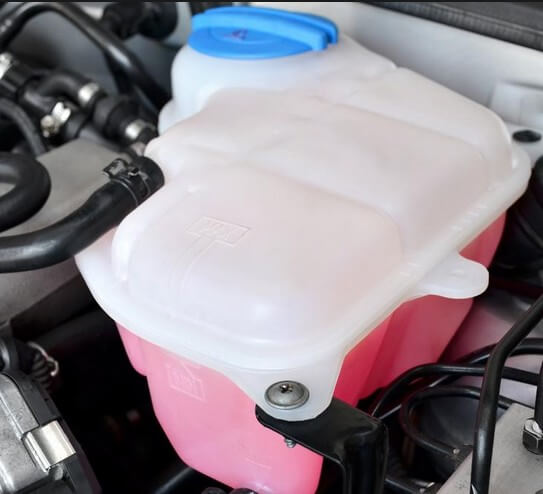 To fix a problem caused by low coolant, add the proper coolant to the reservoir until it reaches the recommended level.
If the reservoir is empty or low, refill it with the proper coolant, then drive the vehicle to check heater operation. Then, find out why the system is low on coolant.
How a Stuck-Open Thermostat Causes No Heat
The thermostat’s job is to regulate engine temperature. When it fails in the open position, coolant circulates continuously and never reaches a high enough temperature. That overcooling is a textbook reason a car heater blows cold.
Here’s the giveaway symptom I listen for: more heat when stopped than when driving. At idle, coolant moves slowly and can absorb more heat from the engine. Once you start driving, airflow across the radiator increases, the engine overcools, and suddenly there’s no hot air from the car heater again.
I’ve seen drivers block the radiator with cardboard to fix the no heat condition. That’s a bad idea. Uneven cooling can cause real damage. If the thermostat is stuck open, replacement is the correct fix—and fuel mileage usually improves, too.
The thermostat regulates engine coolant temperature by modulating coolant flow through the engine. If the thermostat gets stuck in the open or near-open position, it allows too much engine cooling, causing lukewarm coolant to flow into the heater core and reducing cabin heat.
Clogged Heater Cores and Persistent No Heat in Car Complaints
When the coolant level and thermostat operation check out, I move on to the heater core flow. Heater cores clog much sooner than radiators because their passages are much smaller. Skipped coolant changes allow corrosion to build, and once the core
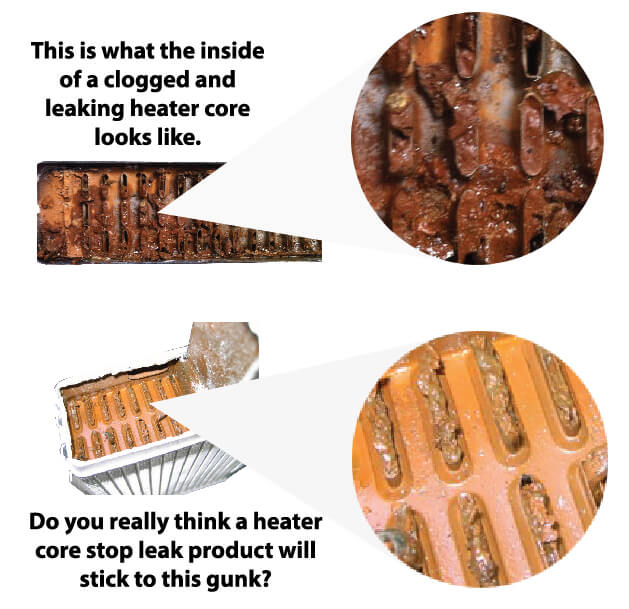
Notice how the heater core passages are plugged with corrosion. That’s why this heater blows cold air.
plugs, hot coolant can’t circulate.
A fully clogged core means no heat in the car at all. A partially clogged core usually produces weak or lukewarm air, which drivers describe as a car heater that blows cold. I confirm this by checking the heater hoses at the firewall. Both should be hot and close in temperature. If one is hot and the other cool, coolant isn’t flowing.
In some cases, flushing restores flow and eliminates complaints of no heat from the car heater. In others, replacement is unavoidable. Either way, neglected coolant service is often the root cause.
If you haven’t kept up with coolant changes, the coolant system can corrode. Since the tubes in the heater core are much smaller than those in the radiator, the core will plug up first. Once plugged, hot coolant can’t circulate, and your heater will blow cold air.
A fully plugged heater core will not provide heat, while a partially plugged core might provide lukewarm heat. Some heater cores can be cleaned out by filling them with CLR cleaner overnight and then flushing them with a garden hose. See this post for more information on how to flush a heater core.
Blend Door Failures That Make a Car Heater Blow Cold
Sometimes the cooling system is doing everything right, yet there’s still no heat in the car. That’s when airflow control becomes the suspect.
The blend door determines whether air passes through the heater core or bypasses it. It is moved by a cable, vacuum, or electric motor (see this post for more information on how a blend door works). These actuators fail far more often than heater control modules, and when they do, the door can stick in the cold position.
When that happens, the engine and heater hoses are hot, yet the car heater still blows cold. I’ve also seen binding blend doors repeatedly destroy new actuators, so checking door movement is critical when diagnosing no hot air from the car heater problems.
Heater Control Valves on Older Vehicles
Some older vehicles use a heater control valve to regulate coolant

From the driver’s seat, this feels exactly like a clogged heater core: no heat in the car despite a warm engine. That’s why I always verify valve operation before condemning major components when a car heater blows cold.
flow into the heater core. These valves may be cable- or vacuum-operated. If the valve sticks closed or a vacuum hose leaks, hot coolant never reaches the core.
How to fix a clogged heater core
With the engine warmed up, touch both the inlet and outlet hoses to your heater core. Even if your heater core is operating
The heater control valve may have more than one hose. Check the shop manual to determine which is the feed hose
properly, both the inlet and outlet hoses should be the same or near the same temperature. If one hose is cold and the other hot, that means the coolant isn’t flowing properly through the heater core. That can be caused by a clogged heater core or an air pocket in the heater core.
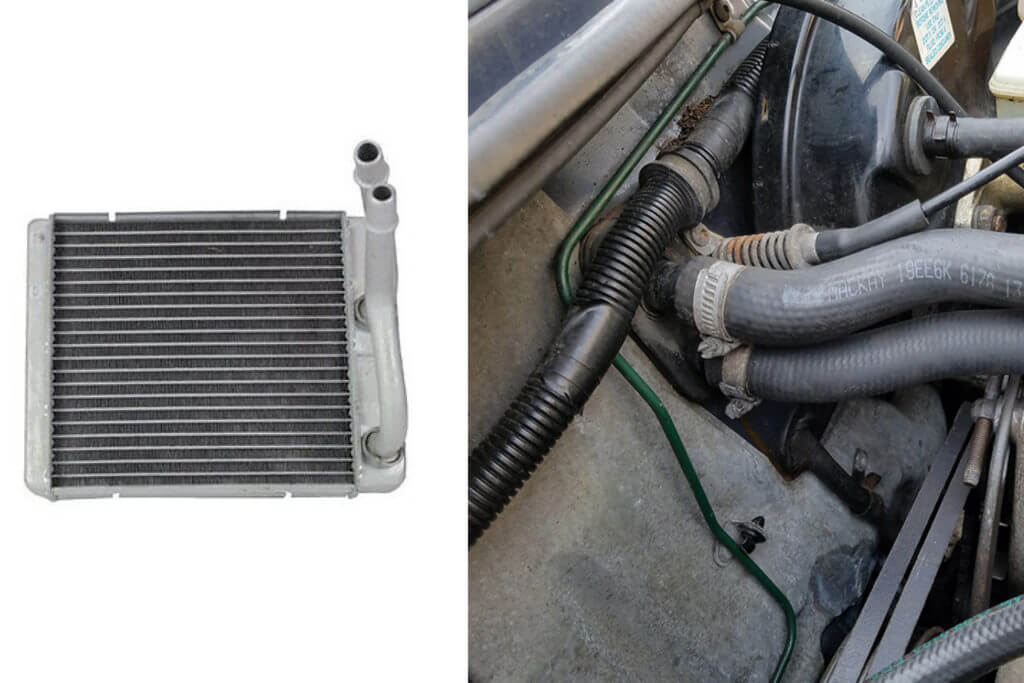 Heater core and hose connections at the firewall
To fix the no-heat condition due to a clogged heater core, you can try flushing as a first step. See this post to learn hose flush a heater core by yourself.
See this post on how heater cores fail
How to check for a blend door actuator or heater control valve issue
Late-model vehicles use an electric motor to move a “blend door,” adjusting how much heat is added to the air from the blower motor.
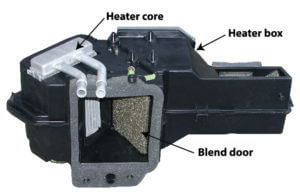
Heater box showing heater core and blend door
Older vehicles use a heater control valve that controls how much hot coolant is directed into the heater core. The heater control valve can be moved by a cable or vacuum.
An electric blend door actuator can fail in any position. Locate the blend door actuator under the dash and watch the shaft when you vary the temperature knob. If the shaft doesn’t move, then either the actuator is bad or the blend door is stuck. Disconnect the electrical connector from the blend door actuator and then remove the actuator retainer screws. Move the door by hand to
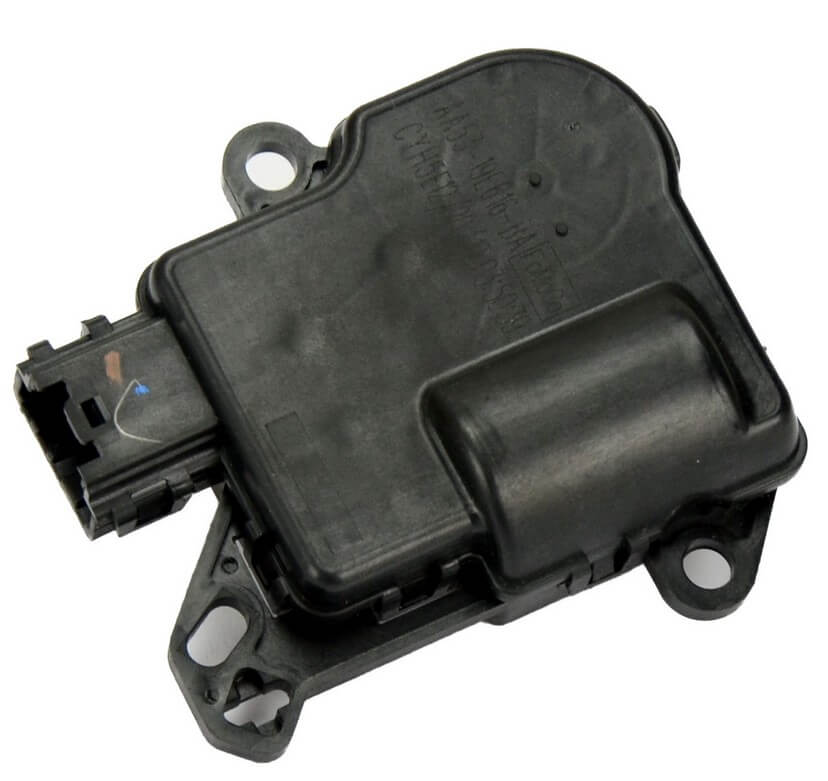
An electronic blend door actuator opens and closes a blend door to regulate the air temperature in your car
see if it opens and closes easily. If it does, then chances are the actuator is bad. However, you could be facing a situation where the heater control module isn’t commanding the actuator to open and close. To diagnose that situation, you’ll need a wiring diagram and a digital voltmeter.
Most electric blend door actuators are simply reversible electric motors with a position-sensing mechanism to tell the heater control module the actual position of the blend door. In this design, you’ll see two wires to run the electric motor and three wires to the position sensor. Isolate the two wires to the motor and attach your digital voltmeter to those two wires. Then, command a different heat setting. You should see the battery voltage on your meter. If not, suspect a bad heater control module.
A blend door actuator is a fraction of the price of the heater control module and fails far more often than the control module, so if you’re going to guess at a fix, replace the actuator first.
Possible stuck open thermostat. An engine thermostat that’s stuck open will cause you to feel cold air when driving and slightly warmer air when stopped. In addition to the cold air problem, you’ll notice a drop in gas mileage.
See this post for more information on blend doors and actuators
©, 2016 Rick Muscoplat
Posted on by Rick Muscoplat