
Power window doesn’t work
Your power window doesn’t work, here’s what to check
If you press the window switch and your power window doesn’t work, most DIYers automatically suspect a bad power window motor. That’s usually not the case. Power window motors rarely fail. The wiring of the switches and the regulator are the most common causes of a power window not working. I’ll walk you through the diagnostic process to deploy when your power window doesn’t work.
Learn how to test a power window motor here
Check the lockout switch first
Most vehicles have a lockout switch on the master switch to prevent passenger windows from opening if the driver locks them out. If your passenger windows don’t work, double-check to make sure you don’t have the lockout switch turned on. If the switch isn’t set to the lockout position, then proceed with the diagnostic steps below.
Listen for the Motor And Other Sounds In the Door
Press the window up or down switch and listen for the window motor. Also, listen for a clicking or grinding, or crunching sound. Those sounds indicate the motor is getting power, eliminating a fuse or circuit breaker problem. A clicking, grinding, or crunching sound usually indicates a stuck or damaged window regulator, the mechanical mechanism that moves the glass up and down. If you hear that, read on. If you don’t hear that, then you have an electrical problem. Skip down to Checking The Power Window Electrical System heading below.
Understanding window regulator types
Older-style window regulators moved the glass with a motor, gear, and scissors mechanism. To reduce weight and cost, carmakers switched to cable regulators. The motor drives a cable that moves sliders up and down two tracks. Cable regulators are far more trouble-prone than geared regulators. The plastic pulleys break, as well as the “sash clips” that hold the glass.

The Three Most Common Causes of Window Regulator Failure
1) Frozen glass— Operating the power window when the glass is frozen to the channels can break the plastic pulleys, strip the motor gear, and break the sash clips that connect the glass to the regulator.
2) Dirt and debris in the window channels— Dirt and debris in the window channels cause drag that puts extra stress on the sash clips, pulleys, motor, and gears.
3) Multiple Rapid Opening/Closing Operations— I find this most often when you’ve got kids in the car who enjoy playing with the power windows. The rapid up/down operations overheat the motor, gears, and pulleys, causing them to fail/
How to Fix A Power Window Regulator Problem
To fix a power window regulator, you first have to remove the door trim panel. I recommend consulting a shop manual to see the fastener locations. My favorite shop manuals are Alldatadiy.com or Eautorepair.net. Both sites sell a one-year or multiple-year subscription. If you buy a subscription and a new regular, you’ll still save almost 50% over paying a shop to do the job for you. However, some libraries offer free in-library access to auto shop manuals. So check that source first.
1) Remove the critical screws and door pulls.
2) Then, carefully pry off the door trim panel
3) Disconnect the electrical connectors to the door switches and lights.
4) Disconnect the glass from the regulator and remove the glass from the vehicle.
5) Disconnect and remove the regulator. Many are secured with bolts, but some are riveted in place.
Drill out the rivets to remove the regulator.
6) Then swap in a new regulator and reconnect the glass.
7) Clean the glass channels and lubricate with spray silicone or dry Teflon lube. Test the new regulator before reinstalling the door trim panel.
Checking The Power Window Electrical System
Understanding the Two Types Of Electrical Systems Used To Operate Power Windows
In older vehicles (built before the introduction of body control modules [BCM]), ALL the wiring for ALL the windows ran through the master switch. Activating a window switch sends power to each window motor.

Traditional power window operation
However, in a BCM system, the window switches are just inputs to the BCM. Think of it this way: When you activate a window switch, you’re asking the BCM to roll the window up or down. It’s the BCM that provides the power and ground to move the window.

BCM power window operation
How to test a power window motor
Disconnect the electrical connector from the regulator motor. Set your multimeter to DC volts. Connect the red and black probes to the two wires on the wiring harness connector you just removed. Then turn the ignition key to the RUN position. Toggle the window switch up and down. If the meter reading toggles between +12 volts and -12volts, the switch is good. The problem lies in the window regulator.
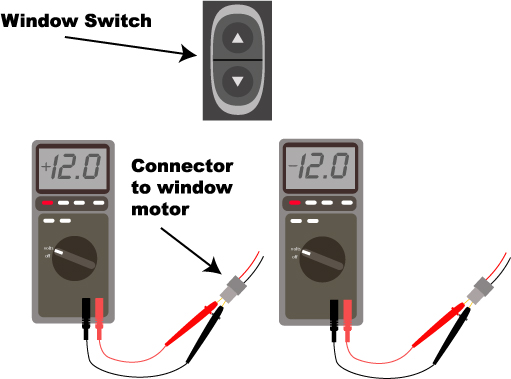
Toggle the window switch and check meter to see if it switches from +12volts to -12volts
Power window voltage toggles but window doesn’t move
If you’re seeing the toggling voltage, the problem is in the window regulator. It’s either a bad motor or a broken regulator that’s causing the motor to stall. Reconnect the electrical connector to the motor and try operating the window. If the motor is good, you should see some movement or hear some noise coming from the motor. If you see movement, the regulator is usually at fault. If you have a cable operated regulator, replace the entire regulator.
If the motor shows no movement, it’s probably bad. But again, if it’s a cable regulator, replace the entire window regulator.
No voltage or ground at power window motor
If you don’t see voltage and ground at the power window electrical connector, the problem is either the master switch or a wiring harness issue. Grab a wiring diagram and check for power and ground coming into the master switch. If you don’t see power and ground, head for the wire bundle in the driver’s door hinge area. Since that door is used most often, those are the wires most likely to break due to the constant flexing. If you find an open or chaffing, repair the wire and you should be back in business.
If the voltage does NOT toggle, then it can only be two things: Bad switch or broken wire. Wires break most often in the hinge area of the door.
If you need to replace the window regulator, click here for instructions.
© 2012 Rick Muscoplat
Posted on by Rick Muscoplat