
Remove Wheel Locks Without a Key in Minutes
How to Remove Wheel Locks Without a Key
Quick Summary
You can remove locking lug nuts without a key by using a 12-point socket, but you do need to be careful. The key to this method is choosing the correct size socket, driving it onto the locking lug nuts securely, and backing them off without damaging the wheel studs. I’ll also explain how to safely remove locking lug nuts from the socket afterward and when it’s smarter to replace the entire set.
I have an article on locking lug nuts and how to obtain a key. Find it here.
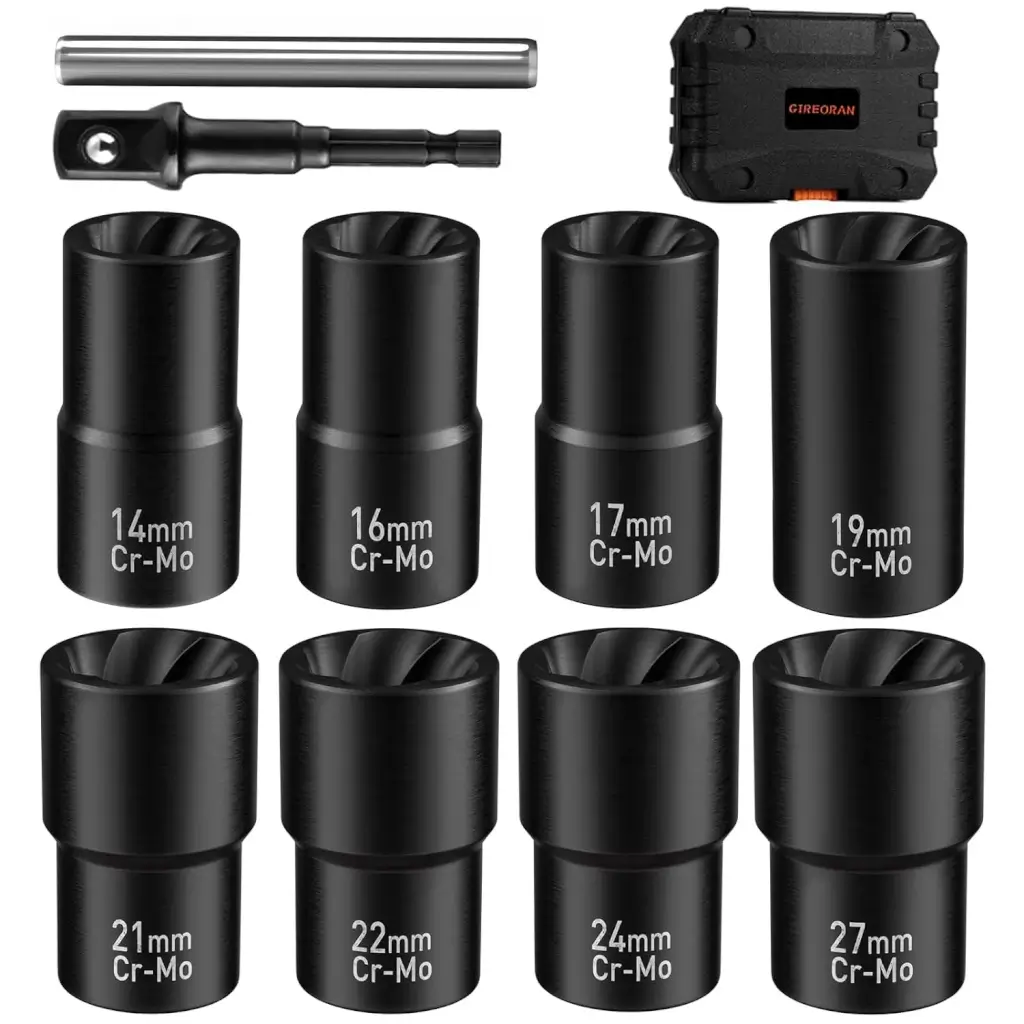
GIREORAN Wheel Lock Removal Kit, 10 Piece Lug Nut Remover, 1/2-Inch-Drive Impact Easy Out Bolt Extractor Socket Set for Removing Damaged, Frozen, Rusted, Rounded-Off Bolts, Nuts & Screws
How to Remove Wheel Locks Without a Key (The Right Way)
I’ve been in this situation more times than I care to admit. A customer buys a used vehicle, or a car comes in for brake work, and suddenly, we realize there’s no wheel lock key anywhere in the glove box, trunk, or tool kit. Now we can’t even remove the wheel.
Several manufacturers make universal wheel-lock removal tools, but they often delay your work. If you need to remove the wheel right now, here’s the procedure.
WARNING: Before I go any further, let me be clear: this procedure is for legitimate repairs on your own vehicle. Locking lug nuts exist to prevent theft. The goal here is to service your own car—not someone else’s wheels.
Understanding Locking Lug Nuts
Locking lug nuts feature a unique patterned face that only matches a specific key. Unlike standard hex lug nuts, you can’t simply put a regular socket on them. That’s the entire point.
But here’s the reality: most locking lug nuts are not invincible. With the right technique, you can still remove locking lug nuts without the factory key.
What you’re doing is creating your own “bite” point using a slightly undersized 12-point socket that grips the outer edge of the lock.
The Socket Trick
When I need to remove wheel locks without a key, I use a 12-point socket that’s just slightly smaller than the outer diameter of the locking lug nuts.
Step 1: Choose the Correct Socket — You need a 12-point socket, not a standard 6-point. The extra edges help dig into the lock’s metal.
The socket must be slightly smaller than the outer diameter of the locking lug nut, tight enough that it won’t slide on by hand. Sometimes that’s 19mm. Sometimes 21mm or 22mm. Every vehicle is different. If it slips on easily, it’s too big. If it won’t start at all, it’s too small.
Step 2: Hammer It On — This is where commitment matters. Place the 12-point socket over the locking lug nuts and hammer it straight on. You want it driven tightly enough that the internal points dig into the lock. This forced fit is what allows you to remove locking lug nuts successfully. You’ll feel when it seats firmly.
Step 3: Break It Loose — Now attach a breaker bar or strong ratchet and apply steady pressure. Avoid jerking violently—you don’t want to snap a wheel stud. If the locking lug nuts were torqued properly, they should break free with firm, controlled force. Once loose, spin them off just like a regular lug nut.
It’s not glamorous—but it works.
Just remember: once you remove locking lug nuts this way, replace them. And next time, keep the key somewhere safe.
Removing the Wheel Lock Lug Nut from the Socket
Now comes the part most people don’t think about. Once you’ve removed locking lug nuts, they’re usually wedged tightly inside the socket. Sometimes extremely tight.
Here’s what I do:
1) Place the socket in a bench vise or slide it into a larger socket.
2) Insert a bolt or punch into the back of the socket.
3) Hammer the locking lug nuts out from the rear.
4) Sometimes they pop right out. Other times they fight you.
5) If they’re really stuck, use a longer bolt or even a punch and continue tapping until they break free.
This step can take longer than removing the lug nut itself.
When This Method Doesn’t Work
There are cases where locking lug nuts are:
• Over-torqued
• Corroded
• Made of hardened steel
If that happens, hammering a socket on may not bite well enough.
At that point, you may need:
• A dedicated wheel lock removal tool
• A reverse-thread extractor socket
• Professional assistance
But in most real-world situations, the hammer-and-socket method works remarkably well.
Important Warnings From Experience
• Do not use an impact gun initially. You can snap studs. Hand tools only!
• Replace all locking lug nuts after removal.
• Always torque replacement lug nuts properly—typically 80–100 ft-lbs depending on vehicle.
Once you’ve figured out how to remove wheel locks without a key, don’t reinstall the same damaged locks. Replace them with standard lug nuts or purchase a new lock set and keep the key somewhere safe.
Knowing how to remove wheel locks without a key can save you a tow bill, a ruined brake job, or a stalled repair. The key is using the right 12-point socket, hammering it on securely, and backing the locking lug nuts off with controlled force.
©, 2026 Rick Muscoplat
Posted on by Rick Muscoplat