
Rusted Wheel Won’t Come Off? Here’s the Professional Fix
How to Remove a Rusted Wheel to Install a Spare Tire
Quick Summary
How do you remove a rusted wheel that’s stuck on the hub? A rusted wheel usually sticks because corrosion forms between the wheel’s center bore and the hub. To remove it safely:
• Remove all lug nuts.
• Spray penetrating oil around the wheel studs and center hub.
• Let the penetrant soak for 15–30 minutes.
• Strike the tire or a block of wood against the wheel with a heavy mallet while rotating the wheel.
• Clean rust from the hub with a wire brush.
• Apply a thin coating of anti-seize before reinstalling the wheel.
Never hit an aluminum wheel directly with a steel hammer or drive the vehicle with loose lug nuts to break the wheel free.
Tools You’ll Need
I keep these items in my garage because they work every time:
• Quality rust penetrant (PB Blaster, Liquid Wrench, or WD-40 Specialist Rust Release)
• Heavy rubber or dead-blow mallet, or a small sledgehammer
• Scrap 2×4
• Wire brush or drill-mounted wire wheel
• Jack and jack stands
• Anti-seize compound
• Safety glasses and gloves
Avoid using regular WD-40 as your primary penetrant. It’s an excellent lubricant, but isn’t designed specifically to break heavy rust bonds.
Step 1: Raise the Vehicle Safely — Before attempting to remove a stuck wheel, make sure the vehicle is on a solid, level surface.
• Set the parking brake.
• Place wheel chocks behind the opposite wheels.
• Loosen the lug nuts slightly before lifting.
• Raise the vehicle using the factory lift point.
• Support it securely with jack stands.
Never rely solely on a hydraulic jack while working around the vehicle.
Step 2: Soak the Rusted Hub — Once all the lug nuts are removed, spray penetrating oil:
• Around every wheel stud
• Around the center hub opening
• Behind the wheel whenever possible
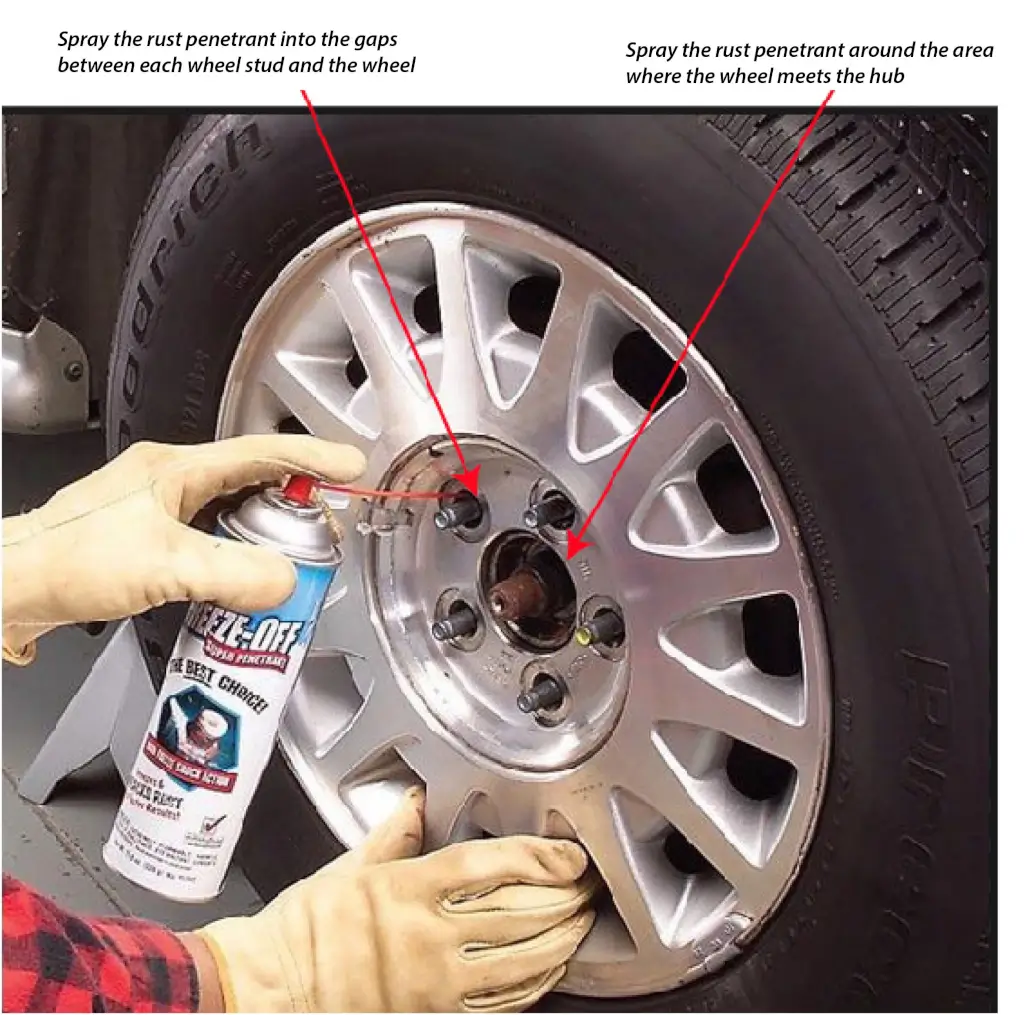
Shoot the rust penetrant between the stud and the wheel at each stud
I let the penetrant soak for about 15 minutes. Then I rotate the wheel about 180 degrees and spray it again. Gravity helps carry the penetrant deeper into the corrosion where it can actually do some good. Patience here often saves a lot of work later.
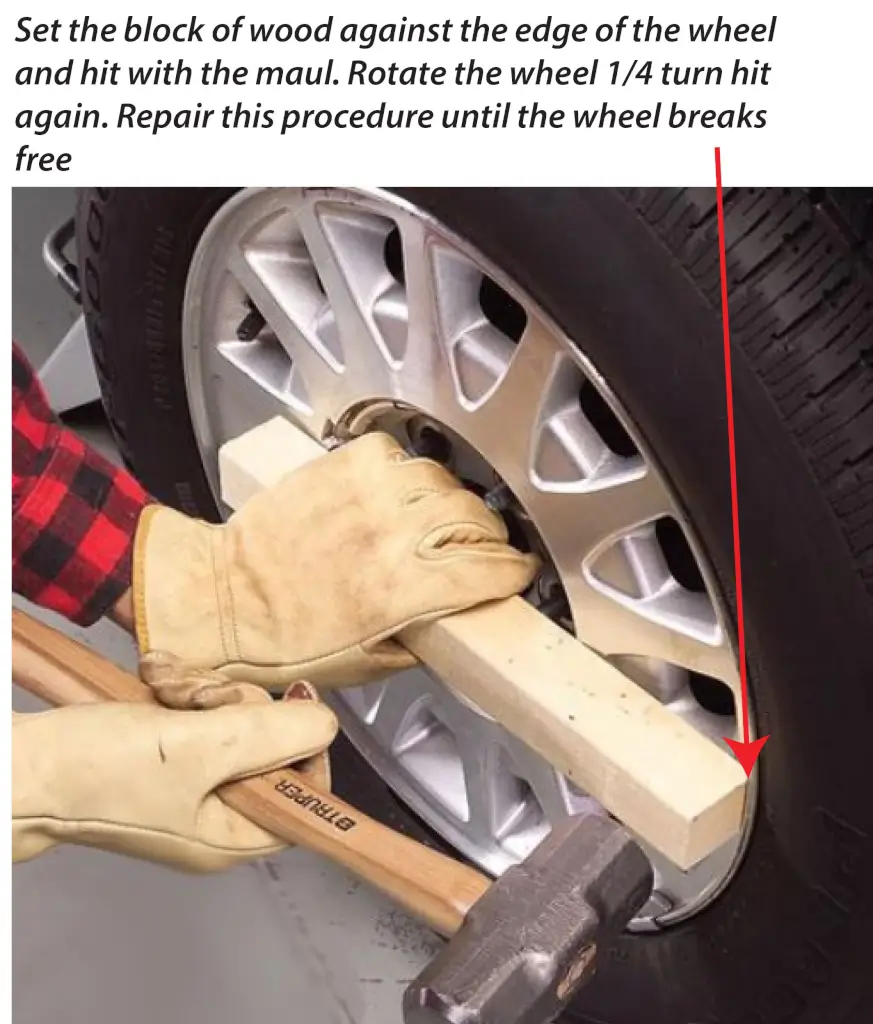
Step 3: Break the Rust Bond the Right Way — This is where many DIYers accidentally damage their wheels. Never strike an aluminum wheel directly with a steel hammer.
Instead, I place a short piece of 2×4 against the tire sidewall or the outer edge of the wheel and strike the wood with a heavy hammer. Then I rotate the wheel about one-quarter turn and repeat. Working around the wheel evenly sends shock through the hub without concentrating the force in one spot. Most of the time, you’ll hear a loud “pop” as the rust bond finally breaks.
That’s exactly what you want.
What If You’re Stranded on the Road?
When you’re trying to install a spare tire, you may not have all your shop tools. If penetrating oil isn’t available:
• Kick the tire firmly with the heel of your boot.
• Strike opposite sides of the tire—not the rim.
• Rotate the wheel and repeat.
• If another person is available, have them pull outward while you tap around the tire.
If the wheel still won’t move, roadside assistance may be your safest option. Continuing to beat on the wheel with random tools can damage the wheel bearings, brake rotor, or expensive alloy wheel.
What I Never Recommend
Over the years, I’ve seen plenty of bad advice.
I never recommend:
• Loosening the lug nuts and driving the vehicle
• Rocking the vehicle with loose lug nuts
• Heating the wheel with a torch
• Hitting aluminum wheels directly with a hammer
• Prying against brake components
Those shortcuts can damage studs, warp brake rotors, crack alloy wheels, or create dangerous safety issues.
Clean the Hub Before Installing the Spare
Once the wheel comes off, don’t simply install the spare and drive away. Take a minute to inspect the hub. Use a wire brush or wire wheel to remove rust from:
• Hub face
• Center pilot
• Wheel mounting surface
Even if you’re installing the spare temporarily, removing heavy corrosion now makes it much easier to reinstall your original wheel later.
Apply Anti-Seize to Prevent Future Problems
This is one small step that pays off every time.

Pick up a small tube of anti-seize at …. improvement store or auto part store
After cleaning the hub:
• Apply only a very thin film of anti-seize compound.
• Coat the center hub pilot and hub face lightly.
• Do not apply anti-seize to wheel studs unless the vehicle manufacturer specifically • recommends it.
Too much anti-seize attracts dirt and can affect lug nut torque.
A light coating is all that’s needed.
How to Prevent a Rusted Wheel
I recommend these maintenance tips every time tires are rotated:
• Clean rust from the hub.
• Apply a light coat of anti-seize.
• Rotate tires every 5,000 to 7,500 miles.
• Remove wheels annually if you live in the Rust Belt.
• Torque lug nuts using a torque wrench.
These simple habits dramatically reduce the chances of another stuck wheel.
Frequently Asked Questions
Why won’t my wheel come off after removing the lug nuts?
The wheel has usually rusted to the hub, not the studs. Corrosion between the center bore and the hub pilot locks the wheel in place.
Can a stuck tire damage the wheel bearings?
Not by itself. However, excessive hammering, heating, or prying can damage bearings and suspension components.
Should I hit the wheel with a hammer?
Only through a block of wood or by striking the tire. Never hit an aluminum wheel directly.
Does anti-seize really work?
Absolutely. A thin coating on the hub face greatly reduces corrosion and makes future wheel removal much easier.
Final Thoughts
Whenever I encounter a rusted wheel, I remind myself that patience wins every time. Rust can create an incredibly strong bond, but it isn’t permanent. With penetrating oil, controlled force, and the proper technique, you can safely remove a stuck tire or stuck wheel without damaging expensive parts.
The final step is just as important as removing the wheel. Clean the hub and apply a thin coat of anti-seize before reinstalling the wheel or spare. Those few minutes of preventive maintenance can save you from fighting the same problem during your next flat tire.
© 2012 Rick Muscoplat
Posted on by Rick Muscoplat