
Symptoms of a Bad Blower Motor Every Driver Should Know
The Biggest Warning Signs of a Bad Blower Motor
Quick Summary — What You Need to Know About Bad Blower Motor Symptoms
The most common blower motor symptoms are: weak airflow, noisy operation, or a fan that won’t shut off. Blower motor symptoms typically develop gradually—until one day, airflow disappears altogether. Understanding what those symptoms look like, how the blower motor and controller operate, and how they fail will help you avoid freezing in winter or overheating in summer. In this article, I’ll walk you through the most common blower motor symptoms and how I diagnose the problem in the real world.
Article
Why Understanding Bad Blower Motor Symptoms Matters
As a bad blower motor begins to fail, it almost always leaves clues. Sometimes the airflow cuts out at random. Other times, the motor starts squealing or thumping like a tired old furnace fan. And in many cases, you’ll get a blower that simply refuses to shut off. Each of these is a telltale sign of a bad blower motor, and when I see them, I know I’m dealing with either a failing motor or a failing blower motor controller.
A bad blower motor typically shows its age through noise, vibration, inconsistent airflow, or a fan that only works on certain speeds. Drivers usually notice these issues during temperature swings—right when they need the HVAC system the most. Once those bad blower motor symptoms begin, ignoring them only guarantees you’ll lose airflow entirely.
When the Fan Won’t Shut Off — One of the Most Common Bad Blower Motor Symptoms
One of the most surprising symptoms of a bad blower motor I diagnose is the blower motor running even after you shut off the ignition. This problem often occurs in modern vehicles because most late-model cars use a solid-state blower motor controller rather than a simple resistor. These controllers regulate fan speed via pulse-width modulation; when they fail, they often remain in the “ON” position. That means the blower motor receives full power regardless of whether the key is in the ignition.
I’ve seen this happen on everything from economy cars to luxury SUVs. Years ago, the issue was primarily limited to automatic climate control systems, but now even basic HVAC setups use electronic controllers. So when your fan refuses to stop running, you’re not only dealing with bad blower motor symptoms—you’re also dealing with a part that can drain your battery in a shockingly short amount of time.
Blower Motor Controller vs. Resistor — Why It Matters in Your Diagnosis
Before I dive deeper into real-world bad blower motor symptoms, it helps to understand what’s controlling the motor. Older vehicles use a blower motor resistor. It works by reducing the voltage to slow the fan, but that
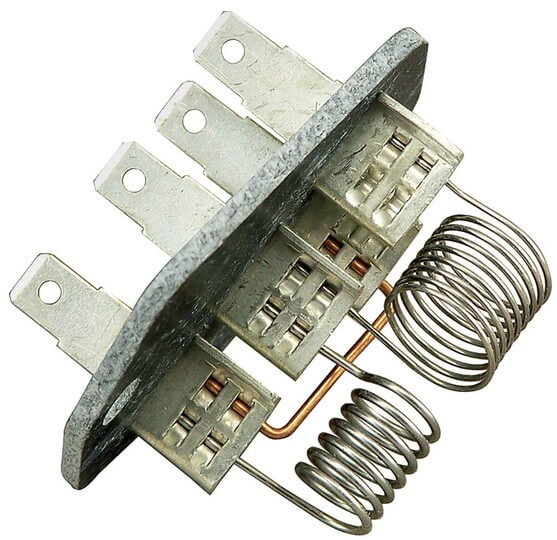
This is a typical older style blower motor resistor with multiple windings of various resistance levels
wasted voltage turns into heat, which is why resistors often fail.
Newer vehicles rely on blower motor controllers—solid-state devices that use pulse width modulation (PWM). PWM rapidly switches power on and off, adjusting the ratio of time spent “on” to determine blower speed. It’s efficient, reliable, and precise… until it isn’t.
And when those controllers fail, the bad blower motor symptoms can look identical to a failing motor:
• No airflow
• Airflow stuck at one speed
• Fan runs with the car off
That’s one of the reasons diagnosing a bad blower motor requires a little more detective work today than it did twenty years ago.
How Pulse Width Modulation Controls Blower Speed
The blower motor controller pulses the motor’s ground connection many times per second. The longer the “on” pulses last, the faster the blower spins. The HVAC control head tells the controller exactly how fast to run the fan—sometimes with a digital command, sometimes with a voltage-based signal.
So when you rotate the fan speed dial, you’re not directly controlling voltage; you’re asking the controller to adjust PWM. And when the controller misreads those commands, one of the first bad blower motor symptoms you’ll notice is a blower that ignores your settings entirely.
For example:
• Lowest speed: power is applied for about 3/10 of a second every second.
• Medium speed: power is applied for 7/10 of a second every second.
The HVAC control head sends a command signal — sometimes digital, sometimes pulsed voltage — telling the controller exactly how to adjust the fan speed.
How Blower Motor Controllers Fail — And What They Have to Do With Bad Blower Motor Symptoms
Over the years, I’ve seen blower controllers fail in three predictable ways:
The blower runs with the ignition off — This is the classic failure mode. The power-switching transistor sticks in the ON state.
The blower works only at a single speed — This makes diagnosing bad blower motor symptoms tricky, because both the motor and controller can cause it.
The blower doesn’t run at all — The controller shuts down completely, making the car feel like it has a dead blower motor.
You can see how easily a failing controller can mimic a bad blower motor, which is why I always check the controller first—especially on late-model cars.
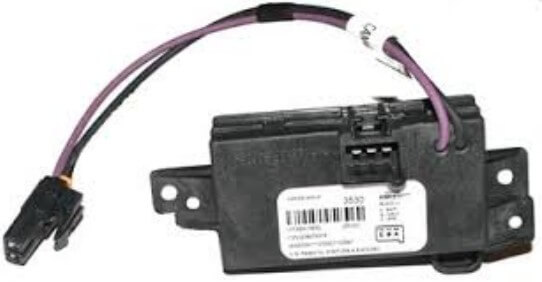
So Is It a Bad Blower Motor or a Bad Controller?
If you want a definitive answer, the best approach is to use a professional bi-directional scan tool. I use mine to command different blower speeds through the HVAC control head and watch how the controller responds. But here’s the truth most shops won’t tell you: in the vast majority of cases I’ve handled, the controller is the culprit far more often than the motor.
However, when the motor itself is failing, the bad blower motor symptoms are usually very clear:
• The blower squeals, groans, or chirps
• Airflow drops noticeably even at high speed
• The motor vibrates or smells like burning dust
• The fan works intermittently, especially over bumps
• It blows fuses because the internal bearings are locking up
When I see all that, I know I’m dealing with a bad blower motor, not just a controller glitch.
How to Fix the Problem and Restore Normal Airflow
Most repairs come down to replacing the blower motor controller, which is usually mounted near the blower assembly, either under the passenger-side dash or behind the glove box. Fortunately, the controller is less expensive than the HVAC control head and is much easier to replace.
If you discover that your blower motor is faulty, replacing it is straightforward on most vehicles. The secret is to disconnect the battery first—both to protect the new controller and to avoid shorting anything during removal.
Final Takeaways — Don’t Ignore Bad Blower Motor Symptoms
If there’s one thing I want you to remember, it’s this: You should never ignore bad blower motor symptoms. Whether your fan won’t turn off, won’t change speeds, or won’t move any air at all, something in the HVAC system is failing. And a failing blower motor or controller can leave you without heat or AC at the worst possible time.
I’ve replaced more blower controllers and motors than I can count, and in nearly every case, diagnosing the bad blower motor symptoms early saved the owner a dead battery, a fogged-up windshield, or a long ride in freezing temperatures. If you’re comfortable with basic tools, you can handle the repair yourself—but even if you take it to a shop, understanding the symptoms gives you a huge advantage.
©, 2016 Rick Muscoplat
Posted on by Rick Muscoplat