
The Best Grease for Brakes: A Comprehensive Guide
Choosing the Right Grease for Brakes
Brake grease plays a crucial role in lubricating sliding brake parts, preventing rust, and for dampening brake vibrations to reduce brake noise. There’s lots of confusion and just plain bad advice in youtube videos about choosing the right grease for brakes. Some DIYers use anti-seize grease because they’ve seen YouTubers apply it to caliper slide pins. That’s wrong; anti-seize is not approved for brake use and should never be used on caliper slide pins. This article will discuss the areas that require grease and which types can be safely used to grease brakes.
Why grease is used on brakes
1) It Lubricates— When applied to the caliper slide pins, brake grease allows the pins to slide smoothly even at high temperatures.
2) It prevents corrosion— A dielectric grease reduces corrosion by stopping galvanic action, preventing slide pins from seizing in the caliper bracket bores.
3) It reduces brake noise— Grease dampens the brake vibration transfer from the brake pad backing plates to the caliper, steering knuckle, strut and spring, thereby reducing brake noise.
The best brake greases for brake jobs
Silicone-based brake grease
Silicone brake grease is dielectric, so it prevents galvanic action and corrosion. It works in high-temperature environments, and it repels water. Since it’s not petroleum-based, like anti-seize, it can be used on rubber caliper slide pin boots and on the caliper piston dust seal.
Where to use silicone grease
• To lubricate caliper slide pins— Clean off the old grease. Install new rubber boots and pin sleeves. Then apply fresh grease to the slide pins.
• Under the anti-rattle clips— Clean the rust off the caliper abutment areas and apply a light film of dielectric silicone grease to prevent rust formation and rust jacking.
• On top of the anti-rattle clips— Apply a light film of silicone-based brake grease on top of the anti-rattle clips to ensure smooth pad movement and prevent rust from forming on the brake pad “T-heads.”
• On the back side of the noise reduction shims— Use silicone-based grease on the noise reduction shims where they contact the caliper body and caliper piston face. Silicone grease dampens brake vibrations and reduces vibration transfer.
Where to use Molybdenum brake lubricant
Molybdenum (Moly) grease can also be used to dampen vibration and prevent vibration transfer from one metal component to another.
Use Moly grease where you have metal-to-metal contact between the backing plate/noise reduction shim and contact with the caliper
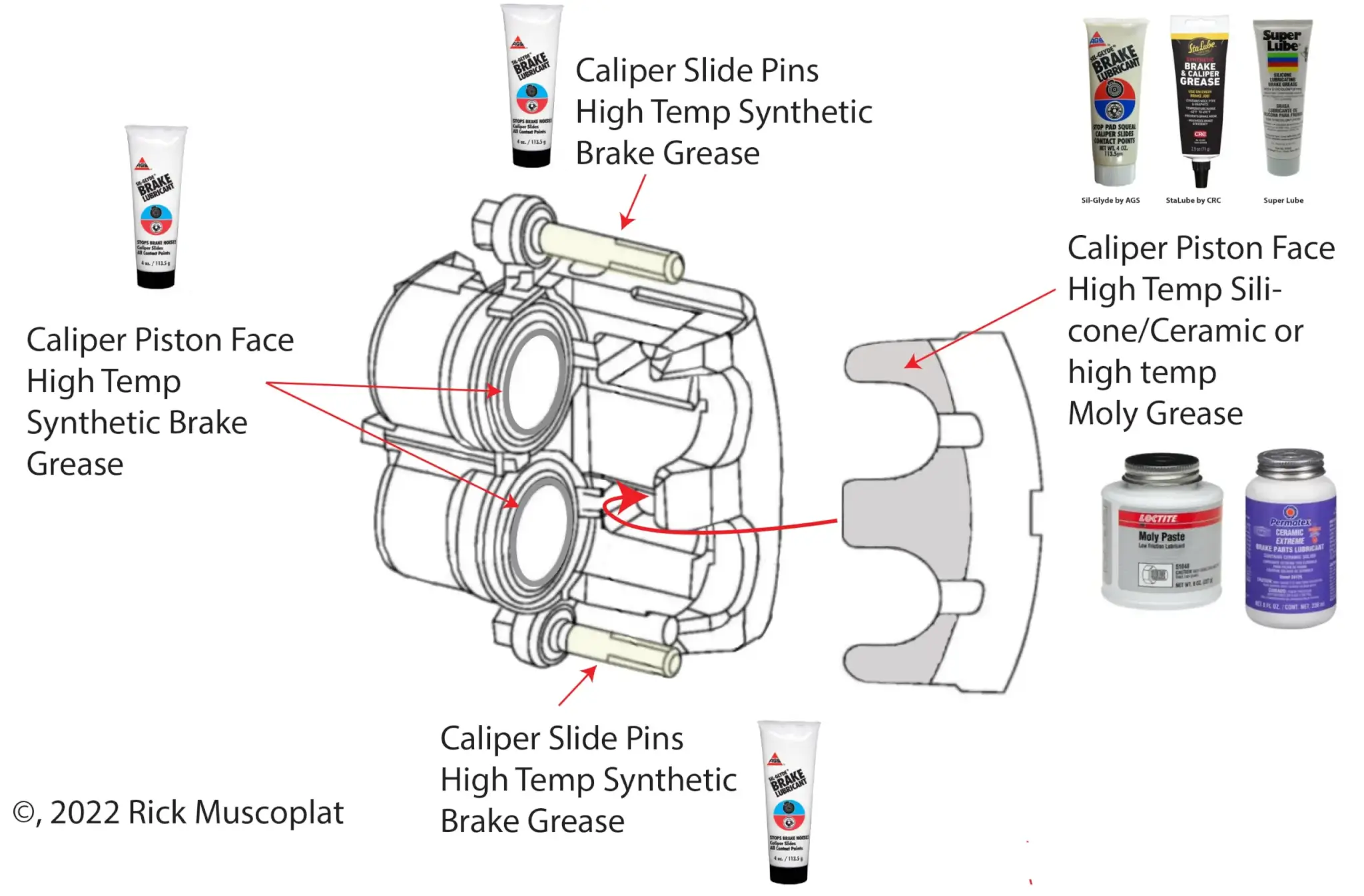
Which grease to use for brake jobs and where to apply each type
Why anti-seize shouldn’t be used in brake applications
Many people apply anti-seize to caliper pins, to the back of noise reduction shims and on anti-rattle clips. But anti-seize is not a lubricant. It’s not designed to help sliding parts move smoothly. It’s designed for one job and one job only; to prevent metal parts from s
The specs on anti-seize packaging may mislead you into thinking it’s safe for use on brakes. For example, a quick glance at the spec sheet shows that anti-seize can handle temperatures up to 2,600°F. That’s way more than any brake system can produce. But that’s a misreading of the spec sheet.
The base lubricant in anti-seize can only handle up to 350°F. After that, the lube cooks and crusts. Only the aluminum, copper, nickel, and graphite fillers last up to 2,600°F. That’s great for preventing seizing. But once the grease is gone, the fillers aren’t actually lubricants, which is what you need for caliper slide pins.
Here’s the full description from CRC Industries on their anti-seize products:
“Anti-seize lubricants are specialty lubricants that reduce friction between threaded and mated metal parts as well as prevent corrosion and seizure of parts under pressure and at temperatures well beyond the performance of conventional lubricants. Essentially they are two-part systems comprised of a base grease that serves to lubricate parts up to maximum temperature rating of the grease (usually about 350° F.) Secondly, the grease acts as a carrier for special fillers that provide the compound with its anti-seizing, anti-corrosion properties under high pressures and at elevated temperatures (up to 2600° F.). The special fillers are what differentiates anti-seize compounds from conventional lubricants and give each type of anti-seize lubricant its own specific properties.” — CRC Industries
©, 2022 Rick Muscoplat
Posted on by Rick Muscoplat