
The Dangers of Engine Braking: Why it’s Bad for Your Car
The Hidden Dangers of Engine Braking Revealed
Drivers with manual transmission vehicles often use engine braking to slow down instead of using the vehicle’s brakes. They’ve been doing it for decades, so they’re incredulous when you tell them it’s bad for their engine. Here’s how engine braking is bad for your car.
Engine braking pulls engine oil into the cylinders
Manifold vacuum increases every time you take your foot off the accelerator. In fact, it’s at its peak when the throttle plate is fully closed. That’s when a gas engine encounters maximum pumping loss or resistance caused by a lack of airflow.
Every internal combustion engine has blow-by, where a small amount of combustion gas escapes past the piston rings and into the crankcase through the ring gap. The blow-by gasses flow from the combustion chamber into the crankcase in normal operation. However, if you use engine braking to slow your vehicle, your foot is off the gas and the throttle plate closes fully, cutting off air into the engine, while it’s also increasing RPMs due to the engine braking.
That creates a vacuum condition in the cylinders when the piston is on its intake stroke. That vacuum condition is what causes engine braking. But that vacuum condition also PULLS blow-by gasses AND oil back UP into the cylinder.
Engine braking with a gasoline engine isn’t like a Jake Brake
Diesel engines don’t have a throttle plate so they don’t close off incoming airflow when using their Jake Brake. When you take your foot off the pedal in a diesel engine, the manifold vacuum doesn’t rise. So blow-by and oil doesn’t get sucked into the cylinder.
A Jake Brake works by taking advantage of the resistance created during the compression stroke and the lack of “spring-back” during the power stroke. A Jake Brake system opens an exhaust value when the piston reaches the top of its compression stroke. The compressed air is then vented to the atmosphere so it can’t be used to drive the piston down during the power stroke.
Gas engines don’t have that valve opening feature. When you use engine braking on a gas engine, you’re relying on the vacuum created by a closed throttle plate and the resistance created during the compression stroke to provide resistance to engine rotation and to slow the vehicle. However, since you can’t vent the compressed air mixture when the piston reaches TDC on the compression stroke, you get some “spring back” as the compressed air drives the piston down during the power stroke.
In other words, engine braking is nowhere near as effective as a Jake Brake and it comes with some serious drawbacks.
Extra braking increases oil consumption and accelerates catalytic converter damage
With the extra oil gets pulled up on the cylinders, you get oil burning as soon as you hit the gas pedal. The oil that doesn’t burn gets swept into the exhaust and dumped into the catalytic converter. Not only does engine braking increase oil consumption, but it also decreases the life of your very expensive catalytic converter. In an older vehicle with worn rings and valve guides, you can increase oil consumption so much that you cause your catalytic converter to melt down.
Engine braking causes carbon deposits
This one is pretty easy to understand; draw extra oil into
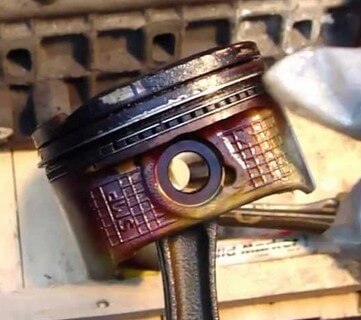
Carbon deposits on piston
the cylinder, and then burn it, and you get extra carbon deposits. Those deposits can cause detonation and piston ring damage
Engine braking in city driving causes the most damage
Repeated high vacuum episodes caused by engine braking in stop-and-go traffic cause the catalytic converter to overheat and self-destruct. Keep in mind that a catalytic converter’s job is to burn off excess hydrocarbons through a catalytic reaction. The catalytic converter doesn’t care if you feed it raw fuel or motor oil, it’s all HC to the cat.
Engine braking is just like cylinder deactivation
Several carmakers use cylinder deactivation to increase fuel efficiency. The system cuts fuel and spark to certain cylinders and disables the intake and exhaust valves when the power isn’t needed. So, the piston meets resistance on the intake stroke and creates a vacuum on the downstroke.
Cylinder deactivation is plagued with problems; the biggest is carbon buildup and spark plug fouling due to the oil that’s pulled up past the oil control rings during the vacuum phase. This has caused huge problems for Honda engines that employ this system.
Engine braking wears clutch components
It’s just plain stupid to wear out a $1,200 clutch to save on brake pads. Every clutch application exercises the clutch master cylinder, slave cylinder, pressure plate, clutch disk, throw-out bearing and flywheel.
©, 2017 Rick Muscoplat
Posted on by Rick Muscoplat