
The Importance of Changing Engine Coolant Regularly
A Beginner’s Guide to Changing Engine Coolant
Engine coolant, also known as antifreeze, plays several vital roles, including regulating engine temperature, preventing corrosion, and protecting against freezing and boiling. Here’s why changing engine coolant at recommended intervals is so important
The reason people ask the question whether they ever need to change coolant is because the base fluids in coolant, like polyethylene glycol and polypropylene glycol don’t wear out and don’t lose their freeze protection properties. But engine coolant does more than prevent freezing. Coolant also lubricates the water pump and prevents corrosion and galvanic action.
What wears out in coolant?
The anti-corrosion additives have a limited lifespan. Once they wear out, the dissimilar metals in your cooling system and engine begin to interact with one another and with oxygen in the system to form corrosion and ion transfer.
What are the coolant additives that wear out?
Every car maker uses a different formula, but here are some of the most common additives:
Phosphate is for IRON protection and pH control
Borate is for IRON protection and pH control
Silicate is for Aluminum corrosion protection
Nitrate is for cast iron and steel protection
Mercaptobenzothiazole (MBT) and Tolytriazole (TT) are best for Copper and Brass Protection
Block Polymers are for Defoamant and Scale and Deposit Control
Potassium Soap of Dibasic Carboxylic Acid for Iron, Solder and Aluminum Protection
Potassium Soap of Monobasic Carboxylic Acid for Aluminum and Iron (w/sebacate) Protection
Nitrite for Cast Iron and Steel Protection
Molybdate for Iron Corrosion Protection (w/nitrite)
Tolytriazole for Copper Corrosion Protection
Modified Silicone for Defoamant
Those additives make up 5%-15% of the total coolant solution, but they’re some of the most important components of coolant.
What happens when the anti-corrosion additives wear out?
Corrosion begins in the heater core and radiator, eventually clogging the very small passages. That reduces the amount of heat transfer from the engine to the outside air, and prevent heat transfer to the passenger cabin.
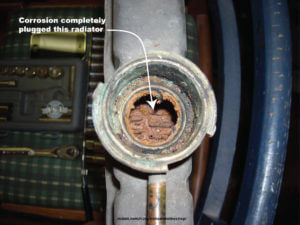
Not changing your coolant on time can cause significant corrosion
Galvanic action begins where metal actually transfers from one metal to another, leaving pinholes in the most vulnerable metals. The cooling systems contain copper, magnesium, cast iron, aluminum and alloys of these materials. Galvanic action always occurs when you have dissimilar metals and an electrolyte. In this case, the worn out anti-corrosive additives allow the coolant to turn into an electrically conductive electrolyte.
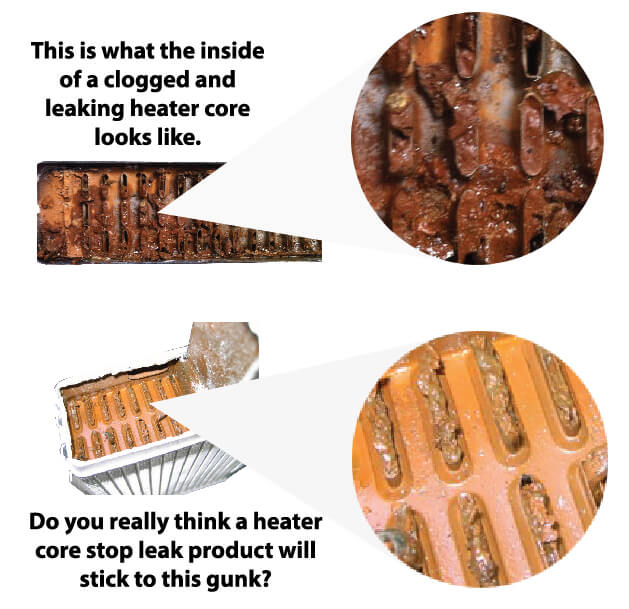
You’re looking at a clogged heater core caused by not changing coolant on time
It never pays for neglect coolant changes
A leaking heater core can requires the removal of the entire dash board. While the heater core itself is fairly cheap, around $100, the labor will cost you at least $1,000.
A leaking radiator costs around $400 and the labor is around $150-$300. But that’s not the worst case scenario. Worst case is that your radiator leaks, you run low on coolant and your engine overheats causing a head gasket failure. Now you’re looking at a $2,000 repair.
A leaking water pump can cost between $300 and $1,200.
Cooling system flush cost
Many shops advertise a radiator flush for around $100. But a radiator flush isn’t the same thing as a cooling system flush. It’s exactly what it says, a radiator flush that ignores the worn out coolant still left in the engine block. So you really want a cooling system flush. That requires special equipment and the installation of the factory specified coolant. So a real cooling system flush costs around $200. $200 is a small price to pay to avoid a leaking heater core, radiator or water pump.
by Alex Steil
©, 2019 Rick Muscoplat
Posted on by Rick Muscoplat