
The Pros and Cons of a Reverse Osmosis System
Reverse Osmosis Water Filters: Science-Backed Benefits and Drawbacks
Quick Summary
A home reverse osmosis treatment system removes dissolved salts, heavy metals, microorganisms, and many synthetic contaminants. They work by using household water pressure to push water through a semi-permeable membrane. Scientific studies show that reverse osmosis treatment systems can remove more than 90–99% of many pollutants, including lead, arsenic, and emerging contaminants.
However, reverse osmosis treatment systems also have downsides. They remove beneficial minerals such as calcium and magnesium, produce significant wastewater during operation, and require periodic maintenance. Research also suggests that long-term consumption of very low-mineral water may reduce dietary mineral intake unless the water is remineralized. Although there is great debate on remineralization, whether the remineralization devices actually work, and whether the need is real.
In short, reverse osmosis treatment systems provide extremely pure water but require proper maintenance.
Reverse Osmosis Treatment Systems: How They Work, the Pros and Cons
Home reverse osmosis treatment systems are one of the most powerful purification technologies available for residential drinking water. These systems are widely used in homes, laboratories, and even large-scale desalination plants.
How a 5-stage reverse osmosis system works
A 5-stage reverse osmosis system works by passing water through a series of progressively finer filtration steps, each designed to target specific contaminants.
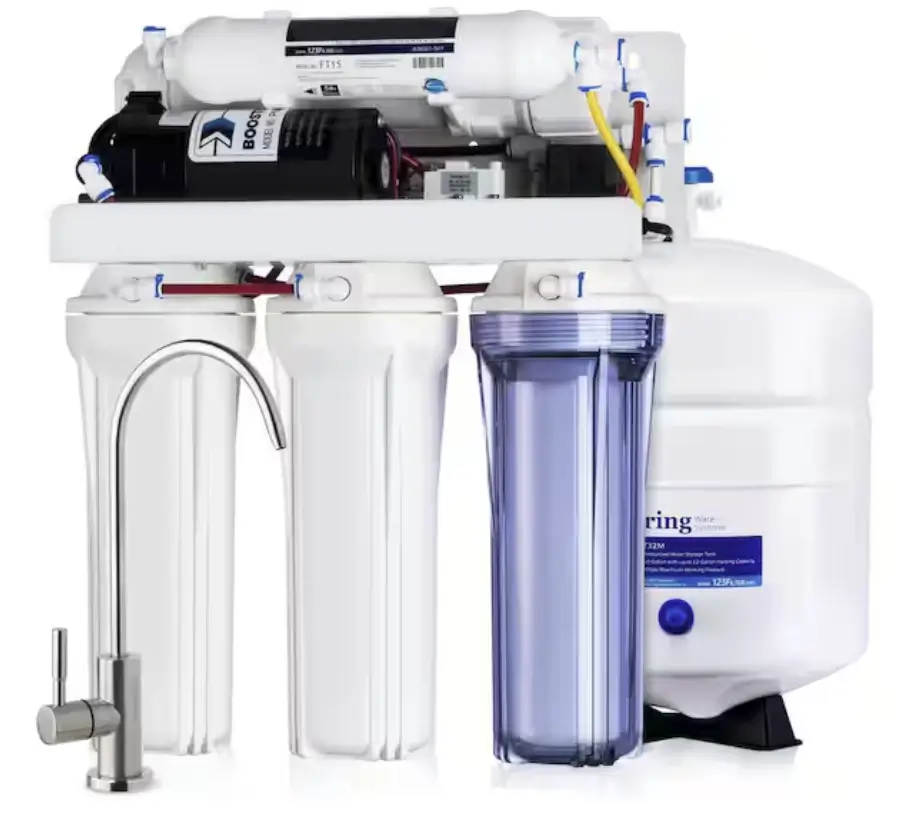
A typical 5 stage reverse osmosis system for home use
1st stage) Water flows through a sediment pre-filter to capture large particles like dirt, rust, and sand present in all piping systems. This pre-filtering is necessary to protect the more delicate filters downstream and prevent clogging or damage.
2nd stage) The water passes through an activated carbon block filter, which adsorbs chlorine, chloramines, and volatile organic compounds (VOCs) — chemicals that can degrade the RO membrane if left unchecked.
3rd stage) The water passes through the reverse osmosis membrane itself. Water is forced under pressure through this semi-permeable membrane, which has pores so small (roughly 0.0001 microns) that dissolved salts, heavy metals like lead and arsenic, fluoride, nitrates, and most other chemical contaminants are physically blocked and flushed away as wastewater. Only water molecules are small enough to pass through, resulting in dramatically cleaner water that is collected in a pressurized storage tank.
4th stage) The fourth stage is typically a post-carbon filter that removes any lingering tastes or odors the water may have picked up while sitting in the storage tank.
5th stage) Water passes through a final carbon polishing filter. This last step improves the taste and slightly raises the pH of the purified water before it is dispensed for drinking.
Home Reverse Osmosis System Pros:
• Excellent filtration quality — RO removes up to 99% of contaminants, including lead, arsenic, fluoride, nitrates, chlorine, PFAS “forever chemicals, dissolved solids, and pesticides, producing some of the purest drinking water available for home use.
• Better taste & smell — Removing chlorine and other dissolved compounds noticeably improves water flavor, which many people prefer for drinking and cooking.
• Cost savings over time — Eliminates or drastically reduces the need to buy bottled water, paying for itself within a year or two for most households.
• Low maintenance — Filter changes are typically only needed every 6–24 months, depending on usage and water quality.
• Compact under-sink options — Most systems fit neatly under the kitchen sink and don’t take up counter space.
• Reduces plastic waste — A direct environmental benefit from replacing single-use plastic bottles.
• Removes contaminants that boiling doesn’t — Unlike boiling, RO eliminates heavy metals, salts, and chemical pollutants.
Home Reverse Osmosis System Cons:
• Wastes water — Traditional RO systems discharge 3–4 gallons of wastewater for every 1 gallon of purified water produced, which is a significant concern in drought-prone areas (though newer “high-efficiency” models are improving this ratio).
• Slow production rate — Water is filtered slowly and stored in a tank, so you can run out during high-demand periods. However, you can speed up the process by installing a permeate pump or an electric pump.
• Removes beneficial minerals — Along with contaminants, RO strips out calcium and magnesium, which some people prefer to keep for taste and health reasons. A remineralization filter can address this.
• Upfront cost — A quality system typically runs $150–$600 installed, with professional installation adding more.
• Ongoing filter costs — While infrequent, replacement filters and membrane costs add up over time ($50–$150/year on average).
• Requires plumbing — Installation involves connecting to your water supply line, which may require a plumber if you’re not handy.
• Low water pressure issues — RO systems need adequate water pressure (40+ PSI) to function well; homes with low pressure may need a booster pump.
• Only treats one tap — A standard under-sink unit only purifies water at that single fixture, not throughout the whole house.
Potential Health Concerns With Demineralized Water
Some researchers argue that extremely purified water may not always be ideal for long-term consumption. The concerns are real but frequently overstated, and the science is more nuanced than many alarmist articles suggest. Here’s a balanced breakdown backed by the research:
What the Science Actually Says
The WHO’s Position (the most credible source)
The World Health Organization convened a group of nutrition, medical, and scientific experts to examine the potential health consequences of long-term consumption of demineralized water, including water produced by RO systems. Their findings acknowledge real concerns, but with important caveats.
For example, the WHO study PREFACE states:
” The World Health Organization assembled a diverse group of nutrition, medical, and
scientific experts in Rome in November 2003. ……The task was to examine the potential health consequences of long-term consumption of water that had been ‘manufactured’ or ‘modified’ to add or delete minerals. In particular, the meeting originated from the question of the consequences of the long-term consumption of waters that had been produced from demineralization processes like desalination of seawater and brackish water as well as possibly some membrane treated fresh waters, and their optimal reconstitution from the health perspective.”
“Information was provided on about 80 of many epidemiology studies of varying quality over the last 50 years that had addressed the issue of hard water consumption and possibly reduced incidence of ischemic cardiovascular disease in populations. Although the studies were mostly ecological and of varied quality, the meeting concluded that on balance they indicated that the hard water /CVD beneficial hypothesis was probably valid, and that magnesium was the more likely positive contributor to the benefits.”
The WHO recommends drinking water containing at least 10 mg/L of magnesium and 100 mg/L of dissolved salts — thresholds that RO water typically fails to meet.
However, the study also states: “In general, it is assumed that food is the principal source of nutrients and hazardous substances exposures for humans. Water can also be a source of beneficial dietary substances, as well as harmful contaminants, including chemicals and microorganisms that can mitigate dietary components. control scale and extend membrane life, and to prevent migration of non-ionized substances such as bacteria, organics, and silica. — VII. POTENTIAL TECHNICAL ISSUES ASSOCIATED WITH DESALINATION, Page 28
Olympian Water Testing on Cardiovascular Risk
“The association between magnesium and heart health cannot be underrated. And our bodies must be at their peak magnesium levels in order to maintain the cardiovascular health of the heart and arteries. It also helps in maintaining healthy blood pressure and also works on energy.
A scientific study has reported a close relationship between magnesium and decreased cardiovascular disease risk. There is even evidence that sufficient magnesium levels can stop hypertension, heart attacks and possibly lower mortality from cardiovascular disease.
Water – especially mineral water – is also good source of magnesium, easily absorbed into the body. What is great about getting your magnesium in water is that it can be added to your daily quota without any calories and with no radical diet changes.
However, the study also states: The source of magnesium comes from many different sources in the diet. These are green leafy vegetables, nuts, seeds, whole grains, etc. But another underutilized magnesium source is tap water. This is the variable amount of magnesium in water — depending on the source — which can be a large factor in daily intake.”
The Important Counter-Argument
Here’s where many alarming articles go too far. The WHO and other health experts note that the majority of essential minerals come from food, not water. In healthy individuals with a balanced diet, electrolyte homeostasis is tightly regulated by the body and largely unaffected by the mineral content of drinking water. There is no strong clinical evidence showing that drinking RO water causes electrolyte imbalance in most people.
Many of the older studies sometimes found associations between extremely low mineral water and certain health outcomes, but these studies are not specific to modern RO drinking water in well-nourished populations, and many lack rigorous controls or conclusive evidence.
Bottom Line
The concerns are scientifically grounded but context-dependent. The risks are most meaningful for:
People with poor or restricted diets
Children (still developing bone density)
Pregnant women
People in regions where RO water is the sole water source and the diet is already mineral-poor
For a healthy adult eating a varied diet in a country like the US, the risks are modest. The practical solution most experts converge on is adding a remineralization filter to your RO system, which adds calcium and magnesium back in. It’s inexpensive (~$30–50) and addresses the primary concern without sacrificing contamination removal.
A review published in Environmental Science and related literature suggests that drinking water completely stripped of minerals may contribute to nutritional deficiencies if the diet does not compensate.
However, most health experts agree that for people with balanced diets, the mineral contribution from water is relatively small. Still, many water treatment professionals recommend remineralization to restore taste and mineral balance.
Final Thoughts: Are Reverse Osmosis Treatment Systems Worth It?
Harmful Chemical Removal from Drinking Water verus Mineral Loss: How to make the decision
Balancing the benefits and drawbacks of a home reverse osmosis system comes down to understanding what you are gaining versus what you are giving up, and then deciding whether those trade-offs can be managed.
On the benefit side — RO systems are remarkably effective at removing genuinely harmful contaminants — lead, arsenic, nitrates, fluoride, chlorine byproducts, and pharmaceutical residues — that municipal treatment alone may not fully address. For households with older plumbing, well water, or water quality concerns, the reduction in toxic chemical exposure is a meaningful and tangible health benefit that is difficult to argue against.
On the downsides — The downside is that the same membrane that strips out harmful chemicals does not discriminate — it also removes beneficial minerals like calcium, magnesium, and potassium that the body relies on for bone health, heart function, muscle contraction, and nerve signaling. Drinking heavily demineralized water over a long period has been associated in some studies with increased mineral leaching from the body, though the degree of risk is hotly debated. It’s important to consider that some studies suggesting that mineral leaching is a health hazard were conducted among poor populations already suffering from malnutrition. It is worth noting, however, that most people in developed countries get the vast majority of their daily minerals from food rather than water, so the dietary impact of drinking RO water is generally considered modest for people eating a reasonably balanced diet.
The most practical way to balance these competing factors is to address the mineral loss directly rather than accepting it as an unavoidable trade-off. Eating a balanced diet that includes mineral-rich foods — leafy greens, nuts, dairy, legumes, and whole grains — can easily compensate for what the filter removes and is the single best way to ensure proper mineral intake. Adding a remineralization filter as a fifth or sixth stage to your RO system is an inexpensive and effective way to reintroduce calcium and magnesium into the purified water before it reaches your glass. However, even water experts disagree on whether this approach actually works. For most households, eating a balanced diet while adding the chemical protection provided by a reverse osmosis water treatment system offers the best of all worlds. without meaningful mineral deficiency.
Reverse osmosis treatment systems are among the most advanced water purification technologies available for homes. The science clearly shows they can remove a broad spectrum of contaminants with extremely high efficiency.
But they are not a perfect solution
They waste some water, remove beneficial minerals, and require regular maintenance. For most homeowners, the best solution is a well-designed reverse osmosis system with remineralization.
When properly installed and maintained, reverse osmosis treatment systems can deliver some of the cleanest drinking water available outside a laboratory.
©, 2026 Rick Muscoplat
Posted on by Rick Muscoplat