
Toyota C1201 Code: The Real Cause Most People Miss
Why the Toyota C1201 Code Is Often Misdiagnosed
Quick Summary
A Toyota C1201 code can freak people out because it’s defined as “Engine Control Malfunction.” If you didn’t know where to start, you’d assume you’ve got an engine computer/sensor issue, and that causes many DIYers and even pros to suspect a bad ECM. But it’s usually not the ECM.
Here are the key takeaways I’ve learned from years in the bay:
• The Toyota C1201 code does NOT usually mean a bad ECM
• It’s commonly triggered by a problem in another system, not the ECM
• The Vehicle Stability Control (VSC) system sets this code when it sees an engine-related fault
• The most common real-world cause? Zero-point calibration issues after repairs, especially after recent steering or suspension work.
You or the shop probably triggered the code while working on the steering or suspension system or moving the steering wheel with the engine off. In other words, you forced it out of calibration. When you start the engine, you’ll get the warning light and C1202 code.
What the Toyota C1201 Code Really Means
Over the years, I’ve seen many technicians get tripped up by the Toyota C1201 code, mostly because the description—“Engine Control System Malfunction”—leads them down the wrong path.
Here’s the reality: this code is set by the Vehicle Stability Control system, not because the engine computer has failed, but because the stability system has detected a problem it can’t trust. When that happens, it disables stability control and logs the Toyota C1201 code as a secondary warning.
So right out of the gate, I treat this as a reaction code, not a root-cause code.
The Real-World Causes I See Most Often
1) Underlying Engine Problems — Start by scanning for engine codes. If there’s a misfire, a lean condition, or a throttle control issue, the VSC system will shut itself down and log a C1201 code as a companion code. I’ve lost count of how many times I’ve fixed the engine problem, cleared the codes, and watched the Toyota C1201 code disappear without touching anything else.
2) Calibration Problems After Repairs — This is the second most common cause—and the one that surprises people. If you’ve worked on steering or suspension components, disconnected the battery, or even turned the steering wheel with the engine off, you can throw off the system’s baseline calibration. The yaw rate sensor and related sensors rely on a known “zero” position when the vehicle is sitting level and still.
When that reference point is lost, the system no longer knows what “normal” looks like. That’s when the Toyota C1201 code shows up, often along with a slip or VSC warning light.
3) ABS and Wheel Speed Sensor Influence — Because the stability control system depends on ABS data, anything that interferes with wheel speed information can play a role. That said, I don’t jump here first. A bad wheel speed sensor usually sets its own code. If I don’t see any supporting ABS codes or erratic wheel-speed data, I move on.
How I Diagnose a Toyota C1201 Code in the Shop
I’ve learned that the fastest way to fix a Toyota C1201 code is to stay disciplined and follow a logical path. I always start by scanning every module, not just the engine computer. If there’s another code present, that’s usually the real problem. Fix that first, clear everything, and then reassess.
If there are no engine codes, my attention shifts immediately to calibration. That’s when I perform a zero-point calibration procedure. I make sure the vehicle is parked on a perfectly level surface, avoid any movement, and follow the reset steps carefully. The behavior of the slip light tells me whether the procedure worked, just as outlined in your source material.
If the code persists after that, I start looking at live data—yaw rate, steering angle, and sensor outputs at rest. Only after those checks do I move on to deeper diagnostics, such as ABS or wiring issues.
How to perform a zero-point calibration
• Park the vehicle on a level surface with no more than a 1° inclination.
• During the zero-point procedure, do not vibrate the vehicle by tilting, moving, or shaking it.
• Do not start the engine during the zero-point calibration procedure.
Clear the zero point calibration data
1. Turn the ignition switch to ON.
2. The warning lights and indicator lights will come on for 3 seconds to indicate that the initial check is completed.
3. Using a jumper, connect and disconnect terminals 12 (TS) and 4 (CG) at the data link connector 4 times or more within 8 seconds.
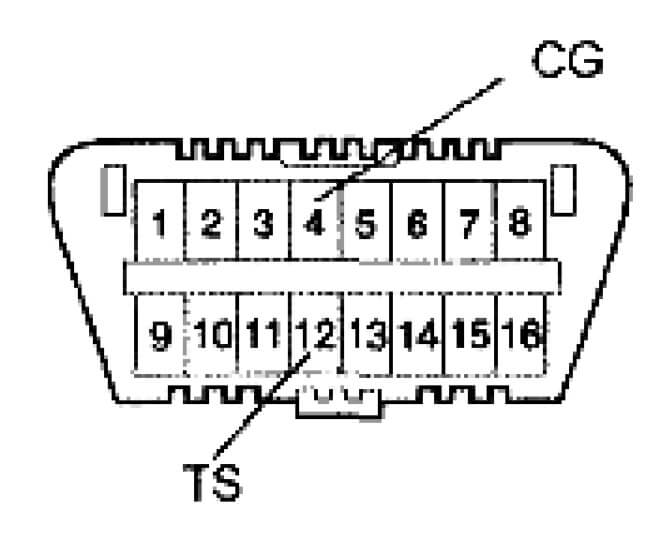
Toyota C1201 zero point calibration. Data Link Connector terminals
4. The “SLIP” warning light should come on. If it does not, repeat the procedure.
NEXT
5. Turn the IGN switch to OFF. Make sure the shift lever is in Park. Apply the parking brake.
6. Connect terminals 12 (TS) and 4 (CG) at the data link connector
7. Turn the IGN switch to ON
8. The “SLIP” warning light should blink. If it doesn’t blink, perform the zero point calibration (6) again.
9. Turn the IGN switch to OFF
The code should be cleared
©, 2018