
Understanding the Benefits of an Active Motor Mount
How An Active Motor Mount Works To Improve Vehicle Performance
An active motor mount is a type of engine mount designed to reduce engine vibrations and improve vehicle comfort by actively controlling the engine’s movement. Unlike traditional passive motor mounts, which rely on fixed damping characteristics, active motor mounts use electronic sensors and actuators to adapt to changing driving conditions and engine loads.
Late-model cars and SUVs are equipped with at least one active motor mount to dampen engine vibration. The active motor mount connects the engine to a subframe and allows it to move slightly. As you press on the gas pedal and the engine generates more torque, the engine moves in an equal and opposite reaction. So, the motor mount must allow some movement. The motor mount also absorbs some vibration, preventing that vibration from transferring to the frame and passengers.
Traditional motor mounts
Traditional motor mounts are made with two metal mounting plates
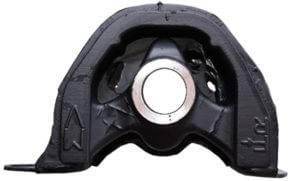
Solid rubber motor mount
molded between stiff rubber components. Those worked well with traditional V-8 engines. However, as car makers started installing smaller 4-cylinder and 6-cylinder engines, the mounts couldn’t handle the vibration properly. So, engine designers had to install balance shafts in the engines to counteract the opposite movements and relieve some of the stress from the motor mounts.
Then carmakers moved to fluid-filled motor mounts
In addition to adding balance shafts, carmakers also started using fluid-filled motor mounts. The fluid-filled mounts, called “hydro mounts” are filled with glycol that absorbs
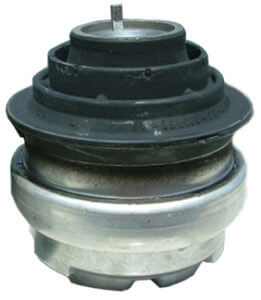
Fluid-filled motor mount
vibration while still preventing excessive engine movement. The hydro mounts are considered passive mounts, meaning their movement is limited by the stiffness of the rubber used, the amount of fluid added, and the design of the fluid chamber. Once made, the stiffness is set.
Unfortunately, hydro mounts can leak and lose their ability to dampen engine movement and vibrations. When that happens, they must be replaced. If you replace a hydro mount with a less expensive traditional mount, you’ll be very unhappy due to the increase in noise, vibration, and harshness.
Carmakers then switched to active motor mounts
An active motor mount is similar to a hydro mount in that it has a chamber that can be filled with either air or fluid. However, the amount of dampening can be changed in an active mount. It can be set to absorb more vibration and movement at idle but stiffen at higher speeds. Car makers Honda, Hyundai, Jaguar, Lexus, Toyota, and others switched to active motor mounts starting in 2005.
One way to vary the stiffness of an active motor mount is to use a vacuum actuator. By sucking air out of the chamber, the active motor mount becomes more like a traditional motor mount, relying more on the stiffness of the rubber than the air chamber. The PCM knows when the engine is at idle, a period when it produces the most vibration, and activates a duty-cycled vacuum switching valve (VSV) to apply intake manifold vacuum to the air chamber so it absorbs more vibration. The VSV allows more air into the active motor mount at higher engine speeds, increasing its stiffness.
How an active motor mount with vibration canceling technology works
Vibration canceling is another way to reduce engine vibration. Similar to noise cancellation in headphones, an active motor mount that uses vibration canceling technology will introduce a “countering” shock wave into the motor mount to cancel out the original vibration. The active control engine mount ECU generates a counter-shake through an actuator inside the active motor mount.
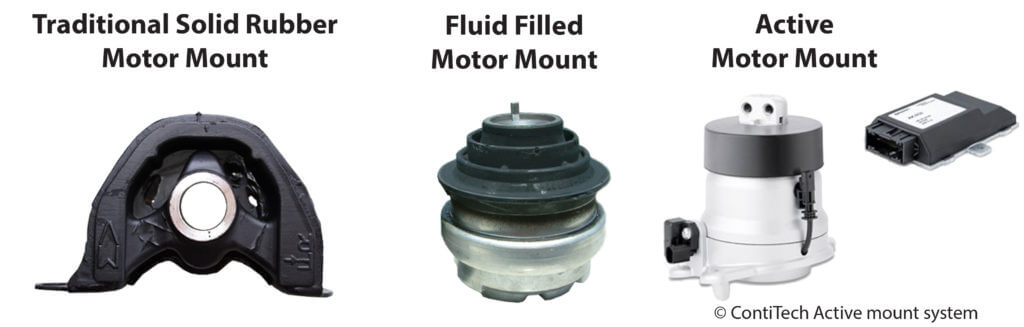
Magneto rheological motor mount
Magnetorheological motor mounts use different technologies to vary the stiffness of the motor mount. Developed by Delphi, magnetorheological (MR) motor mounts contain a fluid filled with small particles of iron. An electric current or magnetic field is then applied to the fluid, causing the iron particles to line up, which increases the viscosity of the fluid. By rapidly varying the electrical current, the MR motor mount can rapidly vary its stiffness.
©, 2018 Rick Muscoplat
Posted on by Rick Muscoplat