
Understanding the P0010 Code: What it Means and how to FIx It
Troubleshooting the P0010 Code: Exhaust Camshaft Position Actuator Circuit / Open (Bank 1)
The P0010 code “Intake Camshaft Position Actuator Circuit / Open (Bank 1).” The P0010 code specifically points to an issue with the Intake camshaft actuator in Bank 1. “Bank 1” refers to the side of the engine containing cylinder 1, which is usually the side with the primary timing components in V-shaped engines. “Camshaft Position ‘B'” indicates the intake camshaft. A P0010 code trouble code is part of a family of trouble codes that can be set if there’s a problem with the engine’s variable valve timing (VVT) system.
The following trouble codes also relate to the VVT system:
P0010 Intake Camshaft Position Actuator Circuit / Open (Bank 1)
P0011 Intake Camshaft Position Timing – Over-Advanced (Bank 1)
P0012 Intake Camshaft Position Timing – Over-Retarded (Bank 1)
P0013 Exhaust Camshaft Position Actuator Circuit / Open (Bank 1)
P0014 Exhaust Camshaft Position Timing – Over-Advanced (Bank 1)
P0015 Exhaust Camshaft Position Timing – Over-Retarded (Bank 1)
The Most Common Causes of the P0010 Code
Notice that the code doesn’t say to replace the VVT solenoid. It may be bad and often is. However, since the code refers to an open circuit condition, you must rule out an open in the wiring harness as well as an open in the VVT solenoid. The most common causes of a P0010 code are:
That could indicate an open condition in the wiring harness, electrical connector, or solenoid coil windings.
• Faulty VVT Solenoid— The VVT solenoid, also known as the oil control valve, regulates oil flow to the camshaft actuators. A an open solenoid coil could cause this code.
• Open in the VVT solenoid wiring harness or connector— Wiring issues, such as damaged or corroded connectors, can interfere with the signals sent to the ECM, leading to erroneous timing adjustments.
Diagnosing a P0010 code Code
1) Start by checking for power and ground to the VVT solenoid. The wiring diagram below is from a 2016 Subaru Forester, but it is similar to many VVT systems.
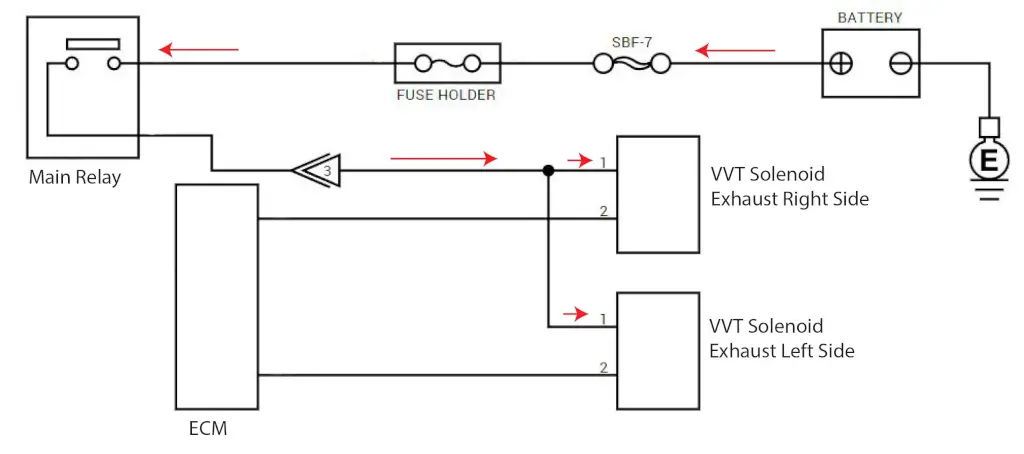
Typical wiring diagram for a VVT solenoid
2) Using a wiring diagram and a multimeter check for power at the Bank 1 VVT solenoid. Disconnect the electrical connector and place one probe on the power terminal and the other on a known good ground connection. When the key is turned to the RUN position, check for battery voltage. If you see voltage above 10 volts, this confirms the solenoid is receiving power.
3) Following the shop manual’s specifications, check the VVT solenoid’s resistance. If the resistance is infinite (signifying an open in the solenoid coil windings) or is significantly off, the solenid is bad. Replace it.
Symptoms of the P0010 code Code
When the P0010 code is triggered, the vehicle may exhibit several symptoms, including:
• Poor Engine Performance: The engine may run rough, lack power, or have reduced acceleration due to improper camshaft timing.
• Decreased Fuel Efficiency: Incorrect camshaft timing can lead to inefficient combustion, resulting in higher fuel consumption.
• Rough Idling: The engine may idle roughly or even stall when the camshaft timing is not within the specified range.
• Increased Emissions: Emissions levels may rise due to incomplete combustion and poor engine performance.
• Rattling noise: A lack of oil can cause the phaser to emit a rattling sound
©, 2019 Rick Muscoplat
Posted on by Rick Muscoplat