
What Causes a Cylinder Misfire in Modern Engines
The Most Common Causes of a Cylinder Misfire
Quick Summary
A cylinder misfire happens when one or more cylinders fail to complete a proper combustion event. In my experience, the most common causes of a cylinder misfire fall into four categories: ignition problems, fuel delivery issues, unmetered air or vacuum leaks, and internal mechanical failures. Misfire trouble codes—especially P0301-P0308—tell you where to look, but not why the misfire is happening. Proper diagnosis means working methodically, not firing the parts cannon. In this article, I’ll walk you through how I diagnose a cylinder misfire, why it happens, and how to narrow down the real root cause before expensive damage occurs.
Artilce
Understanding What a Cylinder Misfire Really Is
When I say an engine has a cylinder misfire, I’m not talking about a vague rough idle or a random shake. A true cylinder misfire means that the air-fuel mixture in one or more cylinders fails to ignite completely—or ignites too late to produce usable power. That incomplete combustion throws the entire engine out of balance.
Modern engine computers are susceptible to misfires. They monitor crankshaft speed changes in real time, and when a cylinder fails to contribute its share of torque, the ECM flags it. That’s why even a subtle cylinder misfire can set a check engine light—or worse, a flashing one that warns of catalytic converter damage.
The Most Common Causes of a Cylinder Misfire
After decades of diagnosing drivability complaints, I can tell you that nearly every cylinder misfire can be traced to one of four root causes.
Ignition problems are by far the most common. Spark plugs wear out gradually, which is why misfires often show up under load or acceleration before they become apparent at idle. When the spark plug gap widens or the center electrode becomes rounded, the spark isn’t strong enough to ignite the mixture consistently. Ignition coils can fail as well, often because they’ve been forced to work harder due to worn plugs. I’ve seen countless coils with burn-through marks where 40,000 volts took the path of least resistance, straight through the coil housing rather than jumping the plug gap.
Fuel delivery issues are the second most common cause of a cylinder misfire. Too little fuel causes the combustion event to end early, while too much fuel can wash down the cylinder and foul the spark plug. A clogged injector, a weak fuel pump, a restricted fuel filter, or a failing fuel pressure regulator can all cause a misfire. I always verify fuel pressure and fuel volume—because pressure alone doesn’t tell the whole story.
Unmetered air is another frequent culprit. The engine computer needs to know exactly how much air is entering the engine so it can calculate fuel delivery. A cracked intake hose, leaking intake manifold gasket, or disconnected vacuum line lets air sneak in without being measured. That creates a lean condition and a classic cylinder misfire, especially at idle or during cold starts.
Finally, mechanical issues cause the most severe and expensive misfires. Worn piston rings, burned valves, stretched timing chains, or camshaft wear prevent the cylinder from sealing properly. When compression is lost, no amount of spark or fuel will fix the problem.
Step-by-Step Guide to Fixing Engine Misfires
1. Diagnose the location of the misfire using the trouble code and freeze frame data from your scan tool — Get the trouble codes read. They’ll tell you which cylinder is misfiring. The code will appear as a powertrain “P” code starting with 0300. For example, a P0301 code means there’s a misfire in cylinder #1.
2. Start by inspecting the spark plug, spark plug wires, and the ignition coil for signs of a problem—
• The gap is too large. That’s the sign of a worn-out spark plug.

Notice the rounded over edge on the center electrode.
• The center electrode is rounded over. Ignition sparks create the most heat when they jump from a sharp edge to another sharp edge. A rounded-over center electrode indicates a worn-out spark plug.
• Fouled spark plug— Excessive carbon buildup from worn piston rings or a rich fuel mixture can cause a spark plug to misfire
3) Check the condition of the ignition coil— Look for signs of arcing or burn-through. A burn-through means the 40,000 volts couldn’t jump the gap in the spark plug and instead fired through the side of the ignition coil
• Faulty ignition coil — Driving too long on a misfiring spark plug causes the ignition coil

Misfiring coil on plug ignition coil. Notice the arcing on the bottom coil. The spark has been shooting right through the side of the coil above the boot.
to overheat, degrade, and fail. Ignition coils can fail even without a bad spark plug, but that’s rare.
4) Check for the proper fuel pressure and volume—
Conduct a fuel pressure and fuel volume test to make sure the fuel injectors are getting the proper pressure and volume.
• Clogged fuel injector — Using the fuel pressure gauge, fire each fuel injector and note the pressure drop. If there’s no pressure drop or one cylinder has a lower pressure drop than the others, suspect a clogged fuel injector. An injector that’s not delivering enough fuel can cause a misfire.
5) Check for unmetered air— The ECM has to know how much air is coming into the engine so it can calculate the proper fuel mixture. A disconnected vacuum hose, a crack in the air intake duct, or a leaking intake manifold can allow unmetered air to enter.
• Check for a vacuum leak
• Check for tears or cracks in the plastic air intake duct that runs from the air filter box to the throttle body.
6) Check for mechanical problems—
I’ll confess, this is the hardest to diagnose. You’ll need to rent test equipment to check cylinder compression and leakdown.
• Perform a wet and dry compression test. A dry compression test checks valve condition. A wet compression test checks the condition of the piston rings.
• Perform a cylinder leakdown test. This test tells you where the cylinder is leaking.
What causes a P0300 Random misfire?
When you see a P0300 random misfire code, it means the computer is detecting engine misfires but can’t nail down which cylinder(s) are causing the problem. Here are the most common causes of a P0300 misfire code.
• Worn spark plugs— If they all have the same number of miles, then they could all misfire on a random basis
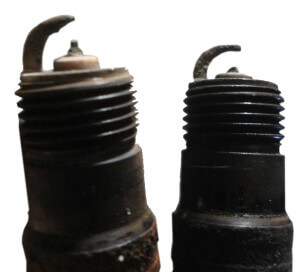
Worn spark plug
• Worn spark plug wires—If they all have the same number of miles, then they could all misfire on a random basis
• Vacuum leak— A vacuum leak would affect all cylinders the same, so it can cause a P0300.
• Unmetered air— Same as a vacuum leak
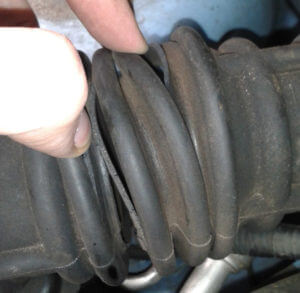
Tear in air intake hose that allows unmetered air into the engine
• Fuel supply problems like low fuel pressure or a bad fuel pressure regulator. Check fuel pressure and perform a fuel volume test
How to diagnose a single cylinder misfire
1) If the engine has spark plug wires: Use a spray bottle to
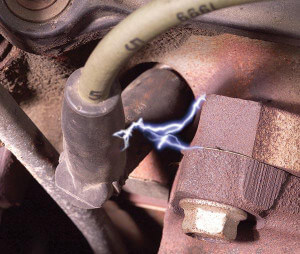
Arcing from deteriorated spark plug wires,
mist the spark plug wires and check for arcing on the plug wire to the misfiring cylinder. If you find arcing, replace the entire set of spark plug wires.
a) If the engine uses coil-on-plug ignition coils, examine the coil from the misfiring cylinder. Check for evidence of fire-through. If you can’t see any failure signs, swap the coil from the misfiring cylinder with a coil from another cylinder. If the coil is bad, the misfire code will show on a different cylinder.
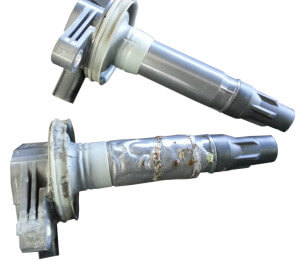
Misfiring coil on plug ignition coil. Notice the arcing on the bottom coil. The spark has been shooting righ through the side of the coil above the boot.
2 Remove the spark plug from the cylinder and check the spark plug gap. Check the porcelain for signs of carbon tracking. Even if the plug appears good, replace it and apply dielectric grease to the porcelain. Then retest
3) Perform a compression test and a cylinder leak-down test to check the condition of the valve and valve seats. If leak-down is 10% or greater, you have a wear problem that requires a valve job.
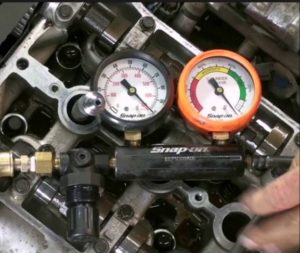
Cylinder leakdown tester
4) If the leak-down test shows less than 10%, swap the fuel injector with another cylinder and see if the misfire follows to the new cylinder
What causes a two-cylinder engine misfire code?
Determine the type of ignition system. If you have a
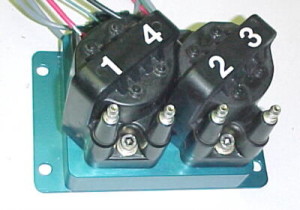
DIS coil pack. Each coil powers two cylinders
distributorless ignition system (DIS), you’ll see individual coil packs or one large coil with spark plug wire towers for each cylinder. In a DIS ignition system, each coil pack provides ignition for two cylinders. Here’s how it works: Two pistons reach top dead center at the same time. One cylinder is at the top dead center of the compression stroke, and the partner cylinder is at the top dead center of the exhaust stroke. The ignition call sends high voltage to the center electrode of the compression spark plug. The
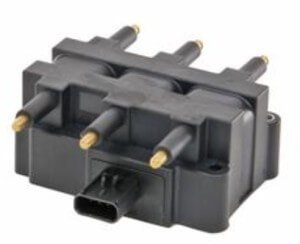
DIS Ignition coil
spark jumps the gap to the side electrode, producing a hot spark to ignite the air/fuel mixture. The voltage flows through the engine block and jumps from the side electrode to the center electrode on the spark plug of the exhaust stroke cylinder. The voltage then flows up through the spark plug wire and back to the coil pack. So a fault anywhere in that system will result in TWO misfire codes.
How to diagnose two-engine misfire codes in a DIS ignition system
1) If the engine has spark plug wires: Use a spray bottle to mist the spark plug wires and check for arcing on the plug wire to the misfiring cylinder. If you find arcing, replace the entire set of spark plug wires.
2) If the coils are separate, swap the coils and see if the misfires move to the new location.
3) Remove the spark plugs and wires and check for spark plug gaps and wire connections. Replace and recheck for misfire codes.
4) Perform a cylinder leak-down test to check the condition of the valve and valve seats. If the leak-down is 10% or greater, you have a wear problem that requires a valve job.
Diagnose engine misfires when cold
This gets a bit tricky because engines often rotate more slowly when cold, and slower rotation can cause misfires. Some of the same checks listed above apply. But follow these checks in order.
1 Check oil level and viscosity. If you’re using the wrong oil viscosity (thick oil), it can slow engine cranking to the point of causing cold misfires
2 Check the last oil change. If you’ve exceeded the recommended oil change interval, the oil may be degraded to the point where it is too thick
2 If the engine has spark plug wires: Use a spray bottle to mist the spark plug wires and check for arcing on the plug wire to the misfiring cylinder. If you find arcing, replace the entire set of spark plug wires.
Multiple engine misfires or no start
The engine cranks but will not fire up. The causes can be:
• no spark caused by bad spark plugs, bad wires, bad ignition coil, bad crankshaft or camshaft position sensor
• no fuel caused by bad fuel pump, clogged fuel injectors, no fuel injector signal due to bad crankshaft or camshaft position sensor. Use the scan tool to check the short- and long-term fuel trim and the crank and camshaft signals.
For more tips on diagnosing engine misfires, read this post
©, 2017 Rick Muscoplat
Posted on by Rick Muscoplat