
What Causes a Knock Sensor Code? 11 Common Causes
What Causes a Knock Sensor Code? Causes, Symptoms, Diagnosis, and Fixes
Quick Summary
A knock sensor code isn’t always a bad knock sensor. In fact, one of the biggest mistakes I see is replacing the sensor before checking the circuit and the engine itself.
A knock sensor code can be caused by:
• A damaged or failing knock sensor
• Corroded, loose, or contaminated electrical connections
• Broken, shorted, or high-resistance wiring
• Incorrect knock sensor installation or mounting torque
• Oil, coolant, or moisture contamination
• Actual engine detonation or abnormal combustion
• Low-octane or poor-quality fuel
• Carbon buildup inside the combustion chambers
• A lean air-fuel mixture or overheating condition
• Abnormal mechanical engine vibration
• In rare cases, an ECM/PCM problem
The important takeaway is simple: a knock sensor trouble code tells you the engine computer has detected a problem involving the knock sensor system or its signal. It does not automatically tell you which component caused it.
That distinction can save you from replacing perfectly good parts.
What Causes a Knock Sensor Code?
Over the years, I’ve learned that people often misunderstand diagnostic trouble codes because they treat the code name as the diagnosis.
A code mentions the knock sensor, so the knock sensor must be bad, right?
Not necessarily.
When I diagnose a knock sensor code, I think of the sensor as only one part of a larger system. The sensor, wiring, connectors, engine computer, mounting surface, and even what’s happening inside the combustion chambers can influence the signal the ECM or PCM receives.
Understanding that system is the key to figuring out what causes a knock sensor code without wasting money throwing parts at the vehicle.
What Does a Knock Sensor Actually Do?
I like to think of the knock sensor as one of the engine’s early-warning devices.
Modern engines are designed to squeeze as much efficiency and power as possible out of every combustion event. Higher compression ratios, turbocharging, advanced ignition timing, and sophisticated fuel control all improve performance and efficiency.
But they also make precise combustion control extremely important.
The knock sensor is typically mounted directly to the engine block or another location where it can detect specific engine vibrations. When abnormal combustion occurs, the vibration characteristics change.
The sensor converts those vibrations into an electrical signal that the ECM can analyze.
If the ECM determines that genuine knock is occurring, it can respond by changing ignition timing and, depending on the engine-management strategy, making other adjustments intended to protect the engine.
Why Engine Knock Can Be So Destructive
Two terms often get mixed up: detonation and pre-ignition.
They aren’t exactly the same thing.
What Is Pre-Ignition?
Pre-ignition happens when the air-fuel mixture begins burning before the spark plug ignites it.
One possible cause is a hot spot inside
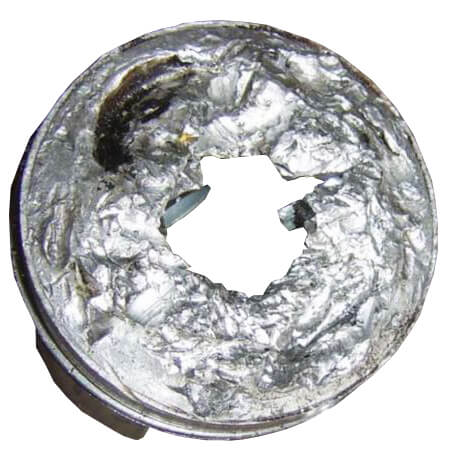
Piston damage caused by the high heat of pre-ignition
the combustion chamber. Carbon deposits, for example, can retain heat and contribute to abnormal combustion conditions.
Imagine the piston still traveling upward on its compression stroke while combustion pressure is already building against it.
That’s not a situation you want happening repeatedly.
Severe or prolonged pre-ignition can cause tremendous cylinder pressure and temperature and may contribute to serious piston damage.
What Is Detonation?
Detonation occurs differently.
Normally, the spark plug initiates combustion and a controlled flame front travels across the combustion chamber.
During detonation, part of the

Examples of detonation damage
remaining unburned mixture can auto-ignite as cylinder pressure and temperature rise. The resulting pressure waves collide inside the combustion chamber.
That’s where the familiar metallic pinging or knocking sound can come from.
Repeated severe detonation can damage pistons, ring lands, bearings, and other internal engine components.
This is exactly why the knock sensor matters.
What Does a Knock Sensor Code Mean?
A knock sensor code generally means the ECM or PCM has detected a signal or circuit condition that falls outside what it considers normal.
A common example is P0325, generally described as a Knock Sensor 1 Circuit Malfunction on Bank 1 or the single-sensor circuit, depending on the vehicle.
The key word there is circuit.
The computer may see:
• A signal voltage that’s too high
• A signal voltage that’s too low
• No usable signal
• An open circuit
• A short to ground
• A short to voltage
• Excessive circuit resistance
• A signal that doesn’t behave as expected
That means a P0325 knock sensor code doesn’t automatically mean the knock sensor needs replacement.
Other knock-sensor-related codes may describe different sensors, banks, signal levels, or performance conditions, so always diagnose the exact code stored in the vehicle.
The Most Common Causes of a Knock Sensor Code
When someone asks me, “What causes a knock sensor code?”, I divide the possibilities into three broad categories:
1. Electrical problems
2. Sensor or installation problems
3. Actual engine or combustion problems. That approach makes diagnosis much more logical.
1. Damaged Knock Sensor Wiring — I would never replace a knock sensor without taking a good look at the wiring first. The engine compartment is brutal on electrical harnesses. Wiring is constantly exposed to:
• Heat
• Vibration
• Oil
• Coolant
• Moisture
• Abrasion
• Dirt and road contamination
• Previous repairs
A wire can look fine from a distance while hiding broken strands, damaged insulation, or corrosion inside a connector.
The ECM needs to interpret a knock sensor signal accurately. An open circuit, short, or excessive resistance can therefore trigger a trouble code even when the sensor itself is functional.
2. Corroded or Loose Knock Sensor Connector — This is one of my first inspection points.
I look for:
• Green or white corrosion
• Oil inside the connector
• Coolant contamination
• Bent terminals
• Pushed-back pins
• Loose terminal tension
• Broken connector locks
• Connectors that aren’t completely seated
Here’s something worth remembering: sometimes a knock sensor code disappears after sensor replacement because unplugging and reconnecting the connector restores a better electrical connection.
The new sensor gets credit for the repair when the real improvement may have been at the connection.
3. A Failed Knock Sensor— Yes, knock sensors can fail.
They’re typically piezoelectric devices, and they spend their lives attached to an engine exposed to heat cycles and vibration.
But I don’t condemn one simply because its name appears in a diagnostic trouble code.
I want the circuit, connector, installation, and relevant engine conditions checked first.
That’s particularly important on vehicles where the knock sensor is buried beneath an intake manifold. Guessing can turn an inexpensive diagnosis into a time-consuming repair.
4. Incorrect Knock Sensor Torque — This one is easy to overlook.
A knock sensor isn’t simply an electrical component that happens to be bolted to an engine. Its mechanical connection to the engine is part of how it works.
If it’s too loose, vibration may not transfer to the sensor correctly.
If it’s overtightened, it may also affect operation, and the sensor itself could be damaged.
That’s why I always recommend using the manufacturer’s exact knock sensor torque specification rather than guessing.
Also inspect the mounting surface for contamination, corrosion, or anything else that prevents the sensor from seating correctly.
5. Oil, Coolant, or Moisture Contamination— Some knock sensors live in locations where a fluid leak can become an electrical problem.
Oil or coolant can contaminate connectors and harnesses, eventually creating excessive resistance or signal problems.
If I find a contaminated knock sensor connector, I don’t stop at cleaning it.
I want to know where the fluid came from.
Otherwise, you can repair the knock sensor circuit today and have the same problem return later.
6. Low-Octane or Poor-Quality Fuel — Here’s where the diagnosis becomes more interesting. Sometimes the sensor isn’t malfunctioning at all.
It may be detecting real combustion knock.
Fuel with insufficient octane resistance can make detonation more likely, particularly under high load, elevated temperatures, high compression, or boost.
If the manufacturer specifies a certain octane level, I would use that when evaluating a suspected knock problem.
7. Carbon Buildup in the Combustion Chamber— Carbon deposits can contribute to abnormal combustion in more than one way.
Deposits may retain heat and create hot spots. Significant deposits can also alter conditions inside the combustion chamber.
Either situation can make abnormal combustion more likely.
So when a vehicle has genuine pinging or detonation—particularly one with substantial mileage—I don’t automatically blame the sensor.
The sensor may be doing exactly what it was designed to do.
8. A Lean Air-Fuel Mixture— An engine running excessively lean can experience higher combustion temperatures and an increased tendency toward abnormal combustion.
Potential causes can include air leaks or fuel-delivery and engine-management problems.
This is why related diagnostic codes matter.
If I find a knock-related code accompanied by fuel-trim, mixture, misfire, temperature, or other engine-management codes, I don’t diagnose each one in isolation. I look for a common underlying cause.
9. Engine Overheating— High engine temperatures can increase the likelihood of detonation.
If the engine is overheating and simultaneously showing knock-related symptoms or codes, the cooling-system problem deserves attention.
Replacing a knock sensor won’t fix an overheating engine.
10. Abnormal Mechanical Engine Noise— The knock sensor detects vibration. That means unusual mechanical vibration can sometimes complicate the ECM’s interpretation of the signal.
Potential sources can include internal engine wear or other mechanical noise.
This is one reason I listen to the engine before assuming an electrical component has failed.
If the engine is making a pronounced mechanical knocking, rattling, or slapping noise, the diagnosis needs to go deeper than the sensor circuit.
11. ECM or PCM Problems— Can the engine computer cause a knock sensor code?
Yes.
Is that where I start?
No.
An ECM/PCM input or software problem is possible, but I’d want to thoroughly evaluate the sensor, wiring, connectors, power/ground integrity (where applicable), installation, and engine condition before blaming an expensive control module.
How Does the ECM Know the Engine Is Knocking?
A knock sensor is essentially detecting vibration, but engines naturally generate enormous amounts of vibration. Road conditions can create vibration too.
So the computer must interpret sensor activity in the context of engine operating conditions. Depending on the vehicle, the ECM can evaluate knock-sensor activity against factors such as engine speed, load, ignition timing, and crankshaft behavior.
The objective is to identify the vibration patterns associated with abnormal combustion rather than reacting to every vibration passing through the engine.
This is also why diagnosis should follow the manufacturer’s strategy for that particular engine rather than relying on one universal knock-sensor test.
Common Knock Sensor Code Symptoms
One confusing part of a knock sensor problem is that the vehicle may seem to run normally.
The Check Engine Light may be the only obvious symptom.
Other possible symptoms include:
• Check Engine Light
• Reduced engine power
• Sluggish acceleration
• Poor throttle response
• Reduced fuel economy
• Engine pinging under acceleration or load
• Hesitation
• Rough operation in some cases
When the ECM no longer trusts the knock sensor signal, some vehicles use a more conservative ignition strategy to protect the engine.
That can reduce performance and efficiency even though the engine still starts and drives.
How I Diagnose a Knock Sensor Code
When I’m troubleshooting a knock sensor code, I don’t start by ordering parts.
I start by gathering evidence.
Step 1: Read Every Stored Code
First, I scan the entire vehicle and record the codes.
I also review freeze-frame data when it’s available because it can tell me what the engine was doing when the fault was detected.
Was the engine hot?
Was it under heavy load?
Were there mixture, misfire, temperature, or voltage-related codes at the same time?
Context matters.
Step 2: Inspect the Connector and Wiring
Next comes a careful visual inspection.
I check the harness for damaged insulation, chafing, melted areas, oil saturation, corrosion, previous repairs, loose terminals, and broken connector locks.
This basic step is frequently more valuable than immediately installing a replacement sensor.
Step 3: Check Sensor Installation
If the sensor was replaced recently, I focus on the installation.
I verify that:
• The correct sensor was installed
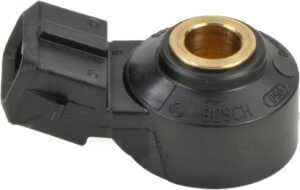
A typical knock sensor.
• The mounting surface is clean
• The sensor is positioned correctly
• The connector is fully seated
• The sensor is tightened to the manufacturer’s specification
Incorrect installation can turn a good sensor into a diagnostic headache.
Step 4: Test the Circuit According to Factory Information
This is where I avoid generic resistance numbers or universal voltage specifications.
Knock sensor designs and diagnostic strategies vary between manufacturers.
I use the wiring diagram and service information for the specific vehicle to determine the correct testing procedure.
Depending on the system, diagnosis may involve checking:
• Circuit continuity
• Shorts to ground
• Shorts to voltage
• Connector integrity
• Expected bias/reference behavior
• Sensor signal activity
• Scan-tool knock data
Never assume a resistance or voltage specification applies to every knock sensor. Use the factory specification for the vehicle you’re testing.
Step 5: Determine Whether the Engine Is Actually Knocking
If the electrical circuit checks out, I turn my attention toward combustion and mechanical conditions.
I ask questions such as:
• Is the correct fuel octane being used?
• Is the engine overheating?
• Is there evidence of a lean condition?
• Is there substantial carbon buildup?
• Has the vehicle been modified?
• Is there genuine pinging under load?
• Is there abnormal mechanical engine noise?
This step separates diagnosing the code from simply replacing the component named in the code.
Can You Drive With a Knock Sensor Code?
The knock sensor is part of the engine’s protection strategy. If the ECM can’t reliably detect detonation, it may compensate with conservative timing. That can reduce performance and fuel economy.
More importantly, if genuine detonation occurs while knock detection is compromised, the engine may have less ability to protect itself.
I would avoid heavy acceleration, towing, high engine loads, or aggressive driving until the problem has been properly diagnosed—especially if you can actually hear pinging or knocking.
If the engine is overheating or making a loud mechanical knock, that’s a different situation. Stop driving and diagnose the underlying problem rather than assuming it’s merely a sensor fault.
Can Bad Gas Cause a Knock Sensor Code?
It can contribute to a knock-related problem, but there’s an important distinction.
Low-octane or poor-quality fuel can increase the likelihood of actual detonation. A healthy knock sensor may detect that condition, and the ECM may respond by reducing ignition advance.
However, a circuit-specific code such as P0325 usually points to the sensor circuit and signal integrity, rather than proving that low-octane gasoline alone caused the electrical fault.
That’s why the exact trouble code matters.
Will a Bad Knock Sensor Cause a Check Engine Light?
Yes.
If the ECM determines that the knock sensor signal or circuit isn’t operating within the expected parameters, it can illuminate the Check Engine Light and store a diagnostic trouble code.
Depending on the vehicle, the driver may notice little more than the warning light.
Other vehicles may feel noticeably slower because the ECM adopts a more conservative ignition strategy.
Can a Knock Sensor Code Cause a Misfire?
A knock sensor code and a misfire code can appear together, but that doesn’t automatically mean one caused the other.
A misfire, lean mixture, abnormal combustion, or mechanical problem can change engine vibration and operating conditions.
When both types of codes appear, I investigate the complete code set and freeze-frame information rather than replacing the knock sensor first.
Why Does My Knock Sensor Code Keep Coming Back?
A recurring knock sensor code after replacement is one of the clearest signs that you need more diagnosis.
If a new knock sensor didn’t solve the problem, I would investigate:
• Damaged wiring
• Corroded terminals
• Poor connector pin tension
• Incorrect replacement sensor
• Incorrect sensor torque
• Dirty mounting surface
• Oil or coolant contamination
• Open or shorted circuits
• Actual detonation
• Engine mechanical vibration
• Manufacturer-specific software or ECM issues
Replacing the same component twice rarely fixes a problem that component never caused in the first place.
What Causes a P0325 Knock Sensor Code?
P0325 generally indicates a problem with the Knock Sensor 1 circuit on Bank 1, or the single knock sensor on applications that use one sensor.
Common P0325 causes include:
• Faulty knock sensor
• Damaged knock sensor wiring
• Open or shorted sensor circuit
• Loose or corroded connector
• Incorrect sensor installation
• Incorrect sensor mounting torque
• Contaminated connector or harness
• Engine mechanical problems
• ECM/PCM problems in less common cases
If you’re troubleshooting P0325, start with the connector and harness before assuming the sensor itself is defective.
Related Knock Sensor Trouble Codes
Depending on the vehicle, you may encounter several knock-sensor-related OBD-II codes.
Common examples include:
• P0325 – Knock Sensor 1 Circuit Malfunction
• P0326 – Knock Sensor 1 Circuit Range/Performance
• P0327 – Knock Sensor 1 Circuit Low Input
• P0328 – Knock Sensor 1 Circuit High Input
• P0330 – Knock Sensor 2 Circuit Malfunction
• P0332 – Knock Sensor 2 Circuit Low Input
• P0333 – Knock Sensor 2 Circuit High Input
Exact definitions and diagnostic criteria can vary by manufacturer, so I always verify the code definition and testing procedure using service information for the specific year, make, model, and engine.
How Much Does It Cost to Fix a Knock Sensor Code?
There isn’t one meaningful price for a knock sensor repair because access varies dramatically.
On some engines, the sensor is relatively easy to reach.
On others, it’s buried beneath the intake manifold, which means a relatively inexpensive sensor can require substantial labor to access.
And if the real problem is a damaged wire or connector, replacing the sensor may accomplish nothing.
That’s another reason I recommend paying for accurate diagnosis rather than automatically paying for sensor replacement.
How to Prevent Knock Sensor Problems
You can’t prevent every electrical or sensor failure, but you can reduce some of the conditions that contribute to knock-related problems.
I recommend:
• Use the fuel octane specified by the manufacturer
• Address overheating immediately
• Repair oil and coolant leaks before they contaminate wiring
• Don’t ignore persistent engine pinging
• Keep electrical connectors protected and properly secured
• Address lean-condition and misfire codes promptly
• Use the correct replacement sensor
• Follow the factory torque specification during installation
• Avoid unnecessary engine modifications that alter fuel or ignition requirements without proper calibration
Frequently Asked Questions About Knock Sensor Codes
What is the most common cause of a knock sensor code?
There isn’t one universal cause across every vehicle. Wiring faults, poor electrical connections, incorrect sensor mounting, contamination, and failed sensors are all possibilities. The correct diagnosis depends on the exact code and vehicle.
Does a knock sensor code mean my engine is knocking?
No. A knock sensor code can indicate that the ECM doesn’t trust the knock sensor circuit or signal. The engine may or may not be experiencing actual detonation.
Can I just replace the knock sensor?
You can, but that’s not how I recommend approaching the repair. Inspect the connector and wiring and follow the manufacturer’s diagnostic procedure before replacing parts.
Can a loose knock sensor cause a code?
Yes. Proper mounting matters because the sensor needs the correct mechanical coupling to the engine. Always follow the manufacturer’s torque specification.
Can carbon buildup cause a knock sensor code?
Carbon deposits can contribute to abnormal combustion and real engine knock. However, if you have a circuit-specific trouble code, you should still perform an electrical diagnosis.
Can low-octane fuel trigger a knock sensor problem?
Fuel with inadequate octane can increase the tendency toward detonation, especially under load. That doesn’t necessarily mean it will directly cause an electrical knock sensor circuit code, so the exact DTC should guide diagnosis.
Why did my knock sensor code return after replacing the sensor?
The original sensor may never have been the problem. Wiring damage, poor terminal contact, contamination, incorrect installation, incorrect torque, or an underlying engine condition can cause the code to return.
The Bottom Line: Diagnose the System, Not Just the Sensor
Whenever somebody asks me what causes a knock sensor code, my answer is the same: don’t let the name of the code diagnose the vehicle for you.
A knock sensor code can originate in the sensor, but it can also come from wiring, connectors, contamination, installation issues, or an actual combustion or mechanical condition.
That’s why my diagnostic order is straightforward:
Read the codes → inspect the circuit → verify the installation → test against factory specifications → investigate actual engine knock → replace parts only when the evidence supports it.
The knock sensor’s job is to help the ECM recognize dangerous combustion before it damages the engine. If the computer can no longer trust that information, clearing the code doesn’t repair the problem.
Find the root cause.
That’s how you fix a knock sensor code correctly—and how you avoid replacing good parts along the way.
For more information on how to test a knock sensor, see this post.
©, 2022 Rick Muscoplat
Posted on by Rick Muscoplat