
What is Different About Start Stop Starter Motors
Why Start Stop Systems Don’t Wear Out The Starter Motor As Fast As You Think
Most people think a stop-start starter wears out quickly due to the huge number of starts. It doesn’t wear out like you think because it’s not the same kind of starter as you’d find in a vehicle without a start-stop. Traditional starters are designed for 50,000 starts, while stop-start starters are designed for up to 500,000 starts. Let’s take a look at how they’re built.
Here’s What’s Different About Start Stop Starters
Start stop starters are gear reduction starters
Start stop starters are designed with a gear reduction system.
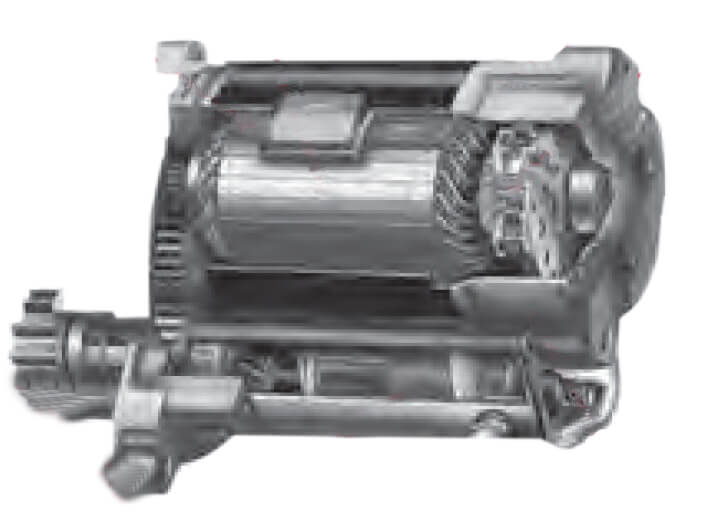
gear reduction start stop starter
So, the engine spins at the same speed, but the start motor turns at a much slower speed than that of a traditional starter. Why is that important? Because 90% of the carbon brush wear in a traditional starter occurs during coast down after the starter is turned off. The majority of the brush wear does not occur during cranking. It occurs as the starter motor spins down. With a gear reduction starter, the cranking and the coast down speeds are much lower than a traditional starter so the coast down time is much shorter, leading to far less brush wear.
They use a completely different brush composition
Traditional starters use a carbon brush on springs. Over time, the carbon brush wears a groove into the motor’s commutator. Brush and commutator wear are common causes of starter failure. However, the brushes in a start-stop starter use a different composition of carbon and copper to obtain longer life and require less pressure against the commentator.
They use different bearings
Traditional starters use sintered bronze oil impregnated
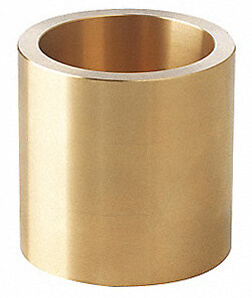
Sintered Bronze Bearing
sleeve “bearings” to support the motor shafts. Sintered bearings don’t actually spin like a traditional ball bearing. Instead, sintered brass sleeves are made from ground-up brass that’s compressed under high pressure to form a sleeve.
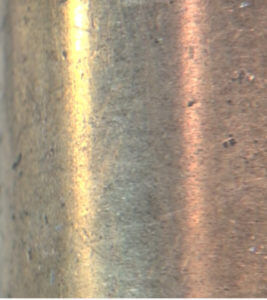
Notice the pores in the sintered bronze bearing. That’s where the oil hides out.
The sleeve is then placed under a high vacuum, and oil is added. The oil is literally sucked into the voids between the ground-up brass particles, and it’s that oil that provides lubrication. Unfortunately, sintered brass sleeve bearings don’t self-lubricate well at colder temperatures.
The bearings for start-stop motors, on the other hand, are sealed needle bearings.
They use different solenoids
In a traditional starter, the solenoid does double duty: It moves the pinion gear into mesh with the flywheel teeth while also acting as the power switch to deliver battery power to the starter motor. Start-stop solenoids have only a single job: to move the pinion gear into mesh with the flywheel. The power switching is done by other means. This eliminates the arcing and pitting on electrical contacts that occur in a traditional starter.
The system uses a dedicated power switching mechanism instead of the solenoid to switch power, so if it fails, the solenoid doesn’t require service. Since the solenoid doesn’t have to hold contacts against one another during cranking, the solenoid in a start-stop starter requires far less power to operate, which also reduces overall current requirements for cranking.
There are many versions of these new motors
Beefed up traditional starter
Start stop starters: These are simply beefed up 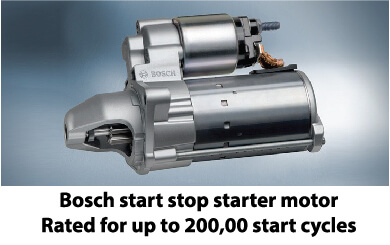 versions of a traditional starter. They’re have dual layer brushes, a different pinion gear spring mechanism that reduces ring gear and flywheel wear by almost 90%.
Tandem solenoid start stop starter—
Where a traditional starter can only engage with the flywheel at zero flywheel rotation, a tandem solenoid design can re-engage with the flywheel from 0-RPM to as high as 600-RPM. That shortens the restart time.
Permanently engaged starter
The weak link in the other two starters is the mechanism that thrusts the pinion gear into the flywheel. A permanently engaged starter eliminates that entire mechanism by permanently engaging the pinion gear with the ring gear on the flywheel. The pinion gear rotates the entire time the engine is running and is connected to the start motor with a one-way clutch. When the start motor needs to restart the engine, it’s instant—totally eliminating pinion gear engagement lag time.
For more information on start-stop and its impact on the starter and electrical systems, see this article at Clore Automotive
©, 2019 Rick Muscoplat
Posted on by Rick Muscoplat