
Auto AC Diagnosis: Why Your Car’s AC Isn’t Working
Step-by-Step Guide to Diagnose Car AC Problems
Quick Summary
Car AC problems always come down to one of three issues: refrigerant flow, heat removal, or airflow. The fastest way to diagnose car AC problems is to check all trouble codes and AC-related live data, compressor operation, verify pressures, feel line temperatures, and inspect airflow across the condenser. Most failures are caused by leaks, electrical faults, or restrictions—not the compressor itself.
How I Approach AC Diagnosis As a Technician
After years of working on automotive systems, I’ve learned that good AC diagnosis starts with understanding one simple truth: your AC system doesn’t create cold air—it removes heat. That mindset changes everything.
When I diagnose car AC issues, I’m not chasing symptoms—I’m tracking where heat transfer breaks down. If the system isn’t cooling, then one of three things is happening:
• Heat isn’t being absorbed inside the cabin
• Heat isn’t being rejected at the condenser
• Refrigerant isn’t circulating properly
Every single AC problem falls into one of those categories.
Step 1 — Set the System Up Correctly Before You Diagnose Your Car’s AC
Before I even open the hood, I make sure the system is operating under the right conditions. This is where a lot of DIYers go wrong.
1) Start the engine
2) Roll up the windows
2) Crank the AC to its coldest setting and MAX AC
3) Set the fan to high
4) Switch to recirculate mode— This setting keeps outside heat out and gives your AC system the best shot at cooling down your cabin.
Step 2: Check For
Step 3: Watch and Listen for AC Compressor Engagement
The compressor clutch (if equipped) should engage when the AC is turned on. Most older vehicles utilize a magnetic clutch on the front of the AC compressor. When you turn on the AC, the system checks the low-pressure switch to ensure the pressure is above the low-pressure limit. If so, the switch will allow the clutch to engage, allowing the compressor to suck in refrigerant vapor from the evaporator, compress it, and send it to the condenser to cool and condense into a high pressure liquid.
1. Have a friend start the engine and turn on the AC system using the Dash controls.
2. See if the AC compressor clutch engages. If not, try the Defrost position.
3. If the compressor does not engage, that can be caused by low pressure due to a leak in the system, a bad compressor clutch relay, a faulty clutch coil, a wiring harness/connector issue, a blown fuse, or an incorrect clutch air gap.
If you have a manifold gauge set, install the hoses and check for static pressure above 40-psi. If the static pressure (compressor not running) is below that, the system is low on refrigerant to out of refrigerant due to a leak.
If the pressure reading is above 40 psi and the compressor does not engage, there is an electrical or wiring problem.
If you have a late model vehicle, your AC system may use a variable displacement compressor that doesn’t have a clutch. If so, ignore this step.
Step 4: Feel the Temperatures Like a Seasoned Pro
While the engine and AC are running, feel the refrigerant lines in the diagram showm below. This is a key part of what to check if your car’s AC isn’t cold. Here’s what I expect on a hot summer day:
Normal System Temperatures For An Orifice Tube System
• The discharge line should feel HOT (around 140°F)
• The liquid line should feel WARM (around 120°F)
• The suction lne should feel COLD (45°–50°F)
• The compressor body shoudl feel WARM (around 140°F)

Tempertures in AC Orifice Tube System
What Abnormal Temps Tell Me
• If the discharge Line is too hot, think blockage, overcharge, or cooling fan failure.
• If the liquid line is too cold, you’ve likely got a restriction.
• If the suction line is too warm, the system is probably low on refrigerant, has a stuck expansion valve, or a tired compressor.
• If the compressor is too hot, that screams restriction or oil starvation.
These checks quickly reveal why your car’s AC isn’t cold, long before you ever touch a wrench.

Temperatures in an AC Expansion Valve System
• The .
What is HOT and What is NOT (Based on the AC system running on a Hot Summer Day (85°F, 33°C)
DISCHARGE LINE HOT: 140°F, 60°C — HOT ENOUGH TO TOUCH BUT NOT HOLD
LIQUID LINE WARM: 120°F, 48°C,
SUCTION LINE COLD 45°F-50F 8°C – 10°C
COMPRESSOR WARM: 140°F, 60°C
If any variation from these temperatures is found, there’s a problem in the AC system.
What Abnormal Temperatures Mean
DlSCHARGE LINE
It ‘s extremely Hot— There’s a restriction in the line or high in the condenser. In other words, the high-pressure refrigerant vapor isn’t flowing freely and cooling.
Very Hot— The system is overcharged, or the condenser is removing enough heat due to clogging or a faulty cooling fan, or there’s air in the system.
Warm— Low on Refrigerant (leak), or the compressor is worn out.
LIQUID LINE
Hot— The condenser is not losing enough heat due to clogged fins or a faulty condenser fan, air in the system, or an overcharged system.Cold — Restriction in the system
SUCTION LINE
Warm— The system is low on refrigerant, the compressor not sucking, blocked expansion valve or orifice tube.
Cool— Worn out compressor, or the Expansion Valve is stuck open
COMPRESSOR BODY
Extremely Hot— Restriction in the discharge line or high in the condenser (burns your hand)
Very Hot— Low on oil
Cool— Too much oil or refrigerant
Dive Deeper with a Manifold Gauge Set
If you’re ready to go beyond the basics of troubleshooting car AC problems, grab your manifold gauges.
1) Hook up your manifold gauge set and check the static pressure. Below 32 psi? The system won’t run—find the leak, fix it, evacuate the system, and recharge.
2) Fire up the car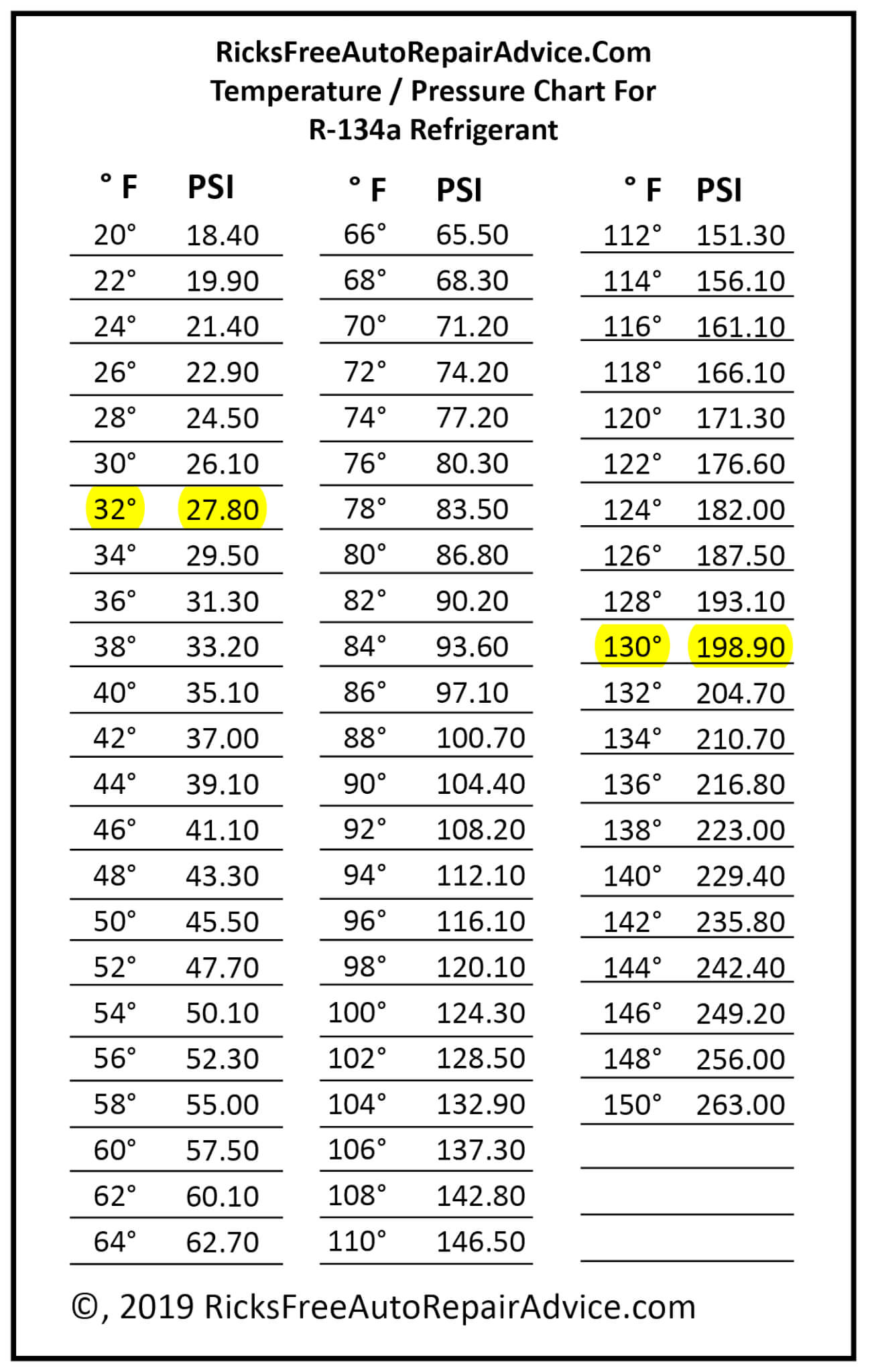
3. Set to MAX AC and Recirculate modes.
4. Check the pressures and refer to the listing below.
The NORMAL OPERATING PRESSURES FOR AN R-134A System with the FAN RUNNING, and outside HUMIDITY at around 50%
High side pressure— As a general rule, the high side pressure should be twice the ambient temperature in Fahrenheit degrees ±10-20
20 psi.
In other words, If the outside temperature is 80° F (27 C), a normal high side pressure should be 160-180 psi. Add 10psi more pressure for every 10% of humidity over 50%.
This pressure rule doesn’t apply to variable displacement compressor systems. In those applications, the high side pressures will vary with the cooling load. In that case, use the high-side pressure immediately at system start-up. That initial pressure should follow the 2x ambient temperature rule.
Low side pressures—
• If your system has an expansion valve: The normal low side pressures should be 15-30 psi. and will cycle a bit
• If your system uses an orifice tube: The normal low side pressure should be 22-46 psi. and it will cycle a bit
• If your AC system has a variable displacement compressor, The normal low side pressure should be 28-35 psi and remain fairly steady.
If the HIGH SIDE pressures are too HIGH, here are the possible causes:
1) There’s low or no air flow through the condenser, or the condenser fins are clogged or folded over. Also, check for gaps around the condenser or missing foam.
2) If your vehicle uses a mechanical radiator fan, check the fan clutch or the electric fan operation and check for correct rotation.
3) Also, check the fan shroud for leaks or gaps.
4) The radiator isn’t cooling properly or is touching the AC condenser and transferring heat into the AC refrigerant.5) The system is overcharged or has air in the system.
6) There’s a blockage near the top of the condenser or in the discharge muffler, after the gauge
port. Check for signs of dented tubing.
7) Does this vehicle have a supplementary power steering or transmission cooler mounted in front of the AC condenser that’s producing to much heat or is blocking airflow through the condenser?
If the HIGH SIDE pressures are too LOW, here are the possible causes:
1) The system is low on refrigerant, most likely due to a leak
2) There’s a restriction in the system, most likely a plugged orifice tube or expansion valve, putting all the refrigerant in the condenser and dryer.
3) The compressor is not pumping properly
4) There’s a lockage before the gauge port
If the LOW SIDE pressures are too HIGH, here are the possible causes:
1) The orifice tube or Expansion valve is not installed correctly, or is stuck open, allowing excess refrigerant into the low side
2) There’s a blockage in the suction line after the gauge port, not allowing the compressor to
suck down the low side.
3) The compressor not pumping properly
4) There’s air in the system
If the LOW SIDE pressures are too LOW, here are the possible causes:
1) The system is low on refrigerant
2) There are restrictions in the system, such as a plugged orifice tube, expansion valve, or receiver dyer.
3) Restricted suction line before the gauge port.
© 2025 Rick Muscoplat
Posted on by Rick Muscoplat